



The Human Toll of Global Trade: Maersk’s Quarterly Report Reflects an Industry at a Crossroads
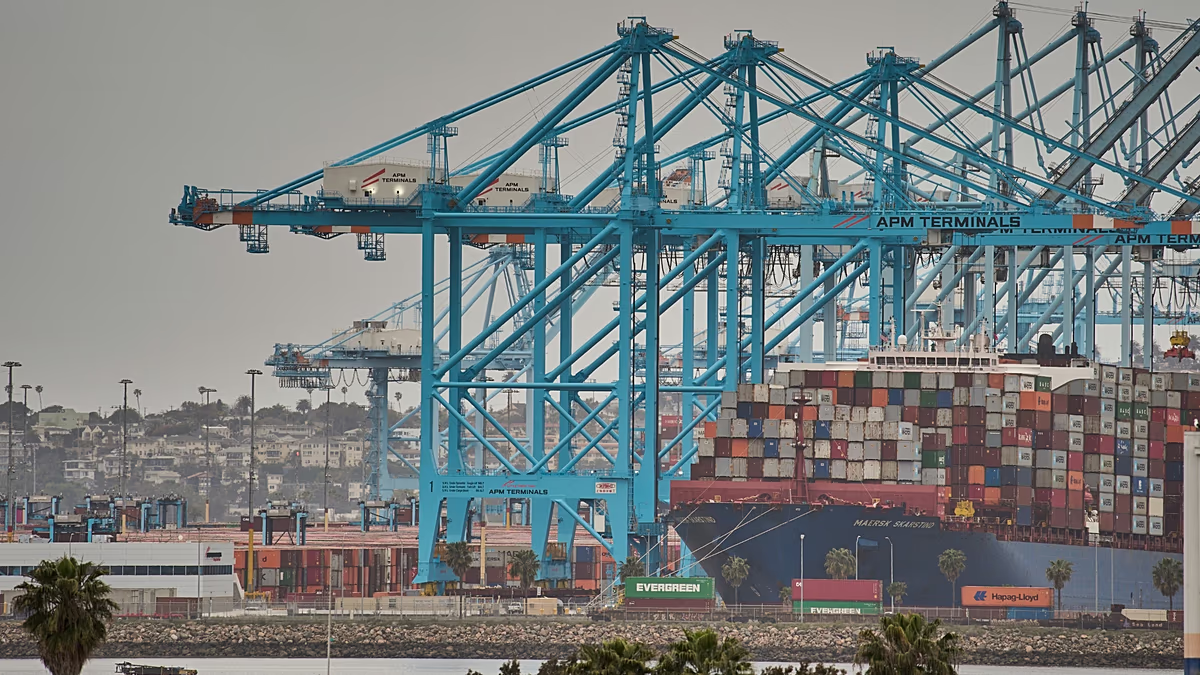
The global shipping industry, the lifeblood of international commerce, finds itself navigating a complex sea of contrasting currents. This reality is starkly illustrated by the first-quarter financial results of A.P. Moller-Maersk, the world’s second-largest container line. The Danish giant reported a dramatic drop in net profit to $100 million for the first three months of the year, a staggering decline from the $1.2 billion earned in the same period last year. This sharp fall came despite a resilient 9.3% increase in the volume of containers it moved. The central paradox is clear: they are shipping more goods than ever, but earning far less for doing so. This squeeze is primarily due to a collapse in ocean freight rates, the prices customers pay to transport their goods. While revenue dipped only slightly to just under $13 billion, earnings per share tell a story of evaporated margins, plummeting from $74 to a mere $4. These numbers are more than financial metrics; they represent the intense pressure on an industry that connects global production to consumption.
Beneath these headline figures lies a human and operational story of resilience and uncertainty. Maersk’s CEO, Vincent Clerc, noted that consumer demand across most regions remained surprisingly robust, driving that strong volume growth. However, he simultaneously warned of a volatile and oversupplied market. The industry is grappling with a wave of new, highly efficient vessels ordered during the pandemic-fueled boom, which are now entering service and flooding the market with excess capacity. This oversupply exerts a relentless downward pressure on freight rates, as companies compete for business. While Maersk maintained its full-year forecast, expecting global container demand to grow by 2-4% in 2026, the shadow of this capacity glut looms large. It’s a classic economic dilemma: healthy demand is being undermined by an even healthier supply of shipping space, turning a potential boom into a battle for survival on razor-thin margins.
Adding a profound layer of geopolitical risk to this economic challenge is the ongoing conflict in the Middle East. Maersk reported that the direct financial impact on its first quarter was limited, but the strategic disruption is immense and casts a long shadow. The company highlighted that the conflict, referenced as beginning on February 28, 2026, has introduced “an additional layer of uncertainty.” Most critically, traffic through the Strait of Hormuz, a chokepoint for roughly a fifth of the world’s seaborne oil and a vital trade artery, remains “at a near standstill.” This paralysis is not just a statistic; it represents stranded cargo, delayed supply chains, and, most importantly, thousands of seafarers living in a state of suspended animation aboard motionless vessels. The U.S. military estimates over 1,550 vessels with about 22,500 mariners are trapped inside the Persian Gulf, a sobering reminder of the human element at the heart of global logistics.
The ripple effects of this regional standstill extend far beyond Maersk’s balance sheet, straining the entire maritime ecosystem. Insurance premiums for vessels daring to operate in the region have skyrocketed due to the heightened threat of attack. Fuel costs have also risen as ships are forced to take longer, more expensive routes to avoid danger zones. The financial strain is palpable across the sector. German competitor Hapag-Lloyd quantified the weekly cost of the Hormuz disruption at around $60 million, a burden driven by these soaring ancillary expenses. For shipping companies already squeezed by low freight rates, these additional costs are a heavy blow. Furthermore, the cargo stuck in limbo isn’t just any goods; it includes critical global commodities like crude oil, refined fuels, and fertilizer, threatening to create shortages and inflate prices for consumers and industries worldwide long after the immediate crisis eases.
Looking ahead, analysts caution that a return to normalcy will be slow and hesitant, even if the Strait of Hormuz were to reopen imminently. Kaho Yu of Verisk Maplecroft points out that energy markets and shipping operators are unlikely to swiftly revert to pre-crisis assumptions. The trauma of disruption has a lasting effect. Refiners, shipping lines, and commodity traders will operate with heightened caution, building larger safety stocks and potentially favoring less efficient but more secure trade routes for the foreseeable future. This crisis has underscored the fragility of just-in-time supply chains and the concentrated risks of global chokepoints. The market’s memory of recent chaos—from the Suez Canal blockage to the Red Sea attacks and now the Hormuz closure—will compel a more conservative, risk-averse approach to global logistics planning.
In conclusion, Maersk’s quarterly report is a microcosm of the forces reshaping global trade. It reflects the clash between solid underlying demand for goods movement and the harsh economics of oversupply and rate volatility. Simultaneously, it underscores how geopolitical instability can abruptly rewrite the rules of engagement, prioritizing security over efficiency and cost. The 4% drop in Maersk’s share price following the report signals investor apprehension about this challenging new paradigm. The industry’s path forward requires navigating not just the physical oceans, but a sea of financial pressures and geopolitical uncertainties. The coming months will test the sector’s ability to adapt, balancing the relentless drive for operational efficiency with the imperative of building more resilient—and necessarily more expensive—supply chains in an increasingly unpredictable world.