


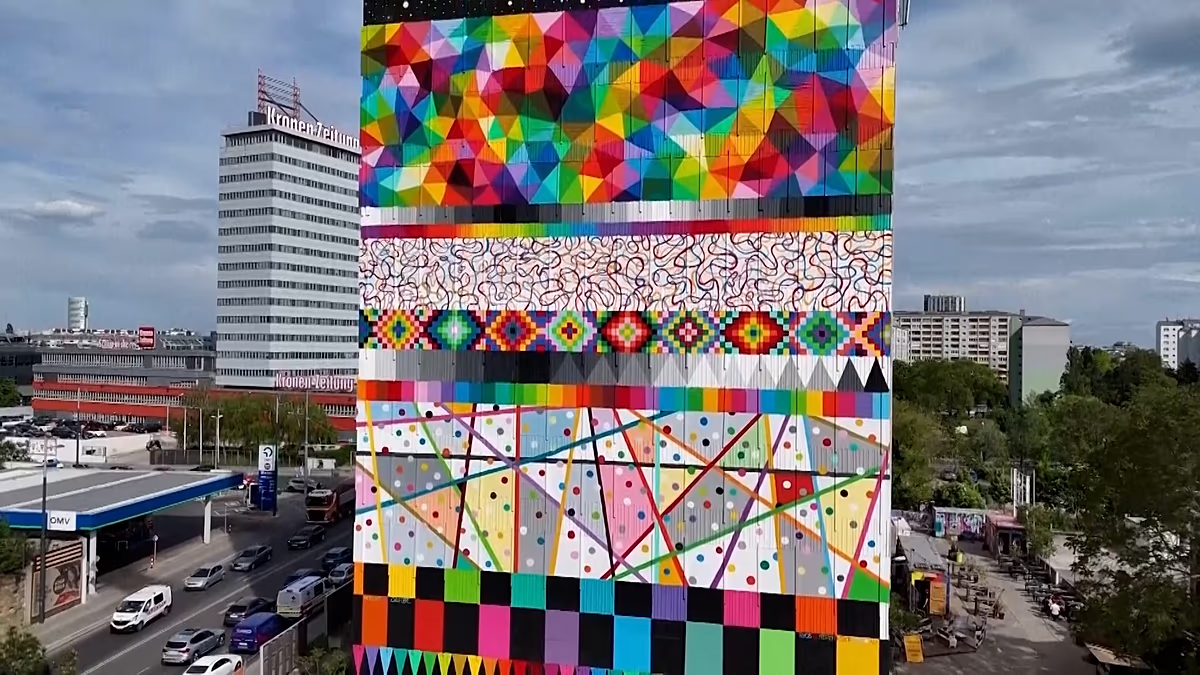
The city of Vienna has transformed a long-dormant landmark into a vibrant canvas for social commentary, unveiling Austria’s largest mural on a vacant office tower as a centerpiece of the cultural programme surrounding the Eurovision Song Contest. Spanning a staggering 1,100 square metres, the artwork titled In Equality now drapes the façade of the former APA Tower in the city’s 19th district. This initiative represents far more than mere decoration for a festive event; it is a profound statement on urban renewal and a bold injection of contemporary art into the city’s architectural landscape. By choosing this prominent, yet forgotten, structure as its gallery, the project immediately frames the conversation around how cities can creatively re-engage with their neglected spaces, using cultural momentum to spark lasting change.
The creative force behind this colossal work is Spanish artist Okuda San Miguel, renowned for his electrifying visual language of geometric shapes and a kaleidoscopic palette. His signature style, which often walks the line between the playful and the profound, is perfectly suited to a project of this scale and intent. For In Equality, Okuda directs his vibrant forms and symbolic figures toward exploring urgent themes of social and gender inequality. In his statement, the artist emphasizes that these issues remain critically relevant across Europe, suggesting that the mural is not just a celebration but a conscious provocation. The artwork thus becomes a paradox: a visually joyful and accessible piece that carries a weighty, necessary message, inviting viewers to reflect on societal structures even as they are dazzled by its colour and form.
The canvas itself—the APA Tower—carries its own narrative of urban transition. Having stood vacant and silent for nearly two decades, the tower is a ghost of a previous era, a monolith on the outskirts of Vienna awaiting purpose. Its transformation through art is a deliberate act of reanimation. Organizers of the Eurovision cultural programme explicitly stated their dual aim: to breathe new, temporary life into the building for the duration of the contest festivities, and more importantly, to cast a sustained spotlight on broader urban renewal projects in the area. The mural acts as a compelling beacon, drawing public and media attention to the potential lying dormant in forgotten urban zones. It asks a poignant question: can a burst of artistic energy catalyze the long-term redevelopment of a community?
This project exemplifies a growing global movement where large-scale public art is leveraged as a tool for urban regeneration and social dialogue. Rather than being confined to a museum, the art becomes an integrated part of the city’s fabric, democratically available to all who pass by. For local residents, the mural changes their daily visual environment, turning a symbol of decay into one of creativity and potential. For Eurovision visitors, it offers a deeper cultural experience beyond the song competition itself, connecting them to local issues and artistic movements. The artwork serves as a bridge between the international spectacle of Eurovision and the specific, grounded context of Vienna’s evolving urban landscape.
Ultimately, In Equality is a powerful confluence of art, social activism, and urban planning. It demonstrates how cultural events can leave a tangible, physical legacy that outlasts the temporary stages and performance schedules. Okuda San Miguel’s vibrant critique of inequality, now permanently etched on the Vienna skyline, ensures that the conversation continues long after the final Eurovision vote is cast. The vacant tower, once an emblem of stasis, is now a dynamic monument to progress and reflection. It stands as a testament to the idea that our cities’ blank walls and empty buildings are not problems to be hidden, but opportunities for collective storytelling and reimagination.
In human terms, this mural is a gift of colour and thought to the public realm. It transforms a mundane commute, sparks a discussion between friends, and inspires a child looking up at its giant, hopeful forms. It represents the belief that art should not be passive but participatory, engaging directly with the community it inhabits. By addressing universal themes of equality from a specific, local site, the project achieves a beautiful resonance. It reminds us that our built environment is a living entity, responsive to the values and visions we choose to project upon it, and that sometimes, the most powerful voices in a city are not spoken, but painted.