

Of course. Here is a humanized and expanded summary, structured into six detailed paragraphs, capturing the urgency and human impact of the crisis described.
The global agricultural system, a complex and delicate web that feeds billions, is facing a shockwave from an unexpected place: the narrow, strategic waters of the Strait of Hormuz. A severe blockade of this vital maritime chokepoint has triggered a fertilizer crisis of monumental proportions. For farmers from the American Midwest to the plains of India, the sudden scarcity of key fertilizers—particularly those rich in potash and phosphate—has sent input costs skyrocketing by as much as 300%. This isn’t just an item on a balance sheet; it is an immediate threat to the very foundation of our food supply. Farmers, who operate on razor-thin margins and long-planned seasonal cycles, are now forced to make impossible choices about which crops to under-fertilize, gambling with their livelihoods and our collective food security.
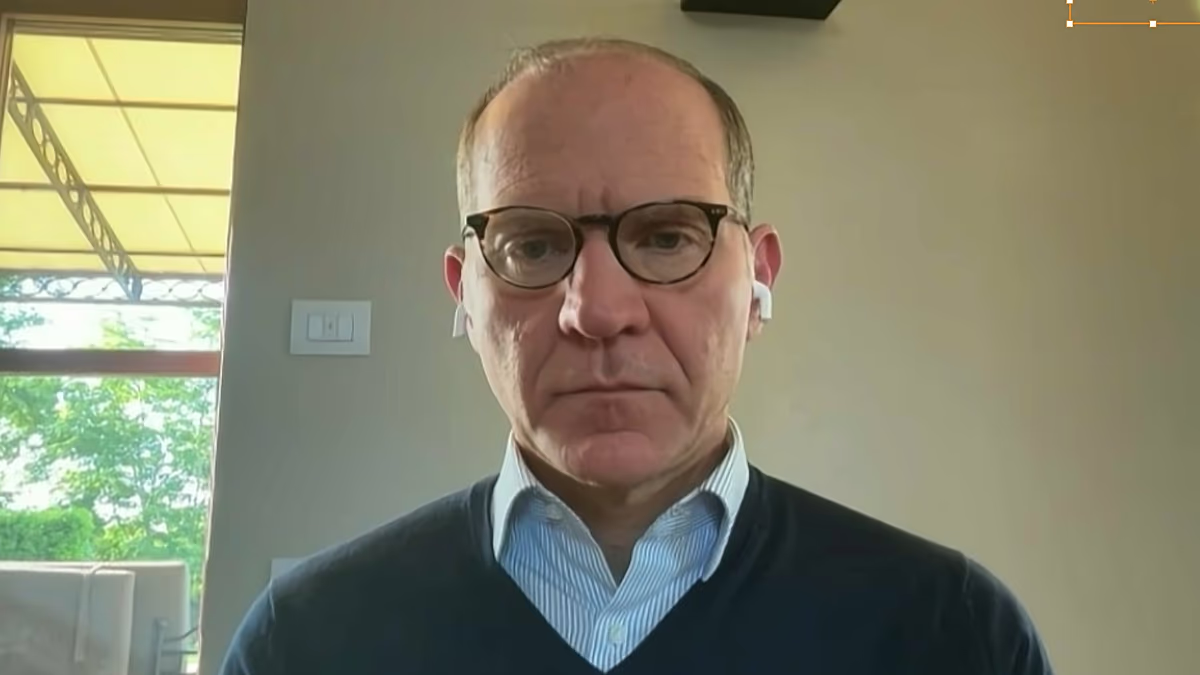
At the heart of this crisis is a simple, brutal equation, articulated by Massimiliano Giansanti, President of the European farmers’ association COPA: “Less fertilizers means less production for wheat. That’s the basis for bread.” His warning cuts through the economic jargon to reveal a fundamental truth. Wheat, a staple that provides more global calories than any other crop, is directly dependent on these nutrients for optimal yield and quality. Without adequate fertilization, crop potential plummets. We are therefore not merely looking at expensive fertilizer; we are staring down the barrel of a looming bread crisis, where the cost and availability of a daily staple for millions could change overnight, hitting the most vulnerable populations the hardest.
The ripple effects extend far beyond the wheat field. This crisis exposes the profound vulnerability of our just-in-time global supply chains. Modern agriculture has become reliant on a steady, predictable flow of inputs from concentrated production hubs, many of which ship through the Strait of Hormuz. The blockade has shattered that predictability. The “… More” hinted at in the original alert likely involves cascading failures: shipping insurance premiums have become prohibitive, alternative routes are longer and more costly, and panic buying is depleting reserves. This creates a feedback loop of scarcity and inflation that markets struggle to quickly correct, leaving farmers isolated at the most critical time in the growing season.
On the ground, the human toll is becoming palpable. A multi-generational farm family watching their carefully budgeted annual plan disintegrate faces not just financial loss, but an erosion of a way of life. The stress is immense—deciding whether to plant at full capacity with astronomically priced fertilizer or to scale back and accept lower yields. Meanwhile, consumers remain largely unaware of the storm brewing between the farm gate and the supermarket shelf, a lag in awareness that will vanish once food prices begin their inevitable climb. This disconnect between the immediate agricultural reality and the public’s perception adds another layer of tension to an already volatile situation.
In response, a frantic search for solutions is underway. Governments and agricultural boards are urging farmers to adopt precision farming techniques to maximize the efficiency of every gram of fertilizer they still possess. There is a renewed, urgent interest in alternative nutrient sources, from expanded organic composting programs to accelerated investment in bio-stimulants. While valuable long-term strategies, they offer little immediate relief for the current planting season. This moment serves as a stark, painful lesson in the risks of over-centralization and may catalyze a regional rethinking of fertilizer production and agricultural resilience for the future.
Ultimately, the blockade of the Strait of Hormuz has done more than disrupt shipping lanes; it has held a mirror to the fragility of our interconnected world. The fertilizer crisis is a powerful reminder that food security is not a given. It is a daily achievement built on stable trade, predictable climate patterns, and accessible inputs. As the world navigates this emergency, the words of farmers like those represented by Giansanti must be heeded. Stabilizing the fertilizer supply is not merely an economic imperative—it is a fundamental act of ensuring that the basic building block of civilization, our daily bread, remains secure and affordable for all.