

In recent years, the NATO alliance has navigated a period of intense scrutiny, largely fueled by the rhetoric of former and current U.S. President Donald Trump. His characterization of the alliance as a “paper tiger,” his taunts directed at European partners over defense spending, and his stark suggestion that he would “encourage” Russia against delinquent members have sown deep uncertainty in many European capitals. This has led to a fundamental questioning of America’s commitment to the transatlantic partnership, casting a shadow over the collective security that has defined the West for decades. Against this backdrop of transatlantic tension, the perspective from some newer member states offers a striking and more optimistic counter-narrative.
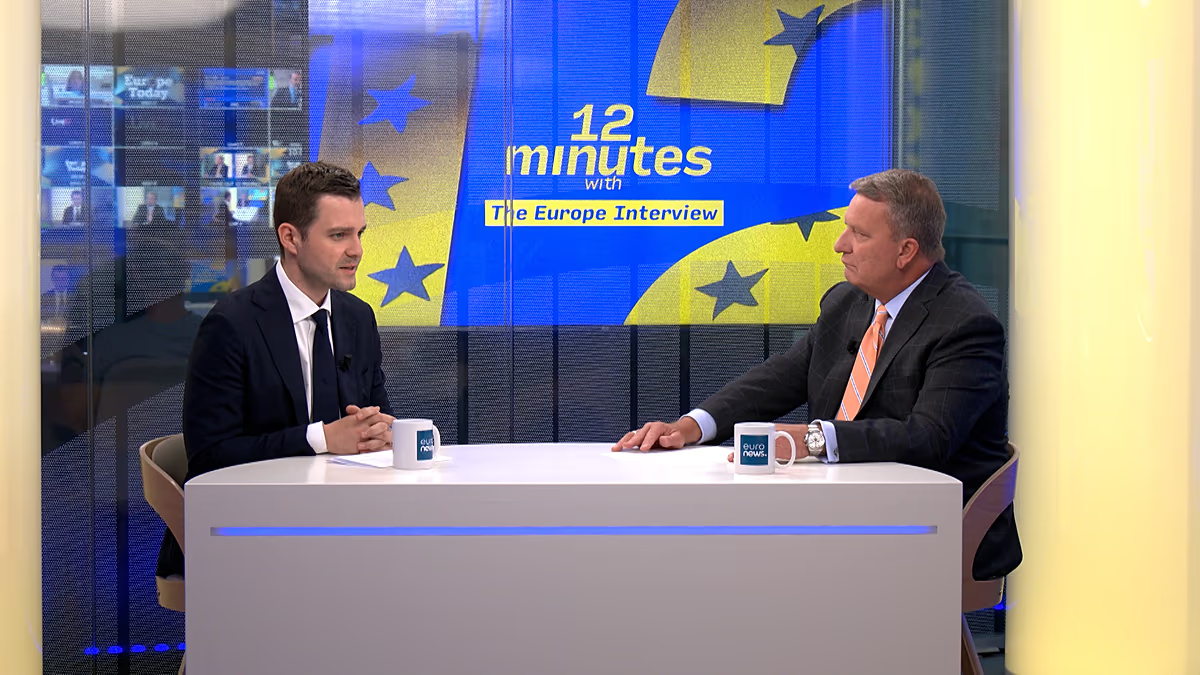
North Macedonia’s Foreign Minister, Timcho Mucunski, provides such a view, arguing that Trump’s tenure has, paradoxically, marked an all-time high for NATO’s strength. He credits the U.S. administration with delivering a necessary “wake-up call” that galvanized the alliance into action. The pivotal moment, for Mucunski, was the 2023 summit in The Hague, where member states pledged to raise defense spending to 2% of GDP as a floor, not a ceiling, with an ambitious collective goal of reaching 5% by 2035. He sees this as a direct response not only to Russian aggression in Ukraine but to broader global threats emanating from the Indo-Pacific and the Middle East. From his vantage point, the fundamental outcome—a reinvigorated commitment to collective defense—outweighs the provocative diplomatic disagreements.
For North Macedonia, which joined NATO in 2020, the alliance’s value is tangible and transformative. Mucunski describes it as providing “much-needed stability in a region that is extremely volatile,” calling NATO “without a doubt the strongest collective security community that civilisation has known.” This deeply held belief underscores a key divergence in perception: while established Western European members may grapple with the discomfort of Trump’s transactional language, newer members from historically vulnerable regions see concrete benefits and a reinforced deterrent shield. Their primary concern is the alliance’s functional strength, which they argue has been amplified by recent spending commitments driven by U.S. pressure.
However, North Macedonia’s path toward its other strategic goal—European Union membership—presents a far more frustrating and protracted journey. Having applied in 2004, it remains stalled, with Bulgaria currently the main obstacle due to longstanding disputes over identity, history, and language. Sofia insists on constitutional changes recognizing a Bulgarian minority before accession talks can advance. This impasse creates a dangerous vulnerability, as Mucunski warns that “hybrid threats thrive where frustration grows and where trust erodes.” He acknowledges the “severe amount of malign influence” from Russia and China in the Western Balkans, which seeks to exploit such delays and disillusionment.
Despite this challenging environment, Mucunski stresses his country’s unwavering pro-European orientation, both in rhetoric and in implemented values. He points to resilience in practice, noting that polls consistently show around 70% of citizens would vote to join the EU. Yet, he highlights a critical caveat: a growing disbelief that “the door will actually open.” This gap between popular aspiration and political reality is corrosive. It risks undermining public faith in the EU project itself and plays into the hands of external actors who offer alternative partnerships without demanding democratic reforms.
Ultimately, the situation of North Macedonia reflects a dual reality within Europe’s broader landscape. On one hand, the NATO alliance, despite internal political friction, demonstrates a capacity for adaptation and strengthened deterrence, as seen through the eyes of its newest members. On the other, the EU’s enlargement process, mired in bilateral historical disputes, risks fostering the very disillusionment and instability it aims to prevent. The challenge for the West is to harmonize these two trajectories—ensuring that the security guaranteed by a robust NATO is complemented by the integrative, values-based future promised by the EU. For countries like North Macedonia, caught in the middle, this synergy is not just a policy preference but a fundamental imperative for their long-term stability and democratic development.