



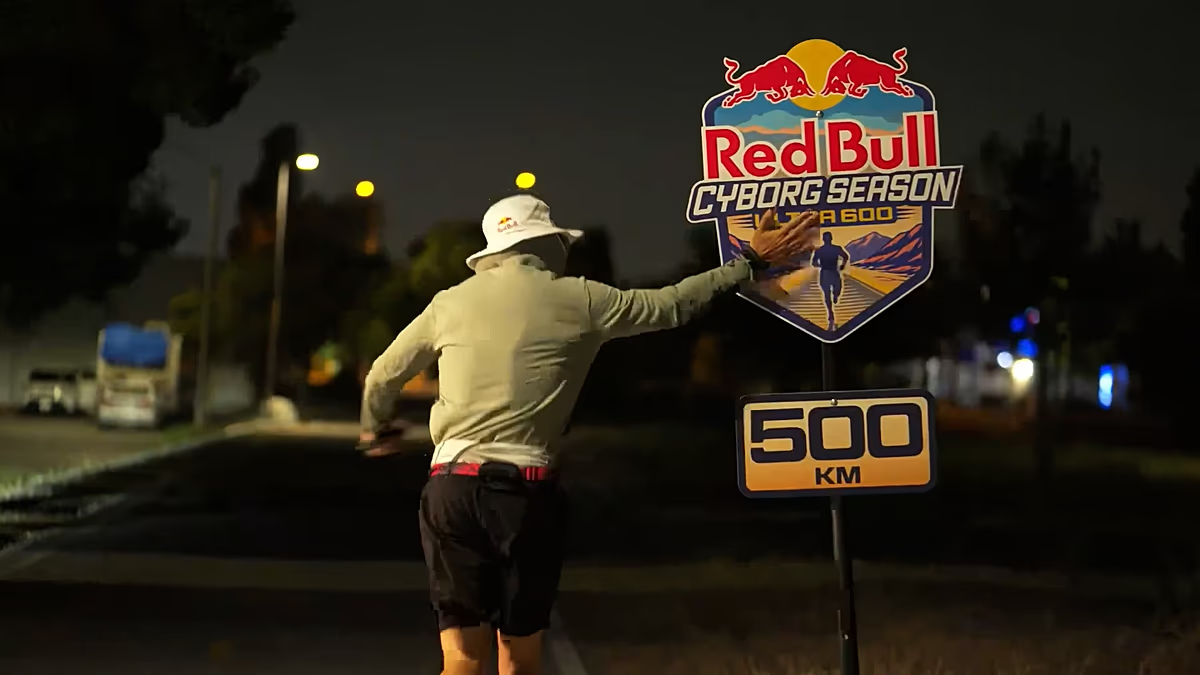
In a staggering display of human resilience, German ultramarathon runner Arda Saatçi has completed a monumental 604.6-kilometre (nearly 376-mile) journey on foot, traversing the harsh and historic landscape from the depths of Death Valley to the iconic Santa Monica Pier in Los Angeles. This epic feat required more than 123 continuous hours—over five full days—of relentless forward motion. Saatçi’s run stands as a profound testament to the extremes of endurance sports, where athletes push the boundaries of physical and mental fortitude far beyond conventional limits. The sheer distance, equivalent to running over 14 standard marathons back-to-back, places this achievement in a rarefied category of ultra-distance endeavors that capture the imagination of athletes and casual observers alike.
The journey began at the symbolic and formidable Badwater Basin in Death Valley, the lowest topographic point in North America, sitting 86 meters below sea level. From this stark, salt-flat starting line, Saatçi’s route wove a tapestry across California’s diverse and demanding geography. He navigated scorching desert roads, busy highways, and evocative stretches of the legendary Route 66, the historic “Mother Road” that once symbolized American migration and hope. This path was not merely a physical challenge but a passage through layers of history and landscape, culminating on May 10th with the ultimate reward: the sight and sound of the Pacific Ocean at the bustling Santa Monica Pier. The completion point offered a stark contrast to the silent, arid basin where his test began, marking a full traverse from continental depression to the vibrant edge of the ocean.
The environment itself was a primary antagonist in Saatçi’s quest. The run unfolded under a brutal sun, with temperatures soaring near 40°C (104°F) as he crossed the infamous Death Valley and Mojave Desert regions. This extreme heat exponentially increased the physical toll, accelerating dehydration and demanding a meticulous strategy for fluid and electrolyte intake. Running in such conditions transforms every step into a calculated risk, where the body’s cooling systems are pushed to their absolute limits. The relentless sun beats down not just on the body, but on the mind, creating a furnace-like arena where the simple act of moving forward becomes an act of defiance against a naturally hostile world.
Perhaps the most formidable battles, however, were fought within the confines of Saatçi’s own mind. The sheer duration of the endeavor—spanning over five days with only minimal, strategic rest—plunged him into the surreal realm of extreme sleep deprivation. This state led to powerful hallucinations, a common yet disorienting experience for ultrarunners, where the brain, starved of restorative sleep, begins to fabricate images and sounds. Coupled with the physical strain and dehydration, these psychological challenges created a surreal and taxing inner landscape. The toll became so severe that on the third day, Saatçi was forced to take an unplanned medical break. This pause was a critical juncture, highlighting that such superhuman efforts are still bound by human physiology and the paramount importance of safety, even for the most seasoned endurance athletes.
This necessary interruption meant Saatçi had to relinquish his initial, ambitious goal of finishing the colossal distance within 96 hours. Yet, here lies a central, deeply human truth of such endeavors: the story is often defined not by the pristine achievement of a pre-set target, but by the gritty, determined response to adversity. Continuing onward after a medical stop and after missing his time goal required a different kind of strength. It demanded the mental flexibility to redefine success in real-time, shifting the victory condition from a clock-based metric to the simple, profound act of perseverance. His decision to keep going, to reach the pier on his own terms and timeline, speaks volumes about the ultrarunning ethos, where finishing the journey itself is frequently the greatest triumph.
Arda Saatçi’s extraordinary run from Death Valley to the Pacific is more than a sports headline; it is a narrative of human potential. It underscores our species’ incredible capacity to endure suffering, adapt to punishing conditions, and persevere through blurred states of consciousness, all in pursuit of a distant, personal horizon. His journey along the old roads of California serves as a powerful modern parable. It reminds us that the most significant victories are often forged not in perfect conditions, but in the heat, the dust, and the lonely miles where the body begs to stop and the spirit chooses to continue. In reaching the Santa Monica Pier, Saatçi did not just complete a run; he embodied the relentless spirit of exploration and endurance that defines the very heart of ultrarunning.