



Here is a humanized summary of the provided content, expanded to the requested length.
Paragraph 1
The United States is intensifying a high-stakes financial war against Iran, moving beyond traditional government actions to actively recruit the global banking sector as its frontline allies. In a significant escalation, the U.S. Treasury Department is calling on private lenders worldwide to become detectives of deception. Their mission is to identify and dismantle the clandestine networks Iran uses to circumvent crippling international sanctions. These networks are sophisticated, employing a shadowy toolbox of front companies, complex digital asset transfers, and manipulated shipping documentation to secretly move the proceeds from Iran’s most vital commodity: its oil. This strategy transforms every compliance officer in every major bank into a potential agent of U.S. foreign policy, leveraging the private sector’s reach to apply pressure where direct government action cannot always go.
Paragraph 2
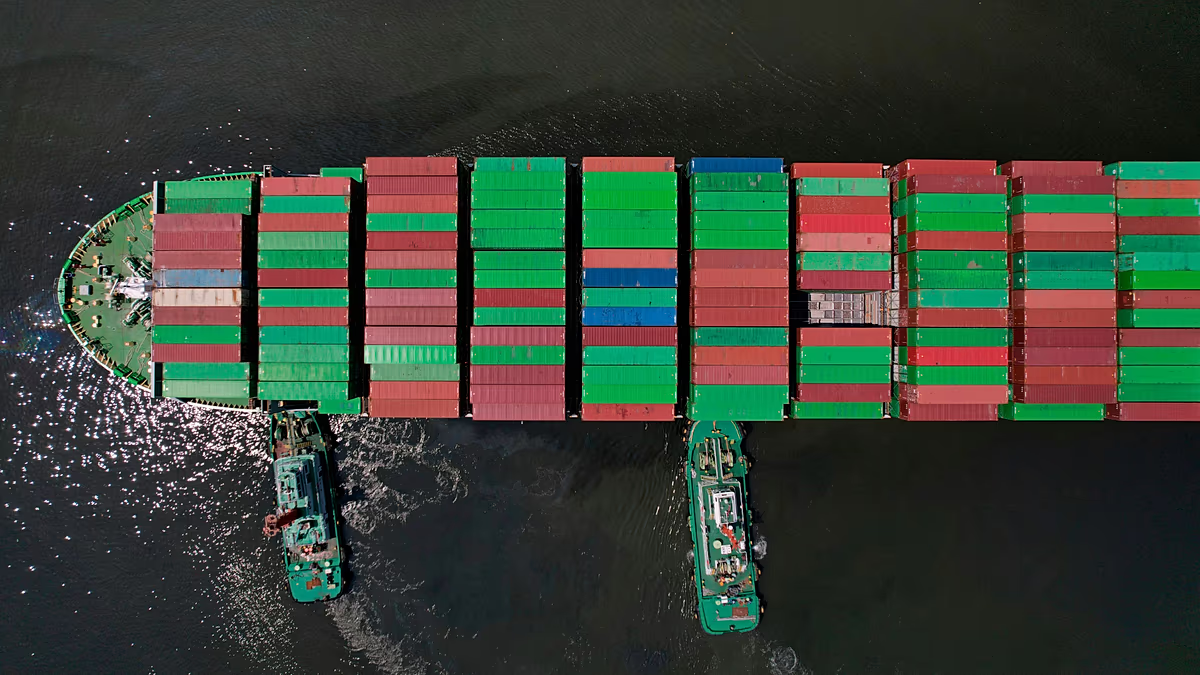
Central to this new advisory are specific, tangible red flags that banks must now vigilantly monitor. A primary focus is on crude oil shipments mysteriously labeled as ‘Malaysian blend.’ U.S. authorities allege this term has become a common alias in shipping paperwork, a bland label used to disguise the petroleum’s true Iranian origin as it journeys to market. Other telltale signs include suspicious gaps in a shipment’s digital paper trail—missing or blatantly falsified records—and the practice of ship-to-ship transfers on the open ocean. These mid-sea cargo handoffs are not routine logistics; they are deliberate maneuvers to break the chain of custody and obscure the original source of the oil, creating a fog of anonymity that the Treasury now aims to pierce.
Paragraph 3
This latest directive is not an isolated move but a key tactic in a broader, coordinated campaign officially dubbed ‘Economic Fury.’ Launched in April, this campaign represents a deliberate shift towards applying ‘maximum economic pressure’ with the explicit goal of financially isolating the Iranian regime. The objective is surgical: to systematically sever Iran’s primary revenue streams, thereby draining the resources that fund both its state operations and the activities of powerful entities like the Islamic Revolutionary Guard Corps (IRGC). As recently as this Monday, Treasury Secretary Scott Bessent reaffirmed the administration’s unwavering commitment to this path, simultaneously announcing new sanctions against twelve individuals and entities accused of facilitating the IRGC’s oil trade, demonstrating action alongside rhetoric.
Paragraph 4
The campaign’s gaze extends far beyond Iranian borders, focusing intently on the global hubs that enable this shadow trade. According to the Treasury’s Financial Crimes Enforcement Network (FinCEN), a web of maritime companies based in strategic locations like Iraq, the United Arab Emirates, and Hong Kong has been integral to transporting sanctioned oil. A recent report quantifies the staggering scale of this activity, revealing that these firms conducted transactions worth approximately $4 billion linked to Iranian oil companies. Most strikingly, at least $707 million of those funds were processed through U.S.-based accounts in 2024, highlighting how Iran’s sanctioned economy still touches, and depends upon, the very Western financial system it is banned from.
Paragraph 5
The U.S. has moved from analysis to direct confrontation with the nations hosting these hubs. Months ago, in April, the Treasury sent formal, sternly worded letters to financial institutions in China, Hong Kong, the UAE, and Oman. These communications served as both a warning and an accusation. They cautioned that any entity—bank or business—found facilitating Iranian transactions faces the severe consequence of secondary U.S. sanctions, which could cut them off from the critical U.S. dollar financial system. Furthermore, the letters explicitly accused these jurisdictions of allowing illicit transactions to pass through their domestic banking systems with what the U.S. deems inadequate oversight, applying diplomatic pressure on host governments to tighten controls.
Paragraph 6
Ultimately, this multi-pronged offensive underscores the enduring power of the U.S. dollar as a tool of geopolitical coercion. As Secretary Bessent’s statements and the ‘Economic Fury’ campaign make clear, the Trump administration is betting that a strategy of relentless financial suffocation will force Tehran into a corner. The threat of being entirely disconnected from the global dollar-based financial network remains a potent one, a sword of Damocles hanging over not just Iranian entities but any third party daring to assist them. In a world where diplomatic negotiations remain fraught and ceasefires precarious, Washington is signaling that its most reliable lever of power is not in the conference room, but in the currency markets and the compliance departments of international banks, where access to the American economy can be granted or revoked with profound consequences.