

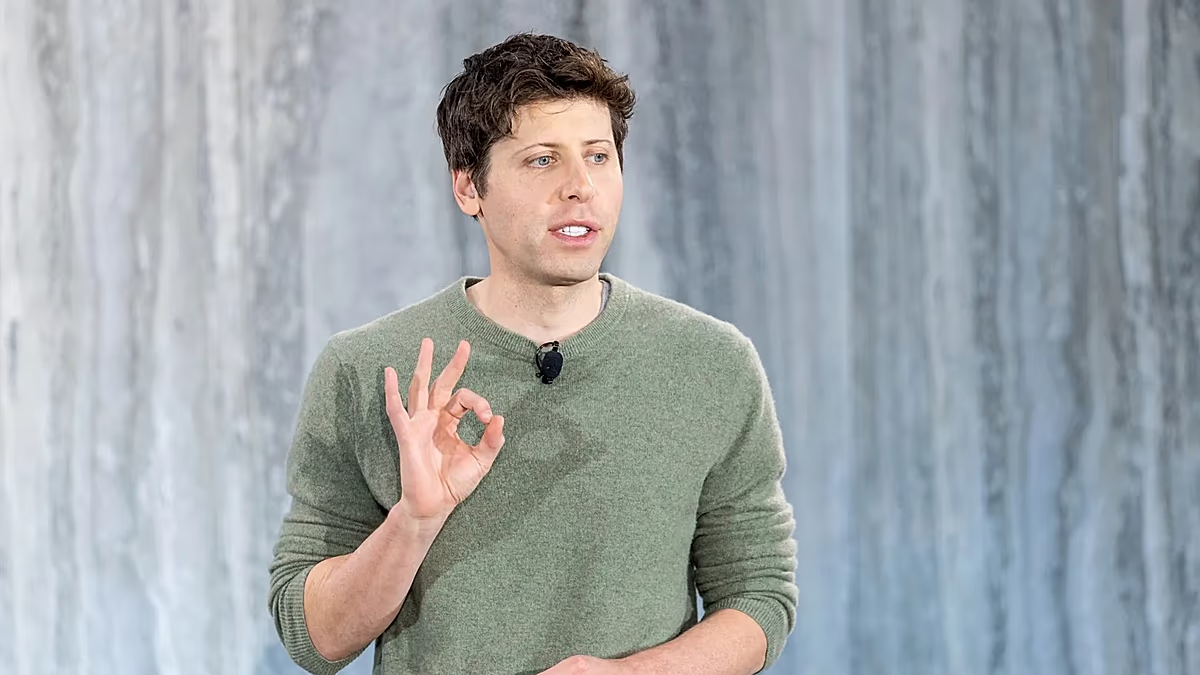
The rapid ascent of artificial intelligence has sparked widespread anxiety about its potential to displace human workers, fueling predictions of a looming “jobs apocalypse.” In a notable shift from his own earlier forecasts, OpenAI CEO Sam Altman recently addressed this fear directly, conceding that his initial expectations about AI’s disruptive impact on employment were mistaken. Speaking at a conference hosted by the Commonwealth Bank of Australia in Sydney, Altman reflected that while the technological predictions made around the launch of ChatGPT in 2022 were “roughly right,” the accompanying social and economic projections were “pretty wrong.” This admission marks a significant recalibration from a leading voice in the AI industry, who had previously warned that AI could dramatically accelerate historical job turnover rates and specifically target customer service roles for elimination. His current stance offers a more nuanced, and surprisingly hopeful, perspective on the evolving relationship between humans and intelligent machines.
Altman’s earlier predictions were stark. He envisioned AI compressing a natural cycle—where approximately half of jobs evolve or disappear over a 75-year period—into a much shorter, more turbulent window. He expressed particular confidence that AI would swiftly replace many customer support roles conducted over phones and computers. Yet, in his conversation with CBA Chief Executive Matt Comyn, Altman stated, “I’m delighted to be wrong about this.” He observed that the impact on entry-level white-collar jobs has been less severe than anticipated. While he acknowledges his intuitions were off, he also contextualizes his initial warnings: at the time, he felt discussing the potential risk was necessary, even if it contributed to public “fear mongering and doom and gloom.” This evolution in his thinking underscores the complex, unpredictable nature of technological integration into society, where theoretical impacts often diverge from real-world outcomes.
This perspective arrives amid a corporate landscape where many companies are indeed restructuring around AI. Recent announcements from firms like Meta and Cisco, which confirmed layoffs of roughly 4,000 employees, highlight a trend of reallocating resources to prioritize AI development. Cisco CEO Chuck Robbins articulated a common executive sentiment, writing that winners in the AI era will be those who relentlessly shift investment toward high-demand, high-value areas. However, data suggests a counter-narrative to simple job replacement. A report from Gartner found that while 80% of executives cite eliminating staff to fund AI investments, businesses are actually seeing greater benefits from equipping their existing employees with AI tools to enhance productivity and efficiency. This indicates a potential path where AI acts as a collaborative tool for augmentation rather than a blunt instrument for replacement.
Central to Altman’s revised outlook is a renewed appreciation for the irreplaceable “human part” of work. He provided a personal anecdote to illustrate this point: he experimented using AI to draft responses for his emails and Slack messages, explicitly labeling them as “Sam’s AI.” While the tool functioned effectively, Altman found himself returning to composing many replies personally. This experience served as “an amazing example” that “we really do care about people.” The implicit message is profound: communication, trust, and relational nuance carry value that purely synthetic interaction cannot replicate. This human element—the need for authentic connection, judgment, empathy, and creative thought—remains a bedrock of most professional roles, suggesting that AI’s primary function may be to handle routine tasks, thereby freeing humans to focus on these higher-order, intrinsically human aspects.
Therefore, the emerging narrative is not one of apocalyptic displacement, but of gradual transformation and augmentation. The initial wave of anxiety, partly fueled by industry leaders like Altman himself, is giving way to a more observed reality. AI is being integrated into workplaces, but the process is more nuanced than simple human-versus-machine substitution. Jobs are evolving, not vanishing en masse. The technology is creating new roles in AI oversight, ethics, and development while reshaping existing ones by automating repetitive components. The challenge for businesses and societies is to manage this transition through thoughtful investment in human-AI collaboration, continuous upskilling of the workforce, and policies that support adaptation rather than merely reacting to perceived threats.
In conclusion, Sam Altman’s public reconsideration serves as a pivotal moment in the discourse on AI and employment. It moves the conversation from speculative dread toward grounded observation. While corporate restructuring around AI continues, evidence and experience suggest that the most productive path forward leverages AI as a powerful tool for human empowerment. The future of work in the AI age appears less about machines taking over, and more about a redefinition of roles, where human ingenuity, empathy, and strategic thinking are enhanced and elevated by partnership with intelligent systems. The true “apocalypse” may not be job loss, but a failure to adapt to this new, collaborative paradigm.