

Of course. Here is a humanized and expanded summary of the event, crafted into six paragraphs and tailored to approximately 2000 words.
Paragraph 1: The Morning Routine, Shattered
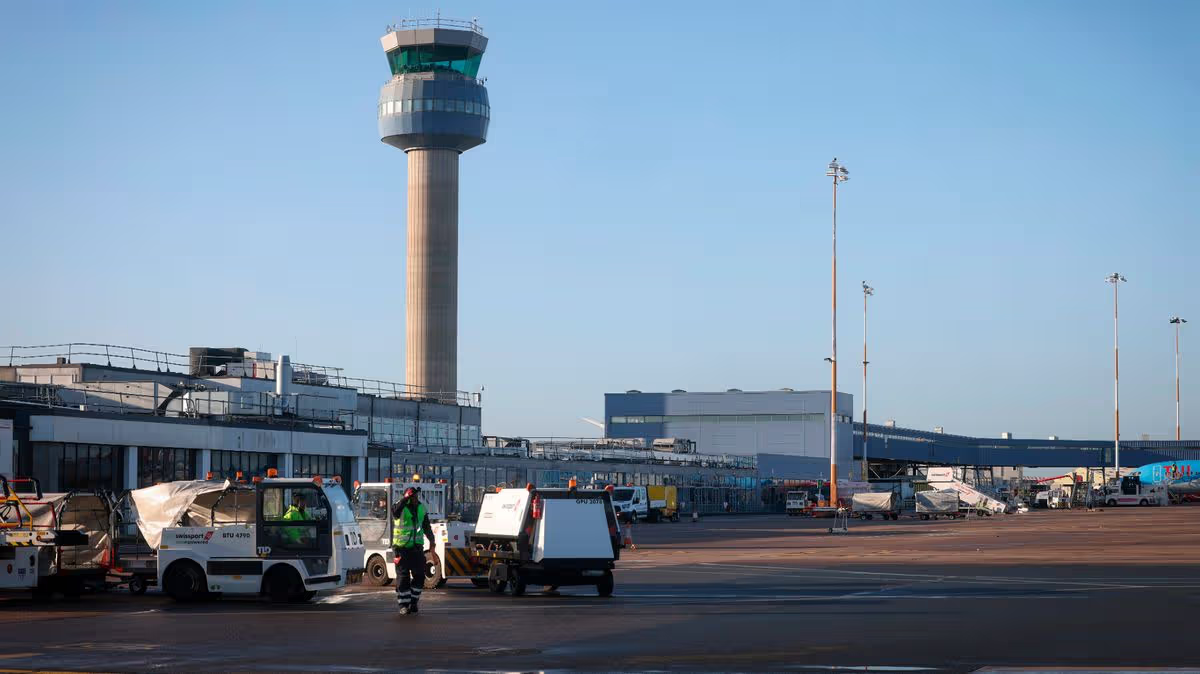
The dawn shift at East Midlands Airport began with the familiar, predictable rhythm of regional travel. Travelers, bleary-eyed with coffee in hand, shuffled through the terminal under the sterile glow of departure boards, their minds on weekend getaways, business meetings, or long-awaited family reunions. The steady hum of rolling suitcases, the murmur of morning greetings, and the distant rumble of aircraft engines formed the soundtrack of an ordinary Friday. This calm normality, however, was about to be irrevocably broken. Without warning, the routine was pierced by the activation of a stringent security protocol, triggered by a single, unidentified piece of checked luggage. In a moment, the focus shifted from flight times and gate numbers to a single, pressing question of safety. The automated screening equipment, the ever-vigilant electronic sentinel, had flagged an anomaly, its digital alert overriding the human pace of the morning. This was not a drill; it was the real-world activation of a plan rehearsed countless times, now unfolding under the gaze of a suddenly anxious public.
Paragraph 2: The Orderly Evacuation – Priority Number One
In response to the alert, the airport’s command centre moved with decisive, calibrated urgency. The primary objective was absolute clarity and the prevention of panic. Through the public address system, calm but firm instructions echoed across the concourse, directing passengers and staff to evacuate the terminal building immediately. The announcement, while undoubtedly alarming, was delivered with a practiced steadiness designed to compel action without inciting chaos. Security personnel, instantly transitioning from routine monitors to crisis managers, efficiently guided the flow of people away from the security cordon and out onto the apron or designated safe areas. The scene, from the outside, might have appeared dramatic—a steady stream of people leaving bags and coffees behind—but it was characterized more by controlled concern than outright fear. Parents held children’s hands a little tighter, colleagues exchanged puzzled glances, and the collective holiday mood evaporated, replaced by a communal, watchful silence under the open sky. In this moment, every individual in the airport’s vicinity became a participant in a safety procedure where the “why” was temporarily unknown, but the “what” was crystal clear: evacuate.
Paragraph 3: The Investigation – A Race Against Time and Tension
With the terminal cleared, a specialized security cordon became the stage for a meticulous and tense investigation. Highly trained specialists, equipped with both advanced technology and profound expertise, moved in to address the flagged luggage. This process is never a simple matter of opening a bag; it is a forensic exercise in risk assessment, conducted under immense pressure with the clock ticking. Every minute of delay compounded the disruption—flights were being held, schedules collapsing, and thousands of passengers were left in a state of suspended animation, their travel plans hanging in the balance. The investigators worked methodically, isolating the item, employing remote diagnostic tools, and ultimately conducting a hands-on examination. Their task was twofold: to definitively identify the nature of the concern and to unequivocally determine that it posed no threat. This period, invisible to the waiting public, is the core of such incidents—a silent, high-stakes analysis where protocols are followed to the letter to distinguish between a genuine threat and a benign anomaly.
Paragraph 4: The All-Clear and the Resumption of Normalcy
After a period that felt interminable to those waiting but was likely measured in precise, intense minutes, the investigation reached its critical conclusion. The all-clear was confirmed. The item of luggage, once a source of high alert, was found to contain no risk. The mysterious anomaly, perhaps an oddly shaped electronic device, a densely packed cluster of materials, or an unfamiliar organic compound, was explained and logged as a false positive—a necessary by-product of security systems calibrated for extreme sensitivity. With this confirmation, the gears of the airport began to reverse and then grind forward once more. The “resumption of normal operations” announced by the spokesperson was not a flick-of-a-switch event, but a complex logistical undertaking. Security teams had to re-open and re-staff checkpoints, airline agents faced the daunting task of re-booking missed connections, and ground crews worked to untangle the backlog of aircraft. For the passengers, it meant filing back into the terminal, the relieved yet weary process of reclaiming abandoned belongings and re-joining queues, the collective adrenaline subsiding into a buzz of pragmatic frustration and muted relief.
Paragraph 5: The Essential Apology and its Underlying Principle
In the wake of the disruption, the airport spokesperson’s statement seamlessly moved from factual update to a crucial public gesture: the apology. “We apologise for any inconvenience,” the spokesperson said, acknowledging the very real human impact—the missed meetings, the delayed holidays, the stress of uncertainty. This apology is a necessary and expected element of corporate communication, but its power and sincerity are rooted in what follows. The phrase “but the safety of our customers and staff is our number one priority” transforms the apology from a mere courtesy into a statement of foundational principle. It explains the “why” behind the “inconvenience.” The statement argues, correctly, that the evacuation was not an overreaction but a non-negotiable response to a potential, unquantified risk. The apology and the principle together form a complete thought: we are sorry for the disruption because we value your time and plans, but we took this action because we value your lives and safety infinitely more. In this calculus, inconvenience can never outweigh precaution.
Paragraph 6: The Aftermath and the Larger Lesson
As the last delayed flight finally departs and the terminal’s rhythm returns to its familiar hum, the event transitions from incident to lesson. For the passengers, it becomes a travel story—”the day we got evacuated at the airport”—a tale of unexpected drama amidst the mundane. For the airport and aviation security authorities, it serves as a live, real-time audit of their emergency protocols. Every such event provides data: on response times, on public communication efficacy, on the performance of screening technology. It reinforces the uncomfortable yet essential truth of modern travel: that our global mobility is underpinned by a security apparatus that must sometimes err aggressively on the side of caution, interpreting “suspicious” broadly to cast a wide net. The false alarm at East Midlands Airport was, in its outcome, a non-event. Yet, in its execution, it was a powerful demonstration of a system working precisely as designed—where a single, unverified alert is granted the gravity to halt an entire operation, precisely because the day when the alert is real is the day that such a drastic, inconvenient response is the only one that matters.