
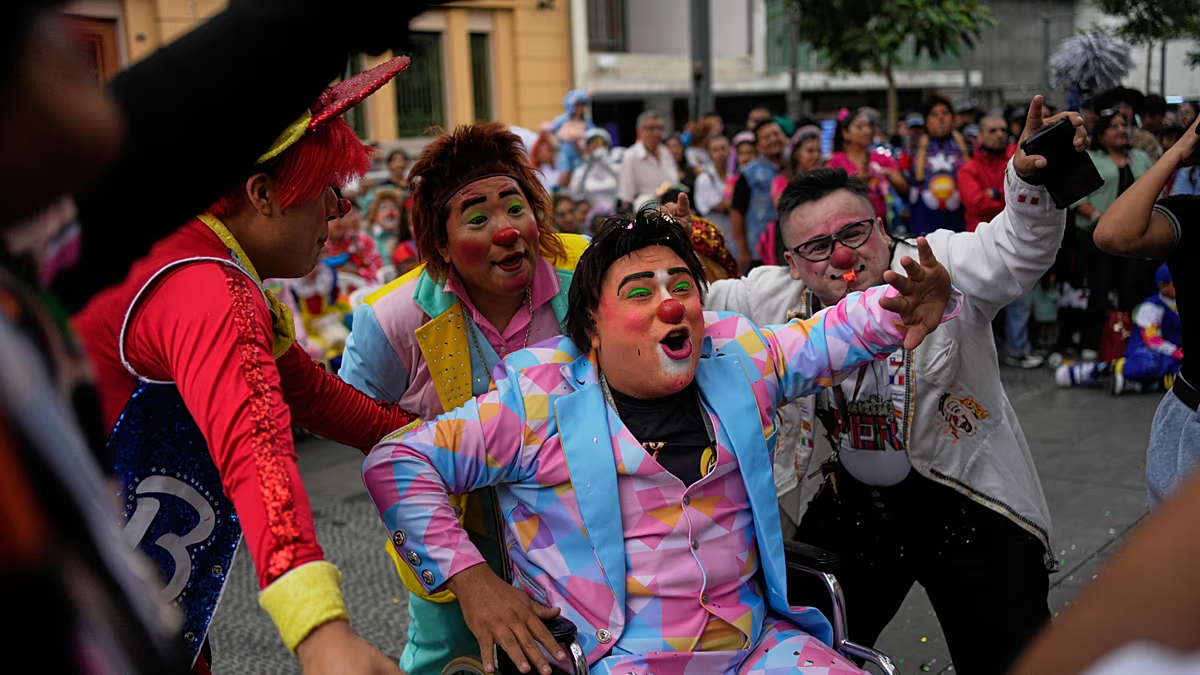


In the vibrant, sprawling heart of Lima, a city of nearly ten million, a spectacle of color and contradiction recently unfolded. A parade of clowns—their faces painted in broad smiles and exaggerated expressions, their bodies clad in bright, polka-dotted costumes and comically oversized shoes—marched directly past the stately facade of the Government Palace. The scene was a jarring, delightful juxtaposition: the solemn seat of political power framed by a living river of carnivalesque joy. Tourists, intrigued by the unexpected pageant, stopped to capture the moment on their phones, documenting a celebration that exists in a unique space within Peruvian culture. This was not a state-sanctioned festival but a grassroots homage, a gathering organized by the country’s largest clown guild to honor one of their own: José Álvarez Vélez, better known by his stage name, Tony Perejil. A beloved figure in Peruvian entertainment, Perejil dedicated his career not to television studios or grand theaters, but to bringing laughter directly into poor and marginalized communities until his death in 1987. This parade, therefore, was more than a memorial; it was a living testament to a particular philosophy of joy, one that sees humor as an essential service, especially to those who need it most.
Despite Peru’s rich calendar of officially recognized celebrations honoring everything from traditional foods to national drinks, this clown parade operates without formal government endorsement. It exists on the fringes of official culture, sustained purely by the passion and community of its participants. Performers from across the diverse regions of Peru journeyed to the capital with their families in tow, a move that underscores the event’s deep personal significance. For these clowns, the parade is a professional pilgrimage and a family reunion, a chance to connect with peers, share techniques, and publicly affirm the value of their often-underappreciated art form. The gathering transforms the anonymous capital into a temporary hometown for a nationwide fellowship of laughter-makers, highlighting a network of artistry that usually functions in isolated pockets—at children’s parties, in hospital wards, on local street corners. Their convergence in Lima is a powerful statement of collective identity.
The messaging woven into the event further clarified its nuanced stance. Amid the balloon animals and slapstick routines, posters bearing the succinct slogan “More clowns, fewer politicians” were prominently displayed. This phrase perfectly encapsulates the dual nature of the parade: it is both a lighthearted jest and a pointed piece of social satire. On one level, it’s a classic clown gag, playing on the simplistic, childlike desire for a world governed by silliness rather than complex policy. On a deeper level, it taps into a long and potent tradition in Peruvian street performance, where humor serves as a sharp tool for social commentary. In a context where public trust in political institutions can be fragile, the clown’s traditional role as a fool—the one figure permitted to mock authority without immediate consequence—resonates powerfully. The sign suggests that the honesty of a clown, whose deceptions are openly theatrical and for the purpose of joy, might be preferable to perceived deceptions in other spheres.
This act of gathering and parading, especially under such a provocative banner, reclaims public space for a purpose that is both celebratory and subtly defiant. In marching past the Government Palace, the clowns are not asking for permission; they are enacting their right to joy and satire. They temporarily rewrite the script of the city’s grand political avenue, transforming it into a stage for resilience and community-focused art. The event humanizes the often-anonymous urban landscape, filling it with personal stories, familial bonds, and the vulnerable, painted faces of performers who choose laughter as their vocation. The tourists filming the scene are capturing more than a quirky photo opportunity; they are witnessing a living cultural practice that prioritizes human connection and critical laughter over formal recognition.
Ultimately, the parade is a beautiful paradox. It is a memorial that feels vibrantly alive, a critique delivered with a smile, and a professional gathering that feels like a family barbecue. By honoring Tony Perejil, the clowns honor their own mission: to serve as accessible purveyors of happiness, particularly for society’s most overlooked members. In a world increasingly dominated by digital abstraction and political cynicism, their physical presence—tangible, colorful, and gently subversive—is a powerful reminder of the enduring need for shared, visceral joy. They argue, through their very existence, that the health of a society can be measured not only by its economic indicators but also by its capacity for collective laughter and its tolerance for those who lovingly provoke it.
Therefore, this seemingly spontaneous parade in Lima is, in truth, a sophisticated cultural performance. It stands as a testament to an organized community that finds strength and identity in its unofficial status. It connects the legacy of a single, community-minded entertainer to a broader, ongoing practice of using humor as both a salve and a mirror for society. The clowns, in their oversized shoes, walk a path between celebration and critique, between memory and immediacy, leaving in their wake a simple, profound invitation to choose laughter, togetherness, and a more honest kind of folly.