

Tokyo’s Governor, Yuriko Koike, has issued a compelling call for international partnership, urging start-ups, small-to-medium enterprises (SMEs), and local governments from Japan, Europe, and Kazakhstan to unite in advancing green hydrogen technology. Speaking during an official visit to Astana, Koike emphasized to Euronews that collaborative forums for sharing knowledge are essential to drive innovation and accelerate the practical implementation of hydrogen solutions worldwide. She framed this call to action within Tokyo’s urgent climate commitments: to halve emissions by 2030 and achieve net-zero by 2050. For Koike, the path to these ambitious goals is not one any single city or nation can walk alone; it requires a global coalition pooling expertise, ingenuity, and resources to overcome shared technological and economic hurdles.
Green hydrogen stands at the heart of this proposed collaboration. Unlike the prevalent “grey” hydrogen produced from natural gas, green hydrogen is generated by using renewable electricity from sources like wind or solar to split water molecules, a process called electrolysis, resulting in zero carbon emissions. However, Koike candidly addressed the central challenge: producing green hydrogen at scale remains costly, and deploying it requires massive investment in brand-new infrastructure—from pipelines and storage facilities to specialized shipping terminals. It is precisely this scale of challenge that makes isolated efforts insufficient. By fostering cross-border collaboration, cities and nations can share the financial burden, avoid repeating mistakes, and accelerate learning curves, turning a promising clean energy source into a practical, widespread reality.
Koike’s visit provided concrete examples of such collaboration in action. In meetings with the mayors of Rotterdam and Amsterdam, she exchanged vital insights on integrating green hydrogen into urban energy systems, supporting the start-ups pioneering this sector, and enhancing overall city resilience. These discussions reaffirmed that major port cities, whether in Europe or Asia, face common challenges in port management and energy transition, making their cooperation not just beneficial but necessary. While national governments, particularly in the EU, Japan, and other leading regions, provide the crucial state backing and strategic funding, the role of agile start-ups and SMEs is irreplaceable. These smaller entities drive progress in critical areas like improving electrolyzer efficiency, innovating fuel cell designs, and developing niche applications for urban transport and local energy storage, ensuring the technology evolves rapidly and meets diverse real-world needs.
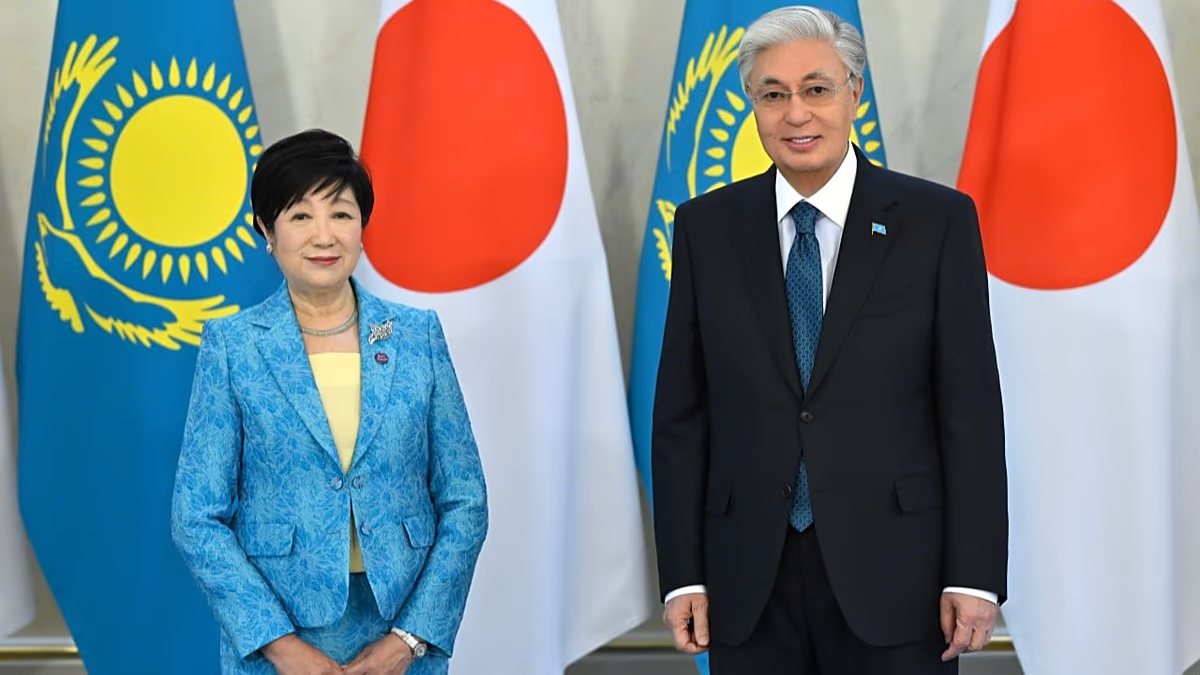
The governor’s trip also served to significantly strengthen ties with Kazakhstan, a nation with immense potential in the green energy landscape. In her meeting with President Kassym-Jomart Tokayev, the long-standing partnership between Japan and Kazakhstan was celebrated, with the President acknowledging Koike’s decades of dedication to fostering cultural and diplomatic ties. Their discussions extended beyond symbolism, focusing on practical cooperation anchored by a recent memorandum of understanding on digital development and urban resilience. In a world of geopolitical uncertainty, the dialogue also covered broader energy security concerns, highlighting how strategic international partnerships can contribute to stability and sustainable development.
Beyond high-level diplomacy, Koike’s agenda showcased the tangible, on-the-ground potential for synergy. She visited AlemAI, Kazakhstan’s premier AI center, illustrating the intersection of digital innovation and green technology. Furthermore, at the Kazakh Ministry of Agriculture, discussions on aquaculture and caviar production revealed unexpected parallels with similar projects on Tokyo’s Kozushima island, opening doors for potential collaboration in sustainable agriculture and food security. These interactions underscored that the partnership extends beyond energy alone, encompassing a wider range of technological and economic exchanges that can benefit both societies.
Governor Koike’s message is clear: the climate crisis is a universal challenge that demands a united response. The journey to a green hydrogen future is fraught with technical and financial obstacles, but by building bridges between cities, nations, and the private sector—from Dutch ports to Kazakh tech hubs and Tokyo’s vibrant start-up scene—these hurdles can be overcome. This model of open collaboration, sharing both best practices and lessons learned, is presented as the most viable blueprint for turning ambitious emissions targets into reality. As Koike concluded, such international efforts strengthen the foundation for a cleaner, more resilient, and interconnected global future.