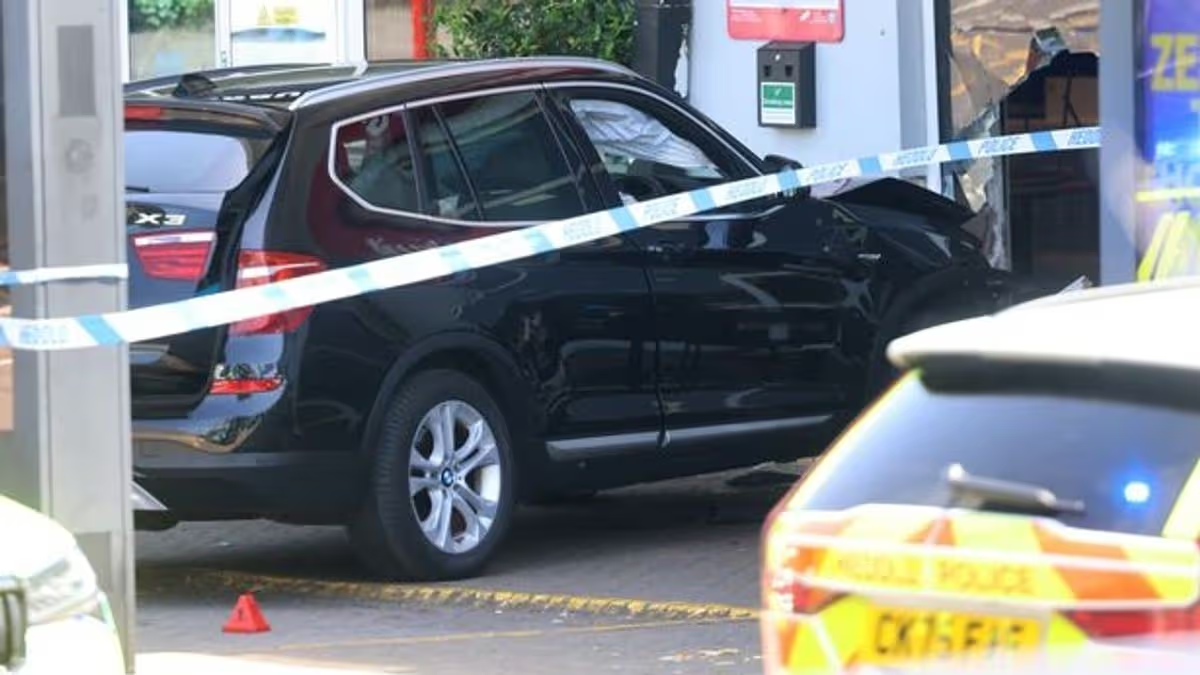



It was an ordinary afternoon at the Cardiff Gate Services, a familiar stop for travelers and locals alike, when the mundane was violently shattered. According to a witness who spoke with Wales Online, the scene of calm was ripped apart by a black BMW car that careened into the outdoor seating area. In a horrifying moment, the vehicle struck people who had been simply sitting at a table, enjoying a moment’s rest, before its trajectory carried it onward with terrifying force into the very face of the main building. The abrupt transition from the hum of daily life to screams and the sickening sound of impact marked the beginning of a community’s nightmare.
The immediate aftermath was one of visceral shock and instinctive human compassion. “It was awful,” the witness recounted, her words capturing the profound distress of those first moments. Yet, amidst the chaos, a powerful image of collective courage emerged. She described how, without hesitation, bystanders rushed to the aid of the injured, their individual fears subsumed by a shared imperative to help. “About 15 people were trying to lift the car off,” she said, a simple statement that speaks volumes about the human response to tragedy. This spontaneous act, a group of strangers united in the desperate physical struggle to free trapped victims, stands as a poignant testament to our capacity for empathy and bravery when confronted with the unthinkable.
The physical scar of the incident was starkly evident. The witness detailed how the vehicle’s collision with the building had left the front window utterly shattered, its glass scattered like grotesque confetti across the threshold where safety was presumed. This breached façade, a symbol of shelter now violated, marked the endpoint of the car’s destructive path. The incongruity of a vehicle lodged in a space designed for people moving, eating, and chatting created a surreal and chilling tableau, a frozen moment of violence that those present will struggle to forget.
In the fog of such a traumatic event, the human mind naturally seeks understanding, a reason to make the senseless somehow comprehensible. The witness gave voice to this universal need, turning from description to hypothesis. “I imagine the driver had a medical emergency,” she offered, “as I can’t understand how they went into the building at that speed.” This reflection is not merely speculation; it is a profound gesture of empathy in itself. Amidst the carnage, the witness instinctively considered the possibility of an unseen tragedy befalling the driver, a victim perhaps of circumstance rather than malice. This attempt to find a cause in illness rather than intent highlights a compassionate reluctance to immediately assign blame, acknowledging the complex web of human fragility that can underlie public disasters.
The scene, however, was ultimately defined by the urgent response of professionals. The witness confirmed that “All emergency services are there,” a phrase that signifies the transition from the initial, chaotic rescue by civilians to the coordinated, skilled efforts of paramedics, firefighters, and police. Their arrival brought a different kind of order—the flashing lights, the methodical triage, the careful extraction, and the forensic investigation. This mobilization represented society’s structured promise of aid and answers, moving to envelop the victims, the witnesses, and the driver in a system designed to heal, support, and unravel the truth of the day’s events.
Ultimately, this incident at a roadside services—a place of transit and temporary pause—becomes a sobering reminder of how quickly the ordinary can fracture. It is a story bookended by profound aspects of the human experience: on one end, sudden, devastating loss and injury, and on the other, the immediate, selfless rallying of strangers performing extraordinary feats of strength and solidarity. Between them lies the shattered glass, the crushed furniture, and the lingering questions. The witness’s account captures more than just facts; it captures the emotional arc from terror to compassion, from chaos to response, leaving us with a haunting picture of a community’s worst moment met with its best instincts.