


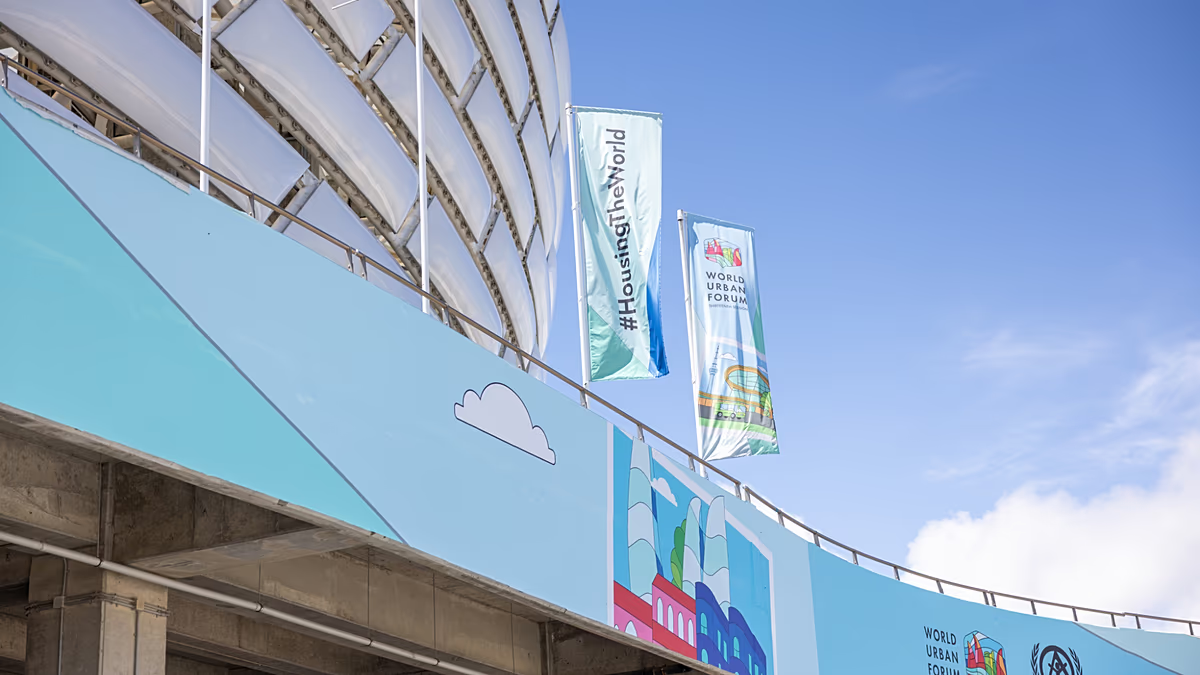
In addressing the global housing crisis, voices gathered from across the world at the World Urban Forum in Baku reveal a profound and often overlooked truth: the greatest barrier to creating homes is not a simple lack of funds, but a critical breakdown in governance and dialogue. This is the perspective offered by Uğur İbrahim Altay, Mayor of Turkey’s sixth-largest city, Konya, who serves as Executive President of the United Cities and Local Governments network. He argues that the “communication problem between the central government and the local administration” is a more significant obstacle than financial constraints. His insight strikes at the heart of a common dilemma, where well-intentioned national housing policies falter because they are not developed in concert with the people who understand the unique tapestry of their own cities. This disconnect can lead to developments that are physically built but socially doomed, highlighting a universal urban challenge that extends far beyond balance sheets.
Mayor Altay’s vision for a solution emphasizes integration over isolation. He warns against the creation of soulless housing blocks disconnected from the city’s pulse, stating, “We have to produce integrated housing with the city, not isolated.” For him, a home is more than a roof and walls; it is the foundation for a fulfilling life. True housing, he suggests, must include spaces “where people can spend time with their children and families, where they can be happy, where they live.” This human-centric approach frames the housing crisis not merely as a quantitative deficit of units, but as a qualitative failure to build communities. It’s a call to move from simply constructing shelters to nurturing neighborhoods, where access to parks, services, and connection is woven into the very fabric of residential planning.
This local perspective on navigating systemic challenges finds a powerful, albeit stark, parallel in the experience of Ahmad Abulaban, City Director of Ramallah Municipality. For Palestinian cities, resilience is not an abstract policy goal but a daily practice forged under extraordinary pressure. Abulaban explains that constant crises have made them experts in crisis management, operating by a clear philosophy: “to survive, to adapt and to grow after any crisis.” This framework of survival, adaptation, and growth offers a profound lesson for all cities facing shocks, whether from climate, conflict, or economic strain. It underscores that resilient housing and urban systems are not a luxury but an absolute necessity, and that local leaders often develop the most pragmatic, ground-level innovations when they are empowered to respond directly to the realities their citizens face.
The unique position of city leaders, caught between high-level policy and on-the-ground reality, is further elucidated by Mauricio Rodas, former mayor of Quito. He identifies the defining trait of mayoral leadership as direct accountability. “Mayors are all about delivery,” he notes, pointing out that they are under constant public scrutiny because their work impacts the minutiae of daily life—from the state of streets to the availability of water. This pressure, he argues, creates a uniquely pragmatic form of governance: “Mayors cannot afford to think about politics, to discuss ideology. They don’t have time for that. They have to work on the ground.” Yet, as Rodas highlights, this ground-level work has planetary consequences. With cities generating 80% of global GDP and over 70% of emissions, the decisions made by mayors are inextricably linked to the world’s most pressing economic and climate challenges. Their role is no longer merely municipal; it is globally strategic.
However, the potential of local leaders is often hamstrung by the very communication gaps Mayor Altay identified. Dr. Ani Binti Ahmad, President of the Sepang Municipal Council in Malaysia, provides a clear example of this tension. She describes her authority as essentially limited to implementing federal housing policies, with little room for adaptation. “What we do is follow whatever policy is made by the federal government,” she states, while also highlighting the practical challenge of negotiating with profit-driven developers. This scenario creates a frustrating impasse: local authorities, who best understand their community’s needs and land-use intricacies, are tasked with executing centralized plans that may not align with local realities, often resulting in ineffective or stalled projects. This disconnect is a major contributor to the alarming projection from UN-Habitat that without urgent change, up to 3 billion people could live in slum conditions by 2050.
Ultimately, the collective testimony from these diverse urban leaders paints a coherent picture for a path forward. The solution to the housing crisis—and by extension, to building sustainable, resilient, and happy cities—lies in bridging the trust and communication chasm between tiers of government. It requires empowering local authorities with the autonomy and resources to translate broad national goals into integrated, community-specific solutions. It demands a collaborative model where central governments set frameworks and provide funding, while cities lead on design and delivery, ensuring homes are connected to jobs, transit, and green spaces. By learning from the adaptive resilience of Ramallah, embracing the pragmatic accountability described by Mayor Rodas, and heeding Mayor Altay’s call for integrated living, we can begin to transform housing policy from a top-down mandate into a collaborative act of community creation. The alternative—continued siloed planning and fragmented execution—will only accelerate the slide toward a planet of slums, failing the very citizens that governments at every level are meant to serve.