


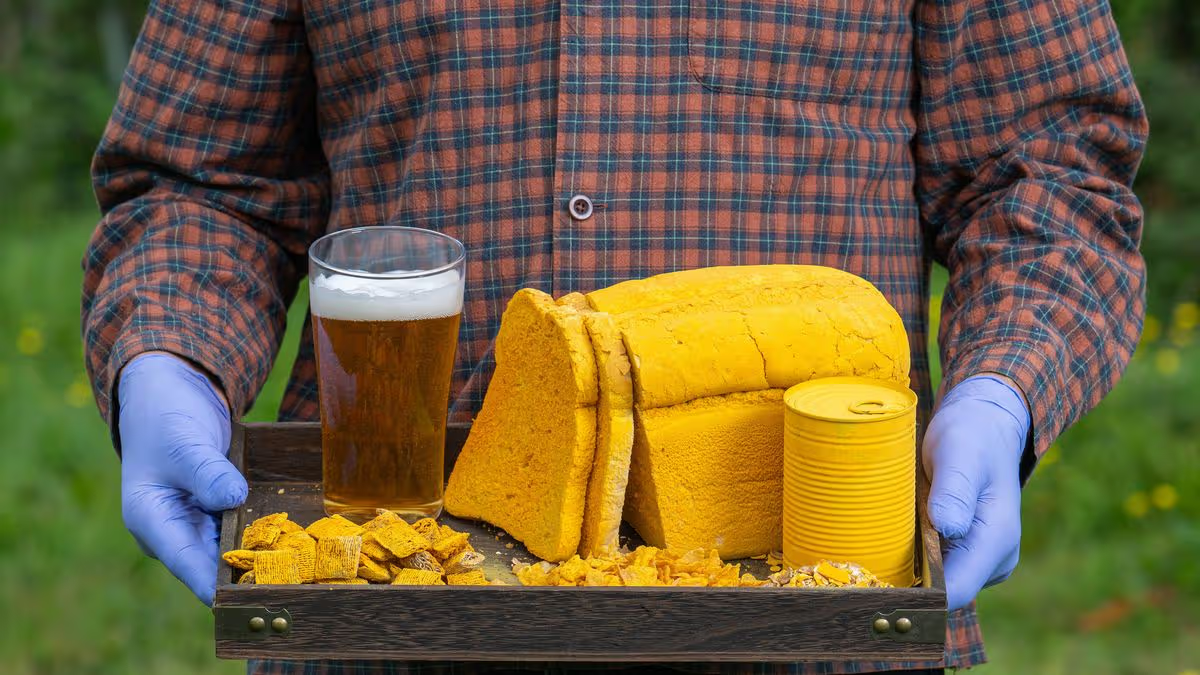
A simmering public health concern regarding a common agricultural chemical has reached a boiling point in the United Kingdom. Campaigners from leading environmental and health groups are urgently calling on the Government to outlaw the use of the pesticide glyphosate as a pre-harvest treatment on crops, a practice they directly link to the presence of this controversial chemical in everyday British foods. Their alarm is underpinned by data from the Soil Association, which found that nearly half of all UK wheat, barley, and oat samples tested contained glyphosate residues. This means the chemical is likely present in a vast array of staple goods, from bread and breakfast cereals to pasta and beer, placing it on the plates of consumers across the nation.
The practice at the heart of the controversy is known as pre-harvest desiccation, where glyphosate—best known as the active ingredient in the weedkiller Roundup—is sprayed on grain crops like wheat and oats not to kill weeds, but to dry out the crop itself for an easier, more uniform harvest. While the UK government and farming bodies argue this technique supports food security and farm viability, campaigners point to a stark divergence in international policy. The European Union banned this specific use of glyphosate in 2023, leaving the UK, in the eyes of critics, dangerously out of step with its nearest neighbours on safeguarding public health. The issue is coming to a head as the Health and Safety Executive prepares a major public consultation on the renewal of glyphosate’s licence in Great Britain, setting the stage for a pivotal decision.
Campaigners are armed with a growing body of scientific opinion that underscores the potential dangers. In 2015, the World Health Organization’s International Agency for Research on Cancer classified glyphosate as a “probable human carcinogen.” More recently, a panel of international scientists convening at the Seattle Glyphosate Symposium in March this year reviewed a decade of new research and concluded unequivocally that glyphosate and glyphosate-based herbicides harm human health and can cause cancer. Their expert statement insisted that the evidence of harm at current levels of use is so compelling that further regulatory delay is unjustifiable. This scientific consensus forms the backbone of the argument that allowing the chemical to be sprayed directly on food crops just days before harvest constitutes an unacceptable risk.
The coalition demanding change, which includes the Soil Association, Greenpeace, The Wildlife Trusts, and the organic pioneer Riverford, estimates that a ban on pre-harvest desiccation could prevent glyphosate from being sprayed annually on an area up to five times the size of London. In an open letter to the Government, they emphasise that such a move must be accompanied by robust support for farmers to ensure their businesses can thrive while transitioning away from chemical dependence. Guy Singh-Watson, founder of Riverford, frames it as a systemic issue, noting that many farmers feel trapped by a system offering few commercially viable alternatives. He, and others, argue that government has a fundamental responsibility to break this cycle and ensure food production does not compromise the health of people or the planet.
In response, a Government spokesman highlighted the UK’s strict regulatory regime, stating that all pesticides, including glyphosate, are only approved if evidence shows they won’t harm human or animal health. They also pointed to the UK Pesticides National Action Plan, which advocates for minimising pesticide use and promoting integrated pest management. However, for critics like Dr. May van Schalkwyk of the University of Edinburgh, this stance is insufficient in the face of “mounting independent evidence.” Campaign coordinators like the Soil Association’s Cathy Cliff argue that the Government’s current position leaves the UK lagging behind Europe and failing in its duty to protect public health from a “toxic chemical” in food.
The coming months will determine whether the UK follows the EU’s lead or charts its own course. The debate encapsulates a classic tension between agricultural practicality and precautionary public health principles. As the public consultation opens, the Government faces a critical choice: maintain the status quo supported by segments of the farming industry, or heed the calls of campaigners and a substantial body of international science to remove a probable carcinogen from the direct path to the nation’s food. The outcome will signal not just the future of a single chemical, but Britain’s broader approach to food safety, farmer support, and its alignment with evolving global scientific understanding.