


In the shadow of a high-stakes summit between US President Donald Trump and Chinese President Xi Jinping, the White House is making a direct and urgent appeal to Beijing. Officials are publicly urging China to leverage its unique relationship with Iran to help reopen the Strait of Hormuz, a vital maritime chokepoint effectively shut down by Tehran amidst ongoing regional conflict. The timing is critical, with the presidential meeting in Beijing seen as a pivotal moment to align great-power diplomacy toward resolving a crisis that threatens global economic stability. This overture underscores a significant, if fraught, recognition: in this complex geopolitical standoff, American strategy now actively depends on Chinese influence.
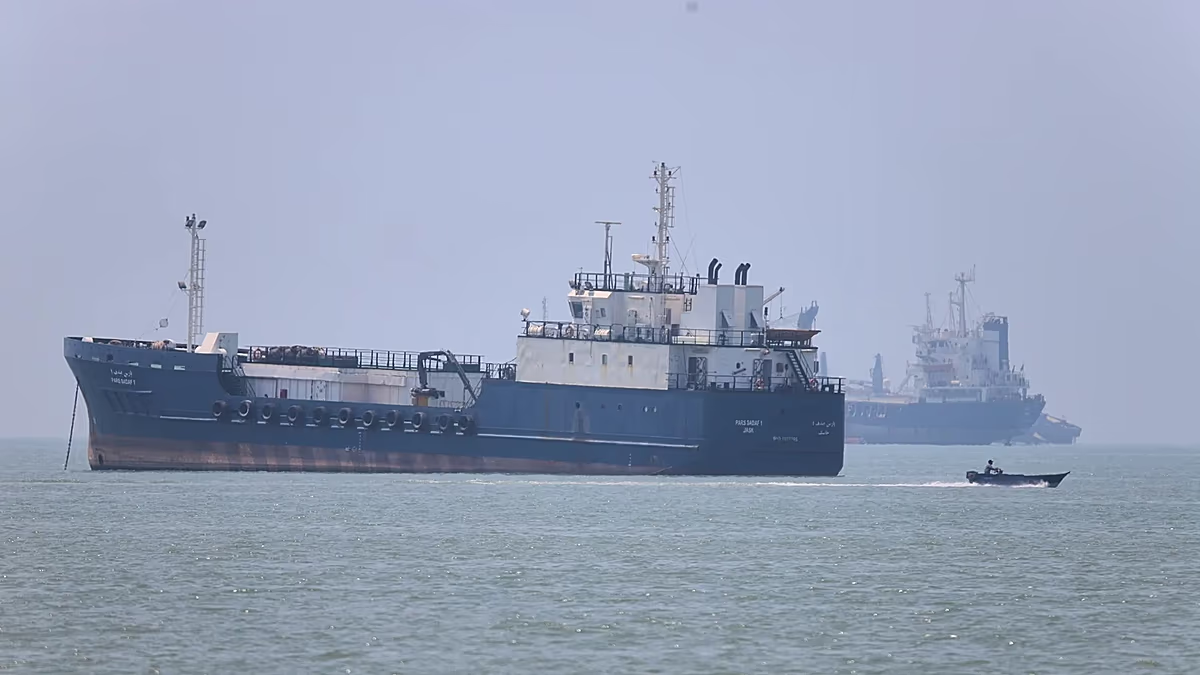
The US pressure campaign is being led emphatically by Secretary of State Marco Rubio. In a White House briefing, Rubio explicitly called on Chinese officials to deliver a stern message to Iranian Foreign Minister Abbas Araghchi during his recent visit to Beijing. “I hope the Chinese tell him what he needs to be told,” Rubio stated, framing Iran’s actions as causing global isolation. His argument pivots on stark national interests, noting that China’s export-driven economy suffers disproportionately from the strait’s closure. With nearly half of China’s crude oil and a significant portion of its liquefied natural gas flowing from the Middle East through these narrow waters, the economic imperative for Beijing is clear. “It is in China’s interest that Iran stop closing the strait,” Rubio asserted, blending diplomatic request with a reminder of shared vulnerability.
Behind the public statements lies a layered diplomatic struggle, particularly within the United Nations Security Council. The United States is concurrently engaged in quiet but “serious efforts” to persuade China not to veto a new US-backed resolution aimed at condemning Iran and demanding the strait’s reopening. This follows a previous veto by China and Russia, who argued that earlier drafts unfairly omitted condemnation of the US and Israeli military strikes that ignited the wider conflict in late February. The American calculus appears to be that face-to-face appeals at the presidential level, coupled with the tangible economic pain China is enduring, might sway Beijing to either soften its diplomatic shield around Iran or apply more decisive pressure behind the scenes.
The context for these discussions is a fragile and complex battlefield. The war, launched by the US and Israel, has led Iran to impose a chokehold on the strait, sending shockwaves through global energy markets and supply chains. The impact has been keenly felt across Asia, prompting China to embark on its own regional diplomacy, including consultations with Pakistan to mediate a temporary, two-week ceasefire. US officials acknowledge these efforts; President Trump himself has credited China with a role in encouraging Iran to agree to that fragile pause. Diplomats confirm that Beijing, as Tehran’s largest oil customer, used its substantial economic leverage to bring Iran back to negotiations when talks threatened to collapse entirely.
However, the Trump administration believes China’s role must not end with ceasefire mediation. Treasury Secretary Scott Bessent, setting the stage for the Trump-Xi agenda, emphasized that reopening the strait to secure international navigation remains a paramount goal. “The threat of attacks from Iran has closed the strait — we are reopening it,” Bessent declared, framing the US-led maritime operation as the solution and extending an invitation: “I would urge the Chinese to join us in supporting this international operation.” This positions the upcoming summit as a critical juncture where trade, arms sales to Taiwan, and broader bilateral ties will be discussed alongside the immediate crisis, with Washington hoping to translate China’s economic sway over Iran into concrete collaborative action.
Thus, the path to the Beijing summit is paved with a compelling diplomatic paradox. The United States, while engaged in military conflict with Iran, finds itself compelled to ask China—a strategic competitor—to act as a crucial intermediary. This scenario highlights the intertwined nature of modern global crises, where supply chains, energy security, and regional conflicts create unlikely convergences of interest. The world now watches to see if shared economic imperatives can forge a temporary bridge between rival powers, compelling them to co-manage a crisis that neither can afford to let spiral further. The outcome will test whether pragmatic necessity can temporarily override deeper strategic rivalries.