

A solemn crowd of over 150 people gathered outside Portswood Police Station in Southampton, their presence a quiet but potent contrast to the violent clashes that had scarred the city just days earlier. They came to remember Henry Nowak, an 18-year-old university student whose life was brutally ended last December, stabbed repeatedly just yards from where they now stood. Almost a week after his killer, Vickrum Digwa, was sentenced to life in prison, the community assembled not for retaliation, but for reflection. In a powerful, silent act of mourning and protest, they collectively took the knee, a gesture heavy with the weight of a national conversation about justice and policing. A three-minute silence followed, a specific and painful tribute referencing the alleged delay in administering first aid to Henry as he lay handcuffed, telling officers he had been stabbed. This peaceful demonstration stood in stark relief against the backdrop of recent turmoil, a community striving to channel its grief into a dignified demand for answers.
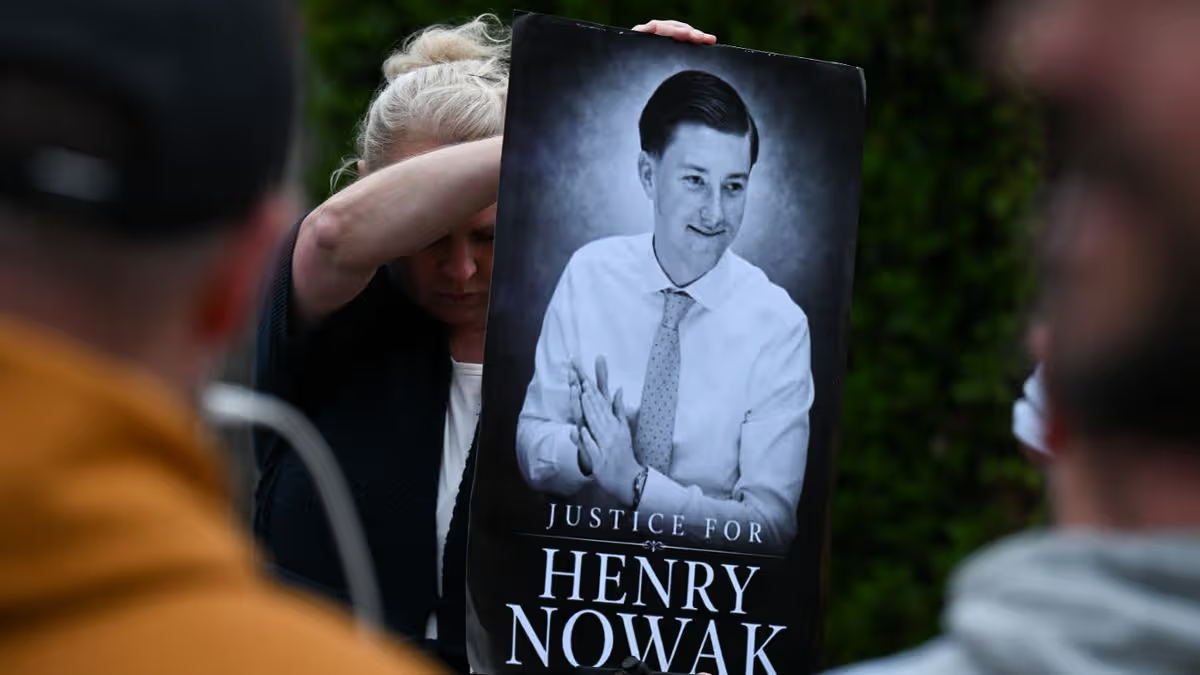
The air was thick with anguish and unresolved questions. Chants of “I can’t breathe”—Henry’s own reported words—and “No justice, no peace” echoed outside the station walls, giving voice to a deep-seated frustration. Protesters held signs bearing Henry’s face and messages like “Justice for Henry,” while banners declared “Never forget Henry Nowak” and criticized local authorities. The anger was directed at perceived systemic failures: a “two-tier” policing system, and what they saw as a tragic lack of “common sense” that night. One speaker captured the collective sentiment, telling the crowd, “A young man has lost his life, a family has been left broken and a city is searching for answers. What should we do with that anger?” Another explicitly rejected any twisted narratives, asserting, “We aren’t racist. We aren’t a racist group. We stand as human beings.” This was a plea for humanity and accountability, rooted in the profound loss of a young man with his whole life ahead of him.
This gathering was consciously defined by its contrast to the violent disorder that had erupted on Tuesday, when far-right figures had descended upon Southampton. That earlier protest, which saw marches toward the killer’s home, degenerated into chaos with bricks, bottles, and fence posts hurled at police, leaving 11 officers injured and streets littered with property damage. Local residents like Colin O’Malley and Sammy Jackson noted that many of those instigating violence weren’t from the community, and that the presence of alcohol had fueled the aggression. In the wake of that damage, tonight’s vigil was a clear attempt by Southampton residents to reclaim their narrative and their streets, to mourn Henry in a way that honored his memory rather than exploited it for other agendas. The quiet determination of the crowd was a direct rebuttal to the mindless violence that had preceded it.
At the heart of this tragedy, and the complex public response to it, is the Nowak family’s own measured and heartbreaking plea. In the aftermath of the sentencing, Henry’s father, Mark Nowak, explicitly warned against “knee-jerk reactions” and the use of his son’s death to “create further division, hatred or tension.” His words hung over both the violent and peaceful demonstrations, a sobering call for nuance. The family’s grief has been channeled into a specific and urgent campaign: to have knife crime treated as a “national emergency.” They call for investment in prevention, stronger actions on knife sales and carrying, and above all, a “common-sense approach to law and order.” Theirs is not a cry for vengeance, but for intelligent, systemic change to prevent other families from enduring similar nightmares. The community’s peaceful protest, in its own way, sought to amplify this dignified call for safety and sense, rather than stoke the flames of hatred.
The juxtaposition of the two protests—the violent Tuesday march and the solemn Wednesday vigil—paints a vivid picture of a society at a crossroads with its grief and its grievances. One path, littered with broken glass and fueled by external agitation, leads only to more injury and division. The other, though filled with raw pain and anger, seeks a form of peaceful solidarity and a constructive demand for change. The protesters outside the police station, taking the knee and observing their three-minute silence, were choosing the latter path. They embodied the frustration of a community feeling failed yet refusing to be defined by the worst elements within it. Their actions spoke to a desire for a justice that is thoughtful, inclusive, and ultimately effective in making streets safer for everyone.
Ultimately, the story unfolding in Southampton is more than a local news item; it is a microcosm of a national struggle. It is about how a community processes a senseless act of violence, how it holds institutions to account, and how it strives to prevent the next tragedy. The memory of Henry Nowak has become a catalyst, but for what? The answer depends on who seizes the narrative. His family has asked for it to be a catalyst for policy and prevention. The peaceful protesters sought to make it a catalyst for collective mourning and a reformed relationship with the police. The earlier rioters tried to make it a catalyst for conflict. As the city moves forward, the challenge will be to honor Henry’s legacy by heeding his family’s call for common sense, investing in the futures of young people, and fostering a community where dialogue, not violence, becomes the default response to even the most profound pain and injustice.