


The war in Iran has fundamentally rewritten the traditional playbook for investors seeking to protect their portfolios from inflation and geopolitical turmoil. For decades, the standard strategy paired two assets: oil and gold. One was seen as a direct hedge against supply-driven price spikes, the other as a timeless sanctuary during times of global conflict. Yet, since the onset of Operation Epic Fury on February 28th, these two pillars have moved in starkly opposite directions, decoupling in a way that has forced a profound reassessment of their roles. Brent crude oil has surged by 37%, a dramatic rally reflecting the tangible mechanics of war, while gold, the supposed ultimate safe haven, has paradoxically fallen by 10%. This divergence is not a minor market anomaly; it is a signal that the very drivers of value for these assets have shifted, revealing that gold’s behavior is governed by a far more complex and indirect set of rules than the simplistic narrative of “war equals gold rally.”
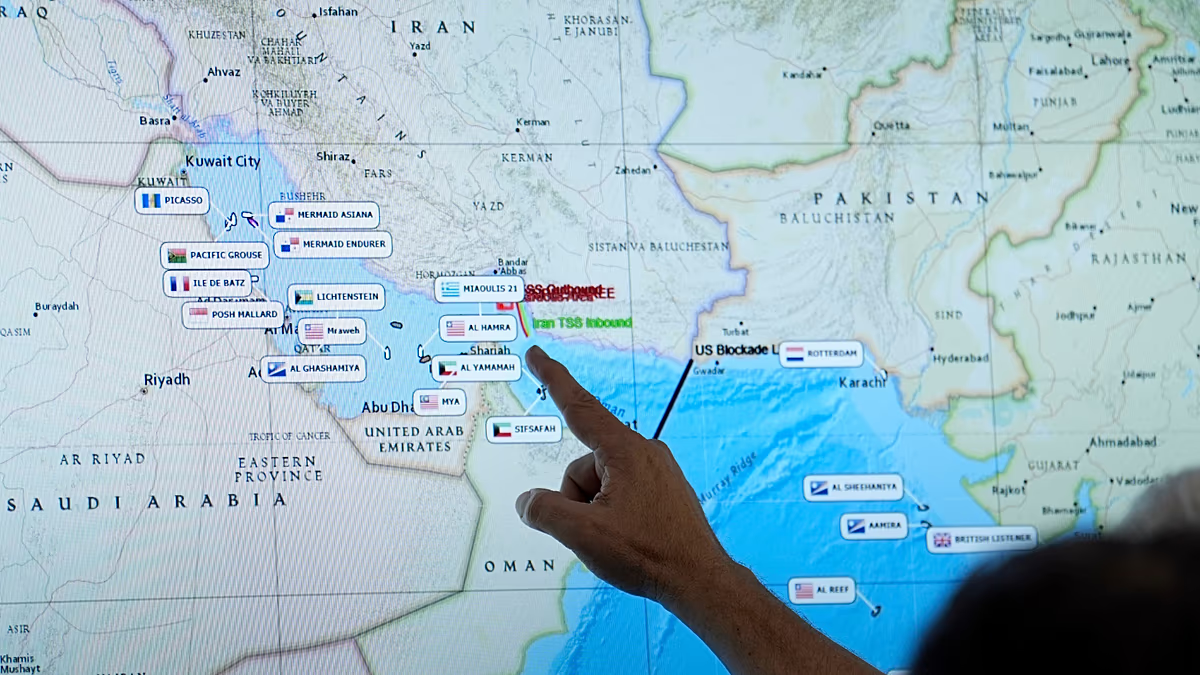
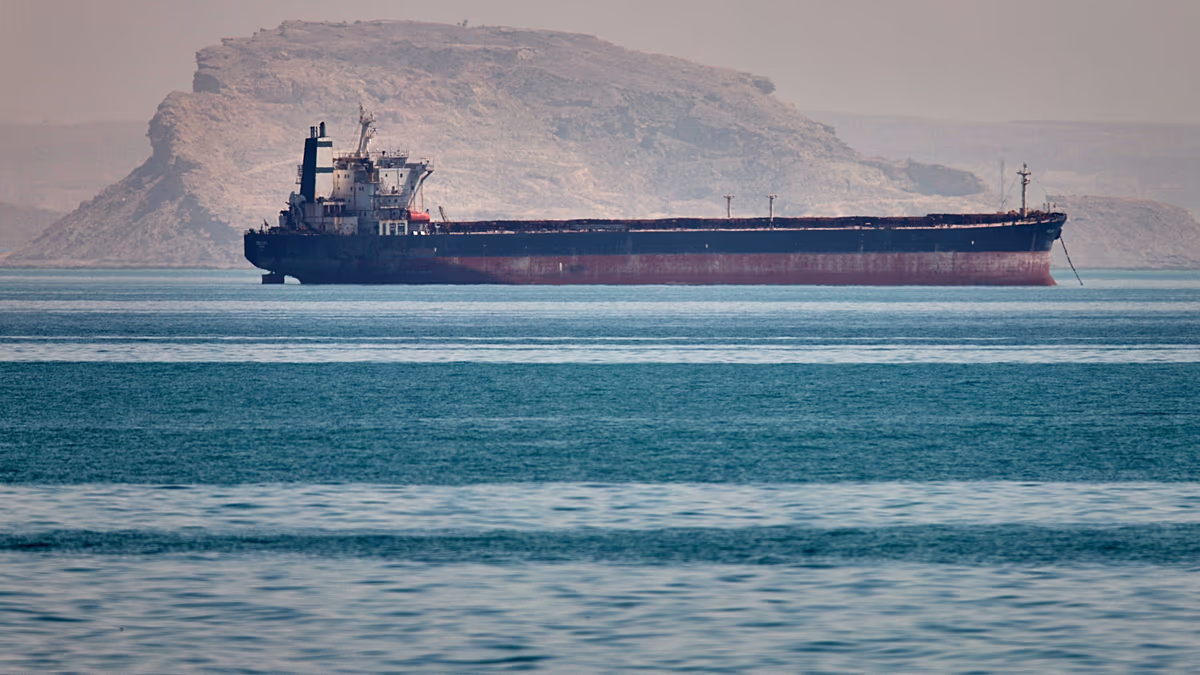
The surge in oil prices is relatively straightforward to explain, rooted in classical economics of supply and demand. According to analyses from Goldman Sachs, the conflict has taken approximately 14.5 million barrels per day of Persian Gulf crude production offline. This catastrophic reduction in supply has triggered a record global drawdown from oil inventories, estimated at 11 to 12 million barrels per day in April. In such a scenario, the market logic is clear: when supply collapses, prices must rise until demand painfully adjusts. Brent crude has climbed from around $70 per barrel to approximately $100, even peaking at $126. This rally represents a pure, direct hedge; investors who bought oil are capturing the inflationary pressure at its very source, as higher energy costs feed directly into broader price indices. Oil, in this context, behaves exactly as the textbook predicts.
Gold’s behavior, however, is the conundrum that demands a deeper exploration. The precious metal had enjoyed a spectacular 65% rally in 2025, buoyed by relentless buying from central banks and a consensus among strategists that it was the definitive asset for wartime protection. Yet, just as the conflict it was meant to shield against erupted, it lost a tenth of its value. The explanation lies not in geopolitics directly, but in the cold calculus of finance. Gold pays no coupon, dividend, or interest. Its entire investment value is therefore driven by the opportunity cost of owning it—a cost set by the level of real interest rates in the United States. When yields on assets like Treasury bonds rise, an investor forfeiting that income to hold a static brick of metal is losing ground daily. Conversely, when yields fall, gold becomes attractive. This is why gold rallied in 2025: markets were anticipating Federal Reserve rate cuts, real yields were drifting lower, and gold had a clear tailwind. The war in Iran has violently severed that tailwind.
The conflict has, through its impact on oil and inflation expectations, drastically altered the interest rate landscape. The CME FedWatch tool now shows zero rate cuts for the entire year as the dominant scenario. More strikingly, a year out, the market-implied odds of a Fed hike now exceed those of a cut. The war’s supply shock has reduced hopes for lower interest rates, as the Fed is expected to hold policy restrictive to combat the inflationary pressures from soaring energy costs. Gold has repriced these expectations in real time, falling from $5,275 per ounce on February 27th to $4,735. As Amy Gower, Metals & Mining Commodity Strategist at Morgan Stanley, framed it, gold’s sensitivity to monetary policy has overtaken its safe-haven status as the dominant price driver. The metal does not respond to events; it responds to the policy reaction that follows them. The transmission is mechanical: higher-for-longer rates raise the opportunity cost of holding gold, suffocating its price even amid warfare.
This leads to a critical, often misunderstood distinction about gold’s true function. Gold does not hedge inflation per se; it hedges against the failure of the institution charged with controlling inflation. When prices rise from moderate levels—as seen with US CPI moving from 2% to 3.3%—gold often suffers because markets trust the central bank to manage the problem. The expectation that the Fed will hike or hold rates is enough to push real yields up and crush demand for gold. Its real moment arrives only when confidence breaks: when inflation becomes unanchored, when the central bank is seen as unwilling or unable to stop it, and when investors question the currency’s ability to preserve purchasing power. The 1970s, the early eurozone crisis, and the 2020 pandemic were such credibility shocks. The Iran war, thus far, has not produced a credibility shock; it has produced a supply shock that the Fed is widely expected to absorb. This distinction is why bullion is down 10%.
Looking forward, the path for these assets remains contingent on the conflict’s resolution. Goldman Sachs remains structurally bullish on gold, forecasting $5,400 by end-2026, anchored by sustained central bank buying and expectations that the Fed will eventually cut rates. However, near-term risks point to weaker prices if disruption in the Strait of Hormuz persists, keeping rate expectations elevated. Conversely, Goldman has upgraded its oil forecast, warning prices could stay above $100 if flows do not normalize. For investors, the lesson is clear: in this new playbook, oil acts as a direct, event-driven hedge, while gold acts as a indirect, policy-driven hedge. Its defensive power is deferred, activated not by the conflict itself, but by the loss of confidence in the response to it. The day the Strait reopens, oil will fall, and the Fed may regain room to cut rates, likely reversing gold’s pattern. Until then, the war meant to make gold shine has illuminated its complexities instead.