

The Weight of Division: London’s Dual Protests Under a Massive Police Operation
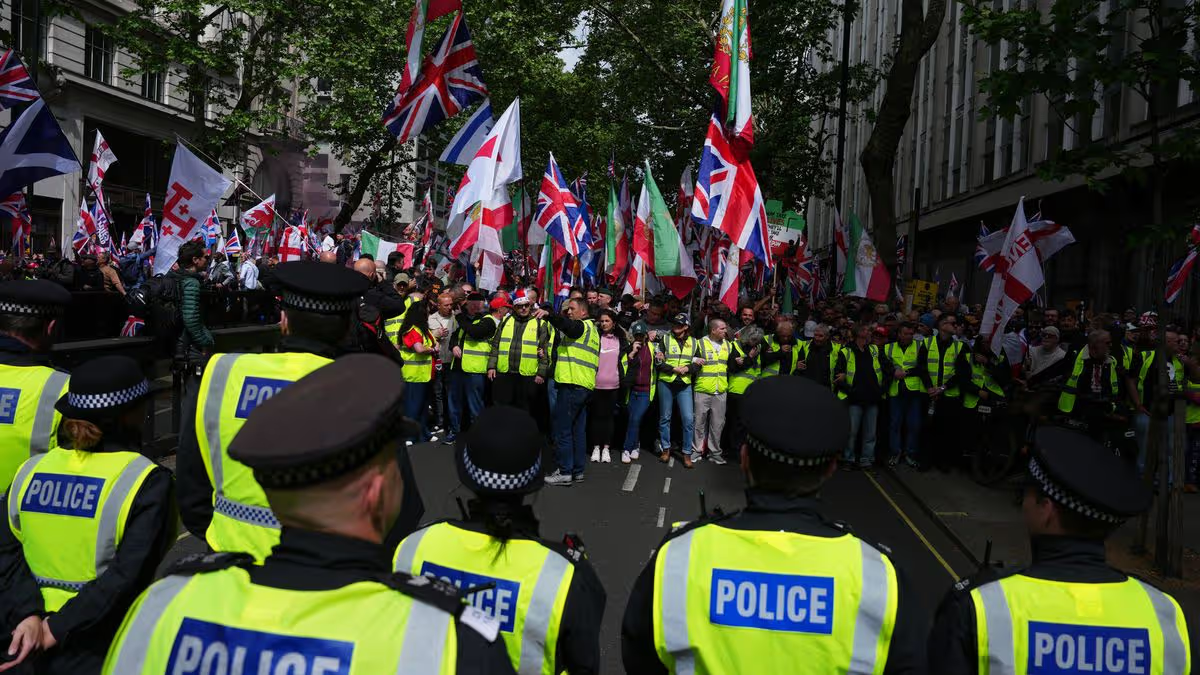
On a tense Saturday in May, London became the stage for a profound and polarizing national drama, as two ideologically opposed marches—the far-right “Unite the Kingdom” rally led by Tommy Robinson and the annual pro-Palestine “Nakba Day” demonstration—converged upon the capital. The Metropolitan Police launched a security operation of staggering scale and cost, deploying over 4,000 officers at an estimated expense of £4.5 million. This unprecedented mobilization, featuring drones, helicopters, police horses, and even armored vehicles unseen for fifteen years, underscored the authorities’ acute fear of violent clashes and hate-fueled disorder. The goal was clear: to maintain a fragile peace between two groups representing deeply entrenched and mutually hostile visions of Britain’s identity and values.
The “Unite the Kingdom” march, organized by activist Stephen Yaxley-Lennon (known as Tommy Robinson), framed itself as a rally for freedom of speech, national unity, and Christian values. However, its character was defined by the symbols and slogans of its participants. Many waved Union Jack and St. George’s flags alongside signs reading “Stop the Boats” and “Get them out,” while “Make Britain Great Again” caps evoked transnational far-right aesthetics. The atmosphere was often confrontational; in Trafalgar Square, a speaker used a microphone to deliver inflammatory statements about Muslims, met with laughter from some marchers. Despite Robinson’s attempt to include international far-right speakers, the government blocked eleven from entering the UK, declaring their presence detrimental to public good. The crowd, estimated at up to 50,000, was smaller than a previous rally, but its composition—including families alongside many men drinking beer—highlighted the movement’s attempt to project a broad, albeit tense, populist appeal.
Simultaneously, the Nakba Day march, commemorating the displacement of Palestinians in 1948, assembled a crowd of up to 30,000 in a starkly different display of solidarity. Led by voices like former Labour leader Jeremy Corbyn and MP Apsana Begum, this protest emphasized cross-community unity against “intolerance, hatred, and division.” Begum explicitly addressed the far-right march, stating that their solidarity—binding Muslims, Jews, Christians, and people of all backgrounds—would not be fractured by its opponents. This march existed in a charged political context, with police having warned that chants like “Death to the IDF” or “Globalise the Intifada” could lead to arrest. The presence of both demonstrations on the same day created a cityscape of parallel realities, each marching not just for a cause, but in direct ideological opposition to the other.
The human dimensions within these vast crowds often told more nuanced stories than the broad political narratives. Amid the Unite the Kingdom march, a momentary encounter unfolded between a protester and a woman wearing a burqa who had unintentionally found herself amidst the crowd. The protester approached her, embraced her, and assured her, “we don’t hate you,” explaining her stance was focused on opposing child abuse by criminal gangs. This brief, personal interaction stood in stark contrast to the wider rhetoric of intolerance, a small but poignant reminder of the complex individuals within monolithic movements. Meanwhile, Robinson himself, surrounded by security, was mobbed by supporters—one remarking on his surprisingly “tiny” stature—before he led chants from a stage in Parliament Square, even invoking support for Elon Musk.
The political backdrop to the day was intensely charged. Prime Minister Keir Starmer had preemptively condemned the Unite the Kingdom march as peddling “hatred and division,” framing it as a battle for the country’s soul. The police operation reflected this seriousness, employing live facial recognition technology for the first time at a protest and maintaining a zero-tolerance stance on hate speech. The Crown Prosecution Service had also issued new guidance for prosecutors on offensive banners and chants, aiming for swift legal consequences. This crackdown followed a rise in the terror threat level and memories of violent clashes at a previous Robinson rally, where officers had faced bottles, flares, and physical attacks.
By evening, the massive police operation reported 43 arrests across both protests, with four officers assaulted and six subjected to hate crimes. While authorities noted the events had proceeded “largely without significant incident,” the high arrest count and the monumental resources deployed spoke to the success of a containment strategy rather than genuine harmony. The day ultimately served as a powerful snapshot of a Britain grappling with profound internal divisions—over immigration, national identity, foreign policy, and the very limits of free speech. The parallel marches, kept apart by a wall of officers and technology, illustrated not just a divided city on a single day, but a nation wrestling with two competing and deeply felt visions of its future.