

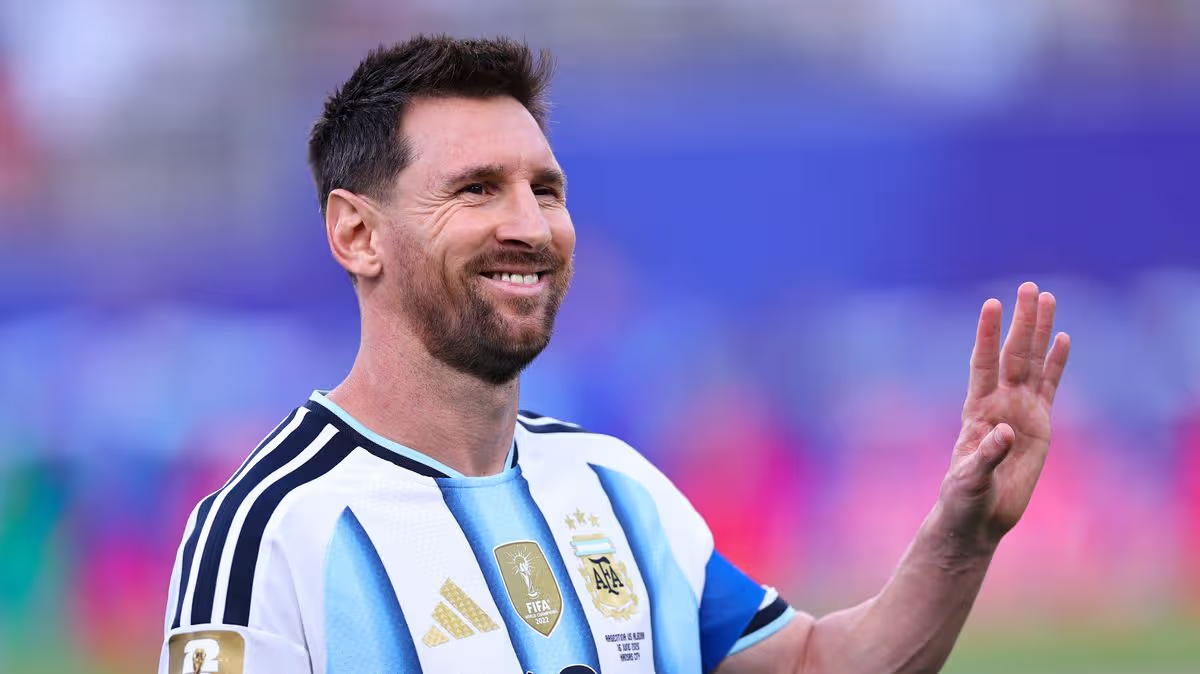
On a night that felt both historic and intimately familiar, Lionel Messi once again painted a masterpiece on the world’s grandest stage. In Argentina’s commanding 3-0 victory over Algeria in Kansas City, the maestro, now approaching 39 years old and in his record-extending sixth World Cup, delivered a performance for the ages. He netted his first-ever World Cup hat-trick, a sublime trio of goals that propelled him to a monumental personal milestone: 16 career World Cup goals, drawing him level with Germany’s Miroslav Klose as the tournament’s all-time joint-top scorer. This was not merely a player adding to his tally; it was an artist, in the twilight of his legendary career, decisively stamping his authority on history once more.
The significance of the occasion was profound. Marking his 200th cap for Argentina, Messi demonstrated a longevity that borders on the supernatural. His enduring genius was underscored by the very opponent he faced; the Algerian goalkeeper, Luca Zidane, is the son of Zinedine Zidane—a figure Messi once battled on the pitch and from the dugout. Against a new generation, Messi’s class remained transcendent. His opening goal, a powerful 25-yard strike that the goalkeeper could only help into the top corner, set the tone. The second showcased his predatory instincts, as he calmly converted the rebound from a saved Alexis Mac Allister shot. The third was quintessential Messi: a deft touch on the edge of the box, a shimmy to create space, and a precise, low finish into the corner.
This landmark achievement places Messi squarely at the center of the ongoing narrative of footballing greatness. While the young phenom Kylian Mbappé, who scored twice for France on the same day, is a formidable heir apparent with 14 World Cup goals already, Messi used this match to create further daylight in their storied rivalry. Similarly, Cristiano Ronaldo, set to join Messi as a six-time World Cup participant, trails far behind in the tournament’s scoring charts. On this night, Messi didn’t just chase records; he solidified a legacy. In becoming the oldest player to score a World Cup brace and then a hat-trick, he proved that his magic is not dimmed by time, but rather distilled into its most potent form.
Much credit for Argentina’s fluid performance must also go to manager Lionel Scaloni, who has masterfully constructed a system that amplifies Messi’s strengths without making the team reliant on them. The defending champions operated like a well-oiled machine, with Messi as its elegant, beating heart. This harmony allows his genius to flourish organically within the team’s structure, a balance that has been key to Argentina’s sustained success. As FIFA President Gianni Infantino looked on, Scaloni’s side delivered a performance worthy of their champion status, a statement of intent for their 2026 campaign.
As Messi departed the pitch to a rapturous standing ovation, substituted to protect the national treasure, the message was clear: Miroslav Klose’s outright record is now within touching distance and likely to be eclipsed soon. While Mbappé’s youth suggests he may one day claim the scoring crown for his own, Messi’s 2026 journey is about more than statistics. It is a final, majestic tour de force, an opportunity to cement his status as the undisputed greatest of all time. Each goal, each deft pass, each moment of control is a brushstroke in a portrait of a player who transcends sport.
For the fans in Kansas City and millions watching worldwide, witnessing this chapter was a privilege. It was a celebration of sustained excellence, a lesson in enduring passion, and a reminder that true greatness is not a fleeting peak but a majestic, enduring plateau. Lionel Messi, at 39, is not just participating in a World Cup; he is defining it, one glorious, record-equalling hat-trick at a time.