


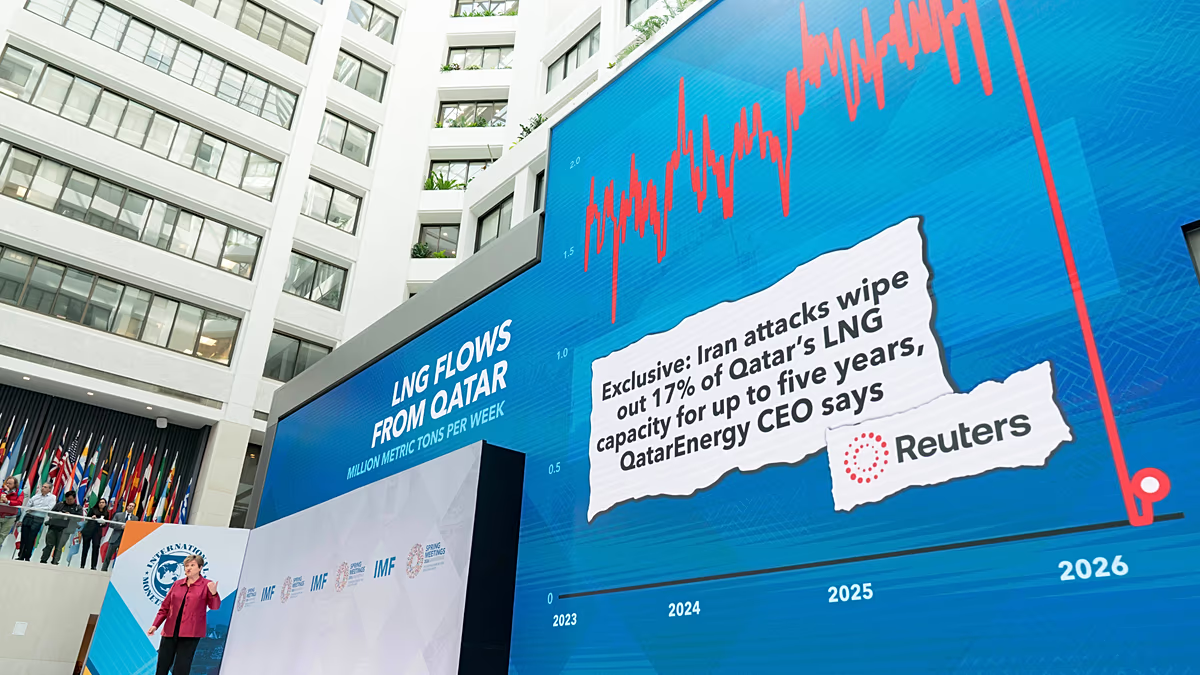
The International Monetary Fund has delivered a sobering assessment of the global economic landscape, significantly dimming its outlook for the eurozone in particular. In its latest World Economic Outlook, the IMF revised its growth forecast for the 19-nation bloc downward to a modest 1.1% for the current year, a notable drop from its previous estimate of 1.4%. This downgrade is presented not as a routine correction but as a direct consequence of the ongoing war in Iran, a conflict that has sent powerful shockwaves through the foundations of international markets. According to the report, the recovery of the world’s major economies, which had been tentatively underway, has been effectively stalled. The primary mechanisms of this economic injury are the severe disruption to global energy markets—fueled by the blockade of the critical Strait of Hormuz—and widespread infrastructure damage across the Middle East, collectively reigniting fears of inflation and scarcity.
The implications of this crisis are felt most acutely in Europe, a region whose industrial and economic health remains perilously tethered to the price of imported energy. The IMF assumes a stark 19% spike in energy costs, a surge that poses a formidable hurdle to industrial output and consumer spending alike. As investment strategist Lindsay James of Quilter observed, Europe’s lack of energy independence leaves it uniquely vulnerable, placing it among the hardest-hit regions. Chief economist Pierre-Olivier Gourinchas underscored that the global economy had previously shown a degree of resilience against other headwinds like protectionist trade policies, but this fresh geopolitical fire has halted that progress in its tracks. Even the news of a temporary ceasefire offers little lasting comfort; James warns that tensions remain high and the world must now acclimatize to a new normal of elevated oil and gas prices for the foreseeable future, preventing any simple return to pre-crisis conditions.
This economic strain is not confined to Western Europe. It compounds an already dire situation in Ukraine, which continues to fight a full-scale invasion by Russia. The country is grappling with a March inflation rate of 7.9%, a figure that encapsulates the brutal duality of its crisis: financing an existential war for national survival while simultaneously shielding its citizens from external price shocks. The governor of the National Bank of Ukraine described the nation’s precarious balancing act as “walking on a razor blade,” a vivid metaphor for the near-impossible task of maintaining economic stability amidst relentless military and financial pressure. This illustrates how regional conflicts can cascade into global economic disturbances, which in turn exacerbate the suffering within the very nations already at the epicenter of violence.
The global picture, as painted by the IMF, is one of sharp divergence. While Europe cools, the United States has also seen its growth forecast trimmed, down to 2.3%. Interestingly, the impact of recent American trade tariffs has proven less severe than initially feared, but the nation is not immune to the overarching energy shock. In stark contrast, Russia—a primary architect of the war in Ukraine—is projected to receive a slight economic upgrade to 1.1% growth. This paradoxical boost stems from its role as a major energy exporter, allowing it to benefit from the higher global prices for oil and gas that are crippling its adversaries. This creates a perverse and complex geopolitical dynamic where energy-exporting nations find temporary fiscal relief, while importers, particularly in the eurozone and vulnerable regions like Sub-Saharan Africa, watch their economic buffers rapidly erode.
Despite the fragile ceasefire on the ground in the Middle East, the IMF maintains a posture of deep caution. The institution warns that downside risks remain dangerously elevated, with the potential for a prolonged period of energy market volatility stretching into 2027. Should this volatile state persist, the world could face a “severe scenario” where global growth plummets to a mere 2%. Such an outcome would represent a profound stagnation, forcing central banks around the world into a prolonged and painful policy dilemma. To combat the persistent, conflict-driven inflation, they would likely be compelled to maintain interest rates at higher levels for longer, a medicine that itself risks choking off investment and consumer demand, thereby deepening the potential slowdown.
In summary, the IMF’s report sketches a world at an economic crossroads, where geopolitical conflict has once again become the dominant driver of financial fortune and misfortune. The eurozone stands as a chief casualty, its growth prospects dimmed by an energy dependency that the crisis has ruthlessly exposed. Meanwhile, the uneven impacts—from Ukraine’s razor-edge struggle to Russia’s wartime economic benefit—highlight the uneven and often unjust distribution of pain in a globalized economy. The overarching message is clear: in an interconnected world, there are no purely regional wars. The fallout, in the form of inflation, stunted growth, and financial instability, quickly becomes a shared global burden, with the most vulnerable nations and populations bearing the heaviest load. The path forward depends not just on diplomats securing lasting peace, but on economies building greater resilience against the inevitable shocks of an unpredictable world.