

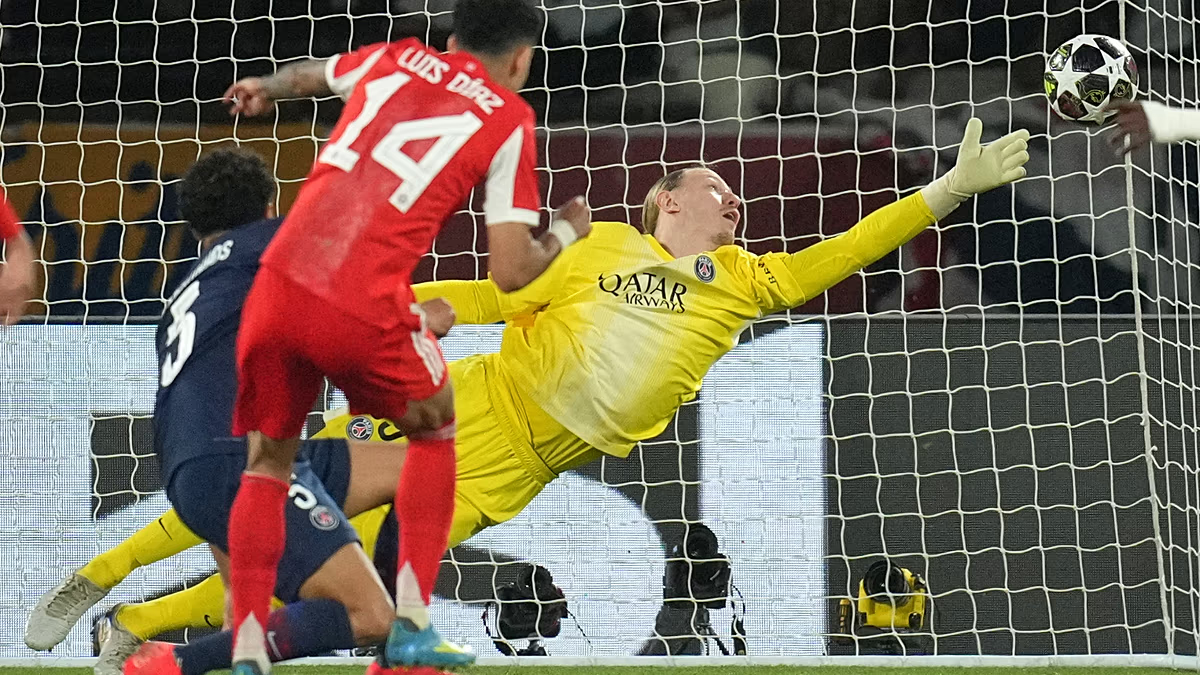
In the dimming glow of what many are already calling a historic Champions League season, one record held for nearly a quarter of a century teeters on the brink of being shattered. The stage was set eight nights ago in Paris, where a footballing spectacle of the highest order unfolded. Paris Saint-Germain and Bayern Munich traded blows in a breathtaking semi-final first leg that ended 5-4 to the French hosts. This wasn’t just a victory; it was a declaration. In a match where the immense pressure of the occasion could have fostered cagey, defensive football, both squads instead showcased an astonishing commitment to attack, their sheer quality overriding tactical caution. That unforgettable night has now set the scene for a monumental conclusion in Munich, where the second leg will not only decide which team advances to the final in Budapest but will almost certainly witness the fall of a longstanding and “haunted” record: the most goals scored by a single team in a Champions League campaign.
The record in question belongs to the legendary Barcelona side of the 1999/2000 season, which found the net 45 times. For 26 years, that benchmark has stood, a testament to a bygone era of flowing, dominant football. Now, incredibly, two modern giants stand poised to surpass it in the same breath. Entering tonight’s decisive clash, Paris Saint-Germain has amassed 43 goals across their 15 matches, while Bayern Munich trails just behind with 42. This marks the first time in the competition’s storied history that two different clubs have each blasted through the 40-goal barrier in a single season. The arithmetic is simple and thrilling: one more goal from PSG would tie the record, two would break it. For Bayern, the task is slightly steeper but no less achievable—three goals would see them claim the crown. The record books are quite literally open on the pitch, awaiting a final, indelible entry.
Paris Saint-Germain’s journey to this precipice has been a masterclass in relentless offensive firepower orchestrated by manager Luis Enrique. Their campaign has been punctuated by explosive performances that have left defenders across Europe shell-shocked. They put five past Chelsea in the round of 16, repeated the feat against Tottenham in the group stage, and delivered their most devastating blow on Matchday 3 with a stunning 7-2 demolition of Bayer Leverkusen in Germany. The goals have come from everywhere. While the brilliant Khvicha Kvaratskhelia leads their charge with ten strikes, the contributions are beautifully spread, with Vitinha and Ousmane Dembélé each adding six, and the promising Désiré Doué chipping in five. Perhaps most impressively, PSG has broken another record along the way: ten of their 43 goals have been scored by substitutes, surpassing the previous bench-scoring record held by Kaiserslautern since 1999, proving their threat is a deep and unrelenting tide.
On the other side of this historic duel, Bayern Munich has crafted its own narrative of attacking excellence. After a strong group stage where they finished second with seven wins and 22 goals, manager Vincent Kompany’s side has truly unleashed its “attacking machine” in the knockout rounds. They announced their intent with a ruthless 10-2 aggregate dismantling of Atalanta in the round of 16. This was followed by the high-drama of the quarter-finals, where they edged Real Madrid 4-3 in a pulsating second leg, before engaging in that nine-goal epic with PSG. Their attack is spearheaded by the phenomenal Harry Kane, whose 13 goals this campaign now stand as the most ever scored by an English player in a single Champions League season. He is ably supported by the in-form Luis Díaz, who has scored in four consecutive games, and the dangerous Michael Olise, with 12 different Bavarians having gotten on the scoresheet.
This sets the stage for a night in Munich that transcends a mere football match. It is a collision of two philosophies built on overwhelming offensive strength, a final, 90-minute audition to see which club will claim the mantle of the most prolific attack the Champions League has ever seen. The tactical battle will be fascinating—will either side, so adept at going forward, dare to retreat and protect what they have? For PSG, their slender one-goal lead is both an advantage and a vulnerability. For Bayern, the roar of the home crowd at the Allianz Arena will fuel their belief that they can overturn the deficit and seize the record for themselves. The ghosts of Barcelona ‘99, Kaiserslautern ‘98, and all the great attacking teams of the past will be watching from the stands of history.
Ultimately, when the final whistle blows tonight, one team will book their ticket to Budapest for a chance at European glory. But regardless of which club advances, this two-legged saga has already secured its place in football lore. We have been treated to a pure, unadulterated celebration of attack over defense, of ambition over caution. Whether it is PSG or Bayern who ultimately breaks Barcelona’s 45-goal record, this semi-final has reminded us why we love the game: for these rare moments of collective breathlessness, for the sheer joy of goals, and for the timeless pursuit of making history. The record may finally be broken, but the memory of this electrifying clash between two footballing titans will endure for far longer.