

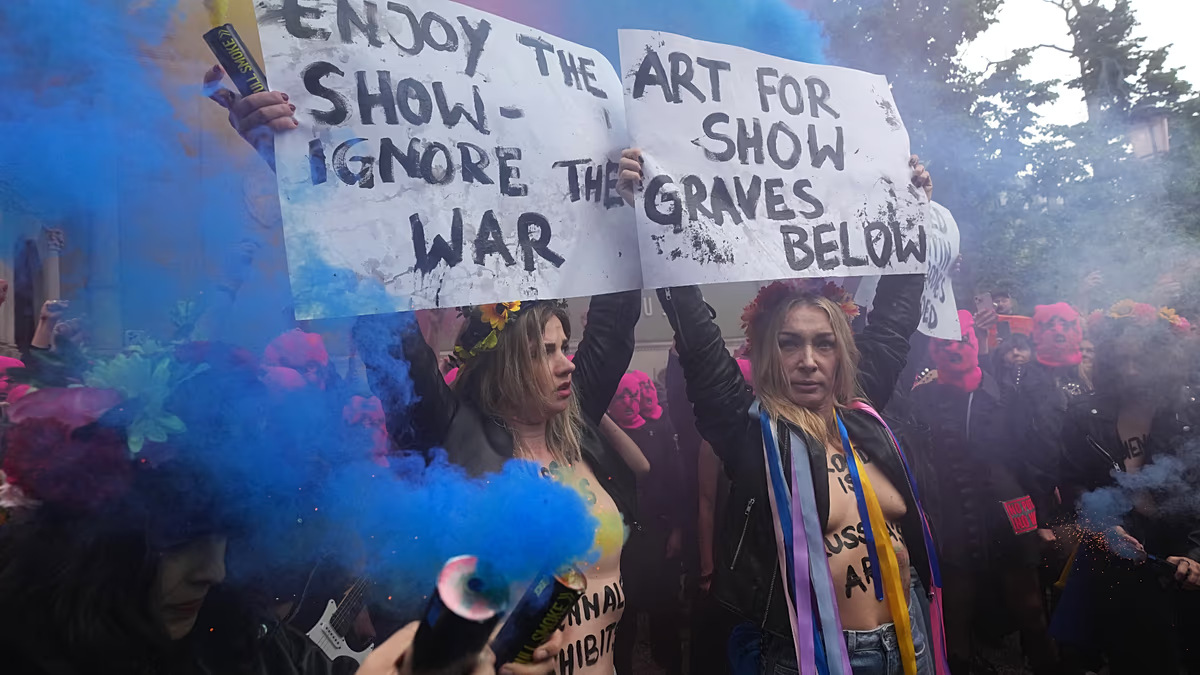
In the storied canals of Venice, a city synonymous with art and history, a starkly modern protest erupted just ahead of the opening of the prestigious Venice Biennale. Activists from the feminist groups FEMEN and Pussy Riot, known for their audacious and symbolic demonstrations, took to the scene. Employing colorful smoke flares and bold slogans, they staged a vivid denunciation of Russia’s planned return to the international art exhibition. This dramatic display unfolded directly before assembled journalists, ensuring their message would ripple through the global media. The protest served as a raw, visceral prelude to an event already mired in deep ethical controversy, perfectly crystallizing the escalating tension between the ideal of artistic openness and the weighty demands of political responsibility in a world fractured by war.
The core of this controversy lies in the paradoxical status of the Russian pavilion for the 2024 Biennale. Organisers have announced that while the physical pavilion—a space owned by Russia since 1914—will remain closed to the public, curated Russian artistic performances will still be presented. These performances will be recorded and broadcast on screens within the exhibition grounds. This compromise attempts to navigate a precarious middle ground, acknowledging Russia’s formal presence while physically limiting its footprint. However, this decision did not emerge in a vacuum. It follows the significant resignation of the Biennale’s international jury, which stepped down in protest. Their departure was a direct response to the participation of nations, including Russia, that are under investigation by the International Criminal Court for alleged war crimes, applying immense moral pressure on the event’s leadership.
This year’s planned return is particularly contentious given recent history. Russia was entirely absent from the 2024 edition after its artists collectively withdrew in 2022 in the immediate wake of the full-scale invasion of Ukraine. Its reappearance, even in a diminished digital format, has thus been perceived by many as a premature and unethical rehabilitation. Organisers contend that the historical ownership of the pavilion legally and traditionally prevents its outright exclusion, framing it as a permanent fixture of the Biennale’s landscape. Critics, however, forcefully counter this bureaucratic argument. They assert that major cultural institutions like the Biennale have a profound responsibility to reflect current geopolitical realities and must not offer a platform that could serve to normalize or distract from ongoing aggression and humanitarian crises.
The internal and external pressure on the Biennale has been substantial and multifaceted. Adding concrete force to the ethical objections, the European Union threatened to withdraw €2 million in crucial funding, a financial ultimatum that underscored the high-stakes political dimensions of the cultural decision. In defending the controversial compromise, Biennale president Pietrangelo Buttafuoco invoked a classic, if increasingly challenged, ideal. He described art as a “neutral space,” a realm ostensibly separate from politics where dialogue and expression should transcend conflict. This perspective champions the belief that cultural bridges must be maintained even when diplomatic ones have collapsed, suggesting that isolation is counterproductive and that art possesses a unique power to communicate beyond state agendas.
This stance of asserted neutrality has met with fierce and widespread condemnation. Ukrainian authorities, for whom the conflict is a matter of national survival, have been vehement in their rejection of the move. They, alongside several European culture ministers, argue that providing any form of platform to Russia at this juncture is a grievous error. Their condemnation centers on the risk of cultural whitewashing—the danger that an artistic presentation, however muted, could inadvertently sanitize a regime accused of atrocities and effectively overlook the grim context of alleged war crimes. For them, the protestors’ smoke flares symbolize a necessary interruption, a demand that the art world not look away from the suffering occurring beyond the gallery walls and canal waters.
Ultimately, the drama in Venice—from the activists’ fiery protest to the closed pavilion with its digital screens—transcends a simple dispute over an exhibition. It represents a fundamental, painful reckoning for global cultural institutions. The episode forces a difficult question: in an age of blatant aggression and information warfare, can art truly claim to be a neutral space, or does that very claim become a political position in itself? The Venice Biennale, caught between its founding principles of open international dialogue and the urgent moral imperatives of the present moment, has become a microcosm of this wider struggle. Its attempt at a technical compromise has satisfied few, highlighting the near-impossible task of balancing principle with practice, and proving that in today’s world, even the most hallowed artistic stages cannot escape the shadow of conflict.