



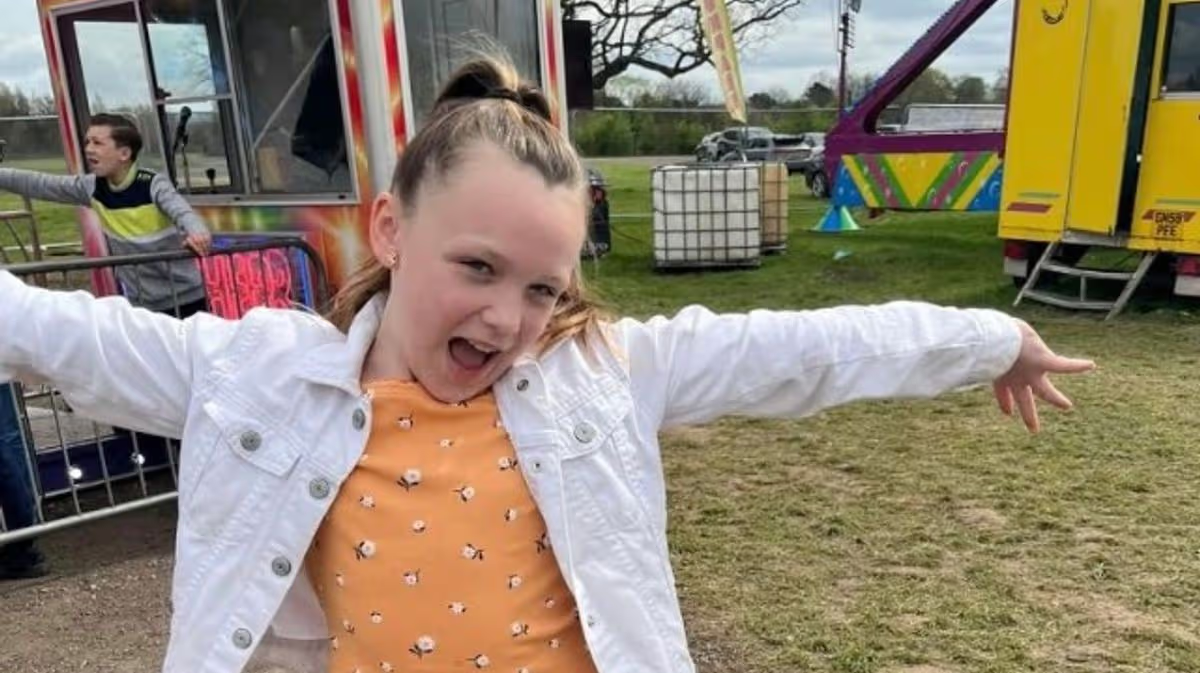
The sun-dappled woods of Banstead, Surrey, should have been a backdrop for a carefree childhood memory. Instead, they became the setting for an unimaginable tragedy that would forever shatter a family. Brooke Wiggins, a vibrant girl just days shy of her 13th birthday, was playing on a makeshift rope swing with two friends. The simple joy of swinging low to the ground turned to horror in an instant when the beech tree branch from which the swing hung cracked, shook, and came crashing down. Brooke was pinned beneath its weight, suffering catastrophic crush injuries to her chest. A frantic, desperate effort ensued as her friends rushed for help and nearby brothers attempted to lift the heavy wood, but it was immovable without machinery. For an agonizing 90 minutes to two hours, emergency services worked to free her with specialist equipment. Tragically, by the time they succeeded, it was too late. Brooke died at the scene, her life extinguished in a moment of play, leaving behind a community in shock and a family plunged into the deepest grief.
The subsequent inquest into Brooke’s death revealed a haunting series of what-ifs and systemic oversights. The tree was under the management of Surrey County Council, which had last inspected it in May 2022. That inspection recommended the removal of ivy to aid future examinations and scheduled a re-inspection for May 2024—a check that never occurred. Crucially, the ivy was never cleared. It was later found to have concealed a crack in the tree that was not visible from the ground. The council’s policy was to remove unauthorized rope swings within seven days of detection, yet this one remained. Council officials explained the immense challenge of managing millions of trees with limited resources, requiring constant prioritization. The ivy removal had been given a low priority rating, meaning it “should” be done within a year, a timeframe that passed without action. The overdue 2024 inspection slipped through without a system to flag it. In a heartbreaking statement, Brooke’s father, Lee Wiggins, voiced the anguished question haunting the family: “If only people had done their job properly… Brooke would still be here.”
Amid the cold procedural details of policy and inspections, the inquest was centered on the radiant life that was lost. Brooke’s mother, Claire Etherington, described her daughter as a “beautiful, fun, caring and loving girl” who possessed an incredible ability to light up any room. She was a creative soul who loved dancing, art, singing, and photography, and she took pride in her style, “never [going] anywhere without her eyelashes on.” Her father remembered an “amazing young woman” who was bright, funny, and had packed so much into her tragically short life. These tributes painted a portrait of a beloved child with boundless potential, making the senseless nature of her death even more difficult to bear. The family’s participation in the inquest was an act of profound love, giving a voice to Brooke in a forum where she could no longer speak for herself.
During the proceedings, the council faced pointed questions about its responsibilities. When asked if warning signs had been erected at the site since the accident, the council’s representative said they had not, noting that signage might inadvertently draw attention to a spot. The barrister for Brooke’s father argued that had the overdue inspection taken place, the rope swing would have been removed, potentially averting the disaster. The council disputed this, suggesting an inspection might not have changed the outcome given the hidden nature of the crack. The testimony revealed the difficult balance authorities must strike between public safety, vast areas of responsibility, and finite resources, though that balance offered no solace to a family mourning their child.
In his conclusion, Assistant Coroner Ivor Collett acknowledged the profound sadness of the case and the council’s criticized inspection regime. However, he ruled Brooke’s death a “terrible accident,” stating that the authorities could not reasonably have been expected to do more with the resources and risks they managed. He found their systems to be reasonable given the scale of their task and noted that warning signs likely would not have deterred playful children. He paid moving tribute to Brooke, recognizing the family’s grief and observing that while her “light shone far less than half as long as was its due, it clearly shone more than twice as brightly.” The formal finding brought a legal resolution, but not an end to the pain.
Brooke Wiggins’ story is a devastating reminder of how quickly a moment of innocence can turn to catastrophe and of the complex, often imperfect, systems in place to manage public safety in our shared spaces. For her parents, family, and friends, the loss is absolute and everlasting. They are left with memories of a sparkling, loving girl and the unanswerable question of “why?” Her death underscores the critical importance of vigilance and adequate resourcing in maintaining public lands, while also highlighting the irreplaceable value of a single, precious life. The community’s memory will hold the joy she brought, even as it grapples with the tragedy of her absence.