


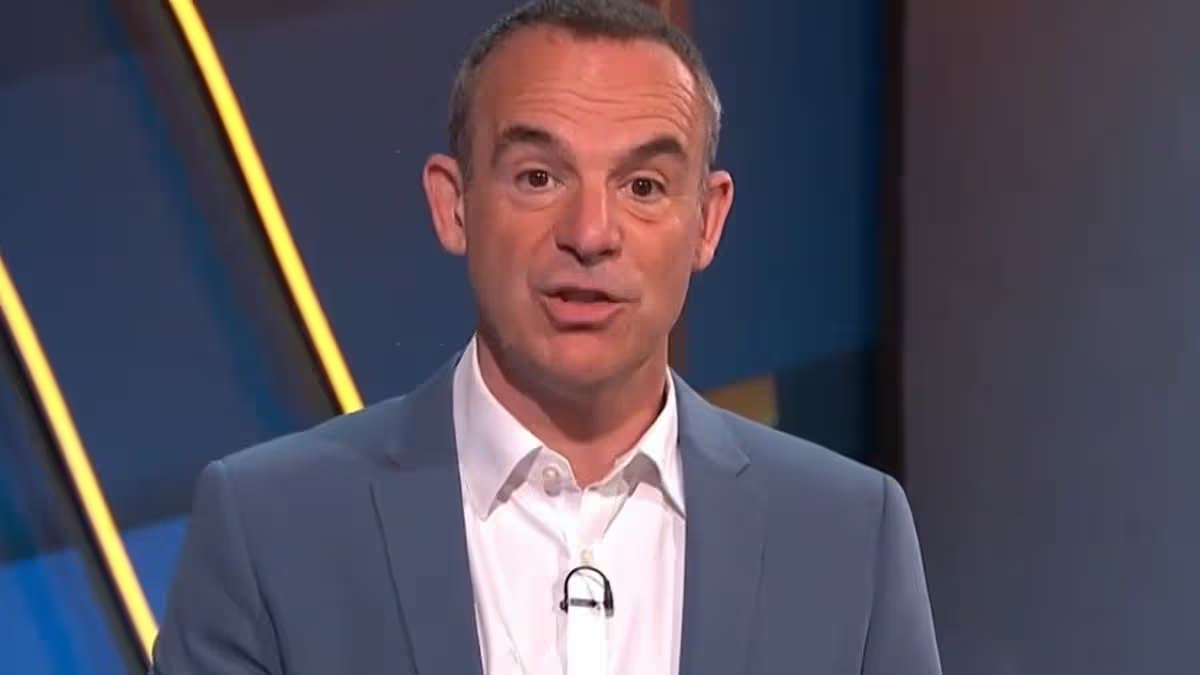
In a recent special episode of ITV’s The Martin Lewis Money Show, the renowned finance guru tackled what he called one of the most critical topics for long-term financial health: pensions. Dedicated entirely to retirement planning, the episode served as a vital guide through the often complex world of private and workplace pensions, inheritance tax implications, and even the process of tracking down lost pension pots. Among the practical advice dispensed, Lewis addressed a fundamental question from a viewer named Daryl, who symbolises the common dilemma of balancing present-day living standards with future security. In his mid-thirties, Daryl was already contributing 15% of his salary and wondered if this was sufficient. Lewis’s response not only offered reassurance but also introduced a simple yet powerful principle for retirement planning that underscores the profound advantage of starting early.
Lewis presented what he termed a “rule of thumb that scares the pants off everybody.” The guideline is straightforward: take the age at which you begin seriously saving into a pension and halve it. The resulting number is the percentage of your pre-tax salary you should aim to contribute for the rest of your working life to target a comfortable retirement. For instance, starting at age 20 would mean targeting a 10% contribution; beginning at 30 would mean 15%; and if one doesn’t start until age 40, the target leaps to 20%. Applying this to Daryl, who started at 30, his current 15% contribution aligns perfectly with the rule. Lewis was quick to praise Daryl, noting that his savings rate was “way more than most people” manage, but he also used the moment to deliver a crucial broader message about the nature of retirement saving.
The true power of this rule, Lewis emphasised, is not as a strict mandate but as a stark illustration of the mathematics of time and compound growth. He frankly acknowledged that “very few people ever get there,” meaning few actually hit these percentage targets consistently. However, the underlying lesson is inescapable: “The earlier you start, the better a retirement that you’re going to have.” Even small contributions made in your twenties benefit from decades of investment growth and employer contributions, effectively allowing your money to work harder for you. Starting later requires a significantly higher percentage of your income to catch up, as you have fewer years for investments to compound. This rule, therefore, acts less as a prescriptive budget and more as a motivational tool, highlighting the costly consequences of delay.
It is important to contextualise this private pension advice within the wider UK retirement landscape, as Lewis did during the show. Alongside any private pension, individuals will typically receive the State Pension, provided they have accrued enough qualifying years of National Insurance contributions. The full new State Pension is currently £221.20 per week (as of the 2024/25 tax year, a note to ensure accuracy versus the slightly differing figure in the source text), with the eligibility age gradually rising to 67 between 2026 and 2028. However, Lewis stressed that while this state provision forms a essential foundation, it is designed only to cover basic needs. A private pension is therefore not a luxury but a necessity for maintaining one’s pre-retirement standard of living, making his rule of thumb a guideline for funding the lifestyle many aspire to in their later years.
Understanding what a pension is deepens the value of this advice. A pension is a long-term savings plan with significant tax advantages. Contributions from you receive tax relief at your income tax rate, and if you are employed, your employer is legally required to contribute as well. This combination—your money, government tax relief, and employer funds—is what Lewis refers to as “pension super powers.” These contributions are invested over decades, with the aim of building a pot that you can access from your mid-to-late fifties (rising to 57 by 2028). The earlier you begin, the longer this pot has to grow through the powerful effect of compounding, where investment returns themselves generate further returns. This makes even modest early contributions disproportionately valuable.
In conclusion, Martin Lewis’s pension special served as a compelling call to action. His simple rule of thumb—half your starting age—provides a clear, personalised benchmark for retirement saving, transforming an abstract goal into a tangible target. While achieving it can be challenging, its primary purpose is to illuminate the non-negotiable financial logic of beginning one’s pension journey as soon as possible. By combining this disciplined approach to private savings with an understanding of the State Pension foundation, individuals can navigate the path to retirement with greater confidence. Ultimately, Lewis’s message is one of empowerment: taking informed, early steps today is the most effective strategy for securing financial comfort and peace of mind in the future.