


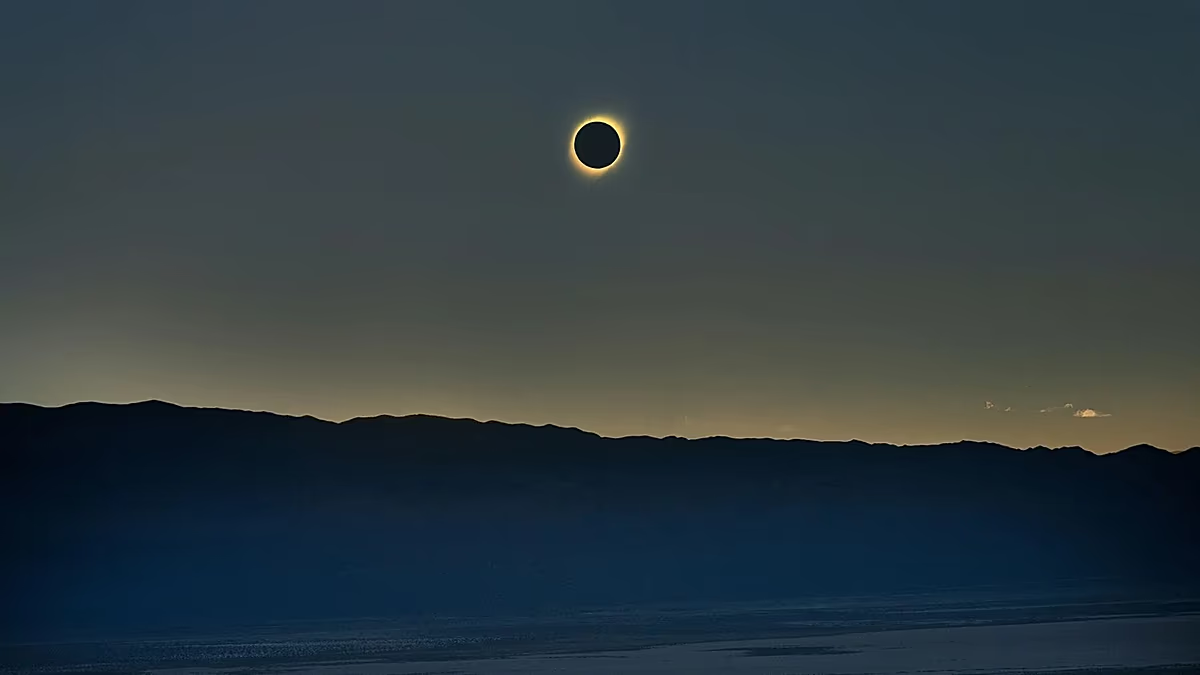
On 12 August 2026, a profound and fleeting darkness will sweep across parts of our planet. A total solar eclipse—an event where the moon perfectly obscures the sun, turning day to an eerie twilight—will grace the skies over Greenland, Iceland, and Spain. For up to two spectacular minutes, cities and towns within the narrow ‘path of totality’ will be plunged into an awe-inspiring silence, where stars become visible and the sun’s delicate corona shimmers in the darkened sky. This celestial alignment is more than just an astronomical occurrence; it’s a powerful, humbling experience that has drawn travelers and dreamers for millennia. If you’ve ever felt the pull of the cosmos, this is an invitation to witness one of nature’s most breathtaking performances, an event truly worth journeying to the ends of the earth to see.
For those seeking a communal celebration under the darkened sky, extraordinary events are being planned across the eclipse path. In Iceland, the iconic artist Björk will host ‘Echolalia,’ a rave in Hafnarfjörður near Reykjavík, where the pulsating music will meet a minute of totality, with custom eclipse glasses provided for safe viewing. Meanwhile, on the stunning Snæfellsnes Peninsula—where darkness will last over two minutes—the Iceland Eclipse Festival will blend DJ sets with profound talks from scientists and astronauts. In Spain, the small town of Vinuesa, near the eclipse’s central path, will host the Iberia Eclipse Festival. Here, music across four stages will fall into a hushed, respectful silence the moment totality begins, allowing everyone to share in the collective wonder. For a more historic journey, Mallorca offers a charming package involving a vintage train, a tram, and a boat trip out to sea, all designed to deliver passengers to a perfect, unobstructed view over the Mediterranean.
Perhaps you prefer a more solitary or self-directed adventure. The beauty of an eclipse is that it can be profoundly personal. Fortunately, excellent resources exist to help you plan your own perfect viewing. Dedicated websites like National Eclipse and Eclipse 2026 provide detailed maps showing the precise path and duration of totality for different locations. In Iceland, local tourism boards for areas like the West Fjords or Reykjanes suggest specific scenic spots. For Spain, the National Geographic Institute offers an interactive tool to check exact timings based on your chosen town. The key is to find a location with a clear, open view of the sky—a high point, a wide-open plain, or a quiet coastline. Remember, the difference between being just inside the path of totality and just outside is the difference between a life-changing spectacle and a mere partial dimming of the light, so double-check your coordinates.
For an utterly clear view, away from any potential clouds or terrestrial obstacles, consider taking to the water. Numerous cruise lines are offering special eclipse itineraries in the North Atlantic and Mediterranean, with voyages ranging from a few days to several weeks. From the deck of a ship, with a 360-degree horizon, you have the best chance of an unimpeded vista. The eclipse transforms the seascape; the light on the waves shifts, the temperature drops, and the world seems to hold its breath. Whether on a large cruise liner or a smaller expedition vessel, sharing this moment with fellow maritime travelers, surrounded by the vastness of the ocean, adds another layer of majesty to the experience. It’s a reminder of our small place in a vast solar system, viewed from the very element that covers most of our planet.
Of paramount importance is experiencing this wonder safely. You must never look directly at the sun without proper protection, except during the brief moments of total eclipse when the moon completely blocks the sun’s bright face. To view the partial phases before and after totality, you need solar viewers that comply with the ISO 12312-2 international safety standard. If certified eclipse glasses are unavailable, you can use indirect methods, such as a pinhole projector—simply a card with a small hole that projects the sun’s crescent image onto the ground. Even a kitchen colander can create dozens of tiny eclipse projections. Organizations like NASA provide simple guides for these safe, DIY viewing techniques. Protecting your eyesight ensures that the memory of the eclipse is one of beauty, not regret.
In the end, a total solar eclipse is a unifying human experience. It transcends language and culture, pulling our gaze upward in shared wonder. The 2026 eclipse offers a unique chance to combine this cosmic event with the stunning landscapes of Iceland’s volcanoes, Spain’s historic towns, or the open ocean. Whether you join a vibrant festival, embark on a quiet personal pilgrimage, or sail toward the shadow, you are participating in a timeless ritual. You are connecting with countless generations before you who stood in awe of the darkened sun. So mark your calendar, plan your journey, and prepare to witness a moment where day becomes night, reminding us of the incredible, clockwork beauty of our universe.