


A Call for Humanity and Justice: The Detention of Aid Activists
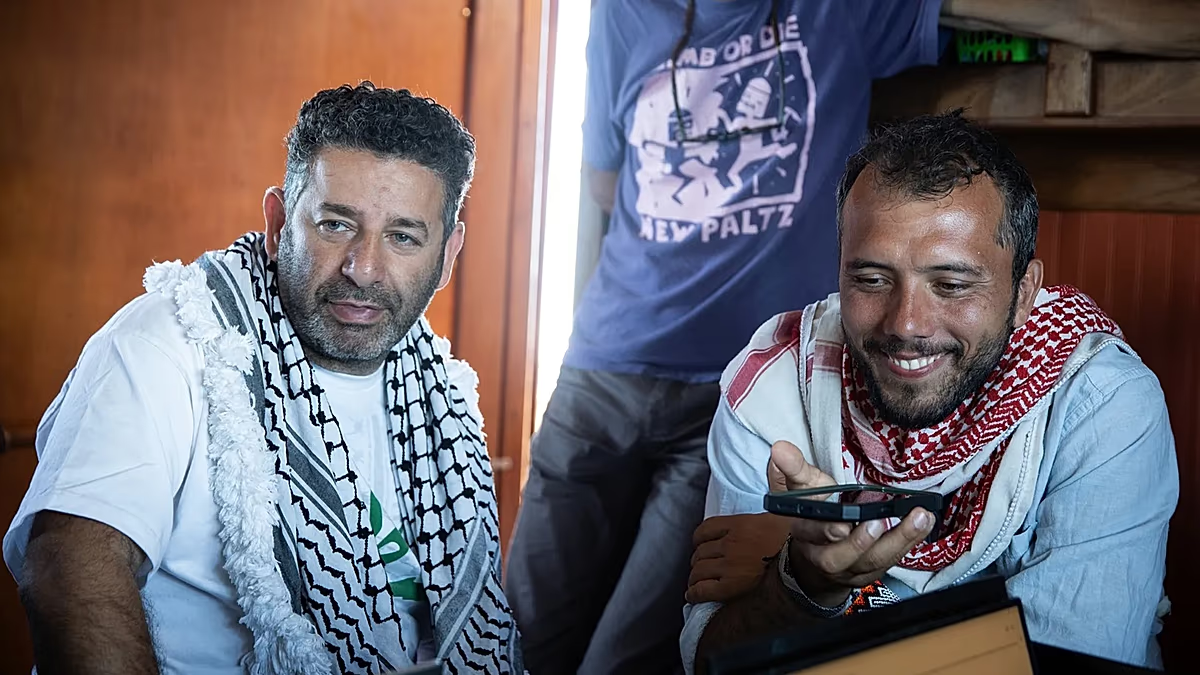
The United Nations has issued a forceful and urgent appeal to Israel, demanding the immediate and unconditional release of two humanitarian activists detained from an international aid flotilla bound for Gaza. Saif Abukeshek, a Spanish national, and Thiago Avila, a Brazilian citizen, are currently being held without charge in an Israeli prison in Ashkelon. Their detention stems from a maritime mission of solidarity, where their vessel, along with others sailing from France, Spain, and Italy, was intercepted by Israeli forces in international waters off the coast of Greece. The UN’s call underscores a fundamental principle: delivering humanitarian aid is not a criminal act. As UN rights office spokesman Thameen Al-Kheetan stated, it is an act of compassion aimed at reaching a Palestinian population in Gaza enduring catastrophic conditions and dire need. This incident raises profound questions about the legality of intercepting civilian ships in international waters and the criminalization of peaceful humanitarian efforts.
The circumstances of the activists’ detention are shrouded in alarming allegations of abuse. Representatives for Avila and Abukeshek have accused Israeli authorities of severely mistreating the two men, who have now resorted to a hunger strike in protest—a desperate measure that has lasted six days and highlights their deteriorating condition and sense of injustice. Kheetan echoed these grave concerns, citing “disturbing accounts of severe mistreatment” and calling for a prompt and impartial investigation. He insisted that “those responsible must be brought to justice,” framing the issue not merely as a diplomatic dispute but as a potential violation of human rights and bodily integrity. The hunger strike adds a layer of acute urgency to the UN’s demands, transforming the situation from a political standoff into a rapidly escalating health and humanitarian crisis for the detained individuals.
Beyond the immediate fate of these two men, the UN statement confronts broader systemic issues in Israel’s policies. Kheetan explicitly called for an end to Israel’s use of arbitrary detention and its application of “broadly and vaguely defined terrorism legislation,” arguing that such practices are inconsistent with international human rights law. This criticism strikes at the heart of a recurring tension: the balancing of state security concerns with the protection of fundamental freedoms and the right to peaceful protest. Furthermore, the spokesman directly challenged the overarching framework of the blockade itself, urging Israel to “end its blockade on Gaza, and allow and facilitate the entry of humanitarian assistance.” This positions the activists’ ordeal not as an isolated event, but as a direct consequence of a 17-year-long closure that has collectively paralyzed Gaza and made external aid missions seem necessary to many in the international community.
Israel’s official response has been one of firm dismissal and strategic redirection. Foreign Minister Gideon Sa’ar announced that the activists intercepted from the flotilla would be transferred to Greece, thanking the Greek government for its cooperation. He reiterated the state’s unwavering position: “Israel will not allow the breach of the lawful naval blockade on Gaza.” This stance is rooted in long-standing security arguments, with Israel contending that such blockades are essential to prevent the smuggling of weapons to Hamas and other militant groups. Historically, Israeli authorities have routinely characterized these aid flotillas as “provocative” publicity stunts, a sentiment echoed by Israel’s former Ambassador to the UN, Danny Danon. This narrative frames the activists not as humanitarians, but as willing pawns or agitators seeking to undermine Israel’s security posture, thereby justifying their interception and detention.
This clash of narratives—humanitarian solidarity versus national security provocation—creates a nearly insurmountable impasse. For the activists and their supporters, the mission is a moral imperative, a direct challenge to a blockade that has contributed to widespread poverty, unemployment, and dependency in Gaza. For the Israeli government, it is a defiance of a legally enforced perimeter, a potential threat to be neutralized. The transfer of the detainees to Greece, while possibly de-escalating the immediate confrontation, does not resolve the underlying dispute. It sidesteps the central allegations of mistreatment and arbitrary detention, leaving the UN’s calls for investigation and justice unanswered. The episode thus becomes another data point in a chronic cycle: a flotilla sets sail, is intercepted, sparks international condemnation, and ends without addressing the foundational issue of Gaza’s isolation.
Ultimately, the detention of Saif Abukeshek and Thiago Avila is a microcosm of a larger, enduring tragedy. It is a story about the lengths to which individuals will go to alleviate suffering, and the forceful measures states will employ to maintain control. The UN’s intervention highlights the failure of existing mechanisms to protect humanitarian action and hold power to account. As these two men continue their hunger strike, their personal plight amplifies a collective cry for a fundamental reevaluation. The path forward requires moving beyond cyclical confrontations to address the root causes: ensuring rigorous adherence to international law, guaranteeing humane treatment for all detainees, and finding a sustainable, lawful solution for the flow of aid to Gaza. Until then, the waters of the Mediterranean will remain a stage for this painful contest between the duty to provide relief and the prerogative to impose a blockade.