



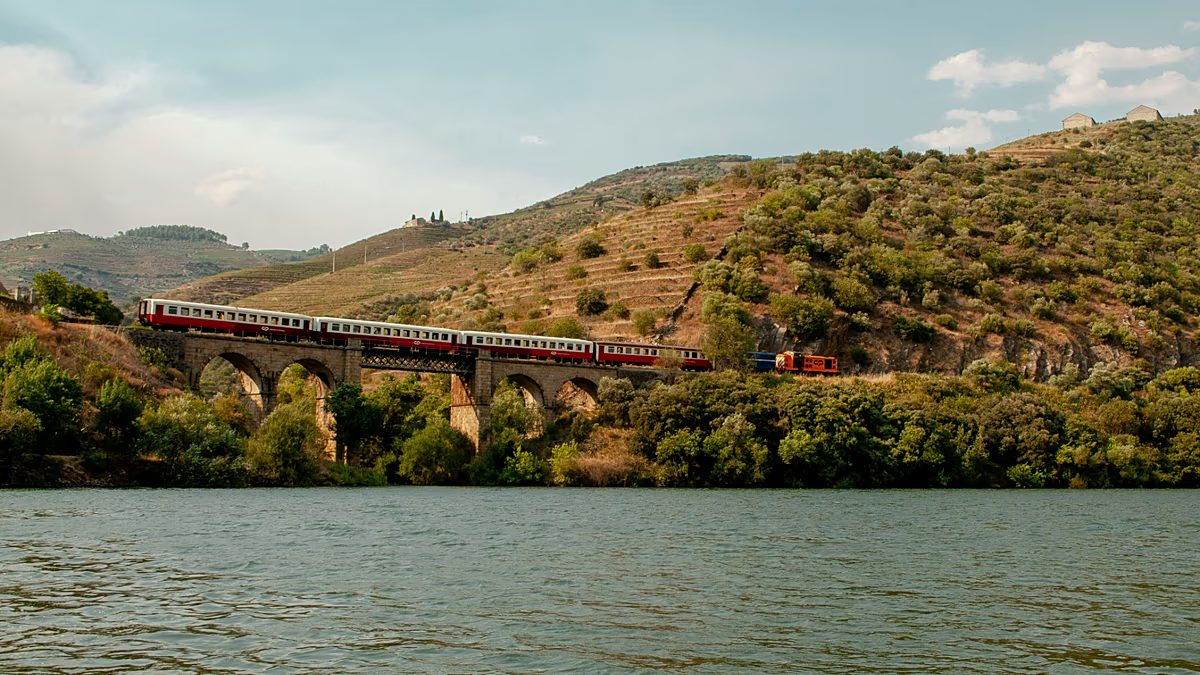
Europe’s natural wonders—its national parks and UNESCO-protected landscapes—often conjure images of remote wildernesses accessible only by car. Yet, this assumption overlooks a quieter, more sustainable reality: many of these pristine places are, in fact, beautifully connected by rail. Trains offer not just a practical alternative but often the preferred mode of entry, aligning with conservation goals and enhancing the travel experience itself. Across Europe, protected areas are increasingly implementing car management strategies—such as traffic quotas and parking reservations—to safeguard fragile ecosystems and manage visitor numbers. As Rail Europe notes, in these destinations, “rail is not an alternative mode of transport: it can be the defining way in, enabling access while supporting long-term conservation.” By choosing the train, travelers reduce environmental impact, avoid access hassles, and immerse themselves in the journey as part of the adventure. Here are four magnificent national parks that exemplify how rail opens the door to Europe’s most stunning natural treasures.
First, consider the dramatic coastline of France’s Calanques National Park, where limestone cliffs meet crystalline Mediterranean waters. This immensely popular park draws up to three million visitors annually, prompting authorities to introduce vehicle quotas and parking reservations to mitigate overtourism. Arriving by train, especially during the busy summer months, becomes not only a responsible choice but a stress-free one. The eastern calanques are accessible from Cassis station, a gateway with direct or easy connections from Paris, Lyon, Nice, and across southern France. From Cassis, a scenic thirty-minute walk leads to the nearest calanque, Port-Miou—a stroll that Rail Europe describes as “particularly scenic and very much part of the experience.” This approach transforms the arrival into a gentle prelude to the park’s wonders, setting the tone for a day of hiking, boating, or diving amid breathtaking coastal geology.
In Austria, the immense Hohe Tauern National Park—a realm of glaciers, waterfalls, and peaks exceeding 3,000 meters—deliberately limits road infrastructure to preserve its high-alpine serenity. Its vast expanse spans three federal states, making the train one of the most straightforward and efficient ways to enter. Three key stations serve as natural gateways. Mallnitz-Obervellach station, situated on a major north-south rail corridor, is just a fifteen-minute walk from a national park center and offers direct access to the Mallnitz valley, with connections to cities like Salzburg, Munich, and Vienna. Zell am See station, a short bus ride from the park boundary, links travelers to Salzburg and Innsbruck. Lienz station, near the southern perimeter, provides access via regional services to Salzburg and northern Italy. This rail network seamlessly integrates the park into the European travel grid, inviting visitors to step directly from the platform into an alpine paradise.
Germany’s Saxon Switzerland National Park, famed for its majestic sandstone formations and forested valleys, welcomes over 1.7 million visitors each year. To protect its delicate habitats, car access is restricted in core areas, elevating rail as the ideal entry point. Bad Schandau station is proudly designated the ‘national park station,’ placing travelers within walking distance of numerous trailheads that lead into the heart of the Elbe Sandstone Mountains. From here, trains connect directly to major German cities like Berlin, Dresden, and Hamburg, as well as to Prague across the border. This direct rail link means that the journey itself becomes a tranquil transition from urban centers to a landscape of towering rock pillars and verdant gorges, emphasizing how train travel can effortlessly bridge the gap between city and wilderness.
For those who wish to savor natural splendors from the comfort of their seat, the Bernina Express offers an unforgettable rail journey through an alpine wonderland. This iconic route, part of the UNESCO-listed Rhaetian Railway, connects St. Moritz in Switzerland with Tirano in Italy. Over approximately 2.5 hours, the train traverses a constantly shifting panorama: frozen lakes in winter, lush meadows in summer, and golden larch forests in autumn. It climbs to the Bernina Pass at 2,253 meters, granting passengers awe-inspiring views of the Lago Bianco and surrounding glaciers. This experience underscores that train travel need not be merely about reaching a destination; it can itself be a profound encounter with nature, where the landscape unfolds as a living spectacle through the window.
Ultimately, these examples illustrate a growing paradigm in European travel: the train as a conduit to nature. Choosing rail aligns with the environmental ethos of many protected areas, reduces congestion, and often provides a more direct and serene arrival than navigating restricted car access. It redefines the journey, making the transition from city to wilderness a mindful, scenic, and low-impact process. As conservation efforts intensify across Europe’s precious landscapes, rail infrastructure stands as a vital partner, offering access that supports rather than strains these fragile regions. In embracing the train, travelers not only enhance their own experience but contribute to the long-term preservation of the very wonders they seek to enjoy, ensuring that Europe’s natural heritage remains vibrant for generations to come.