



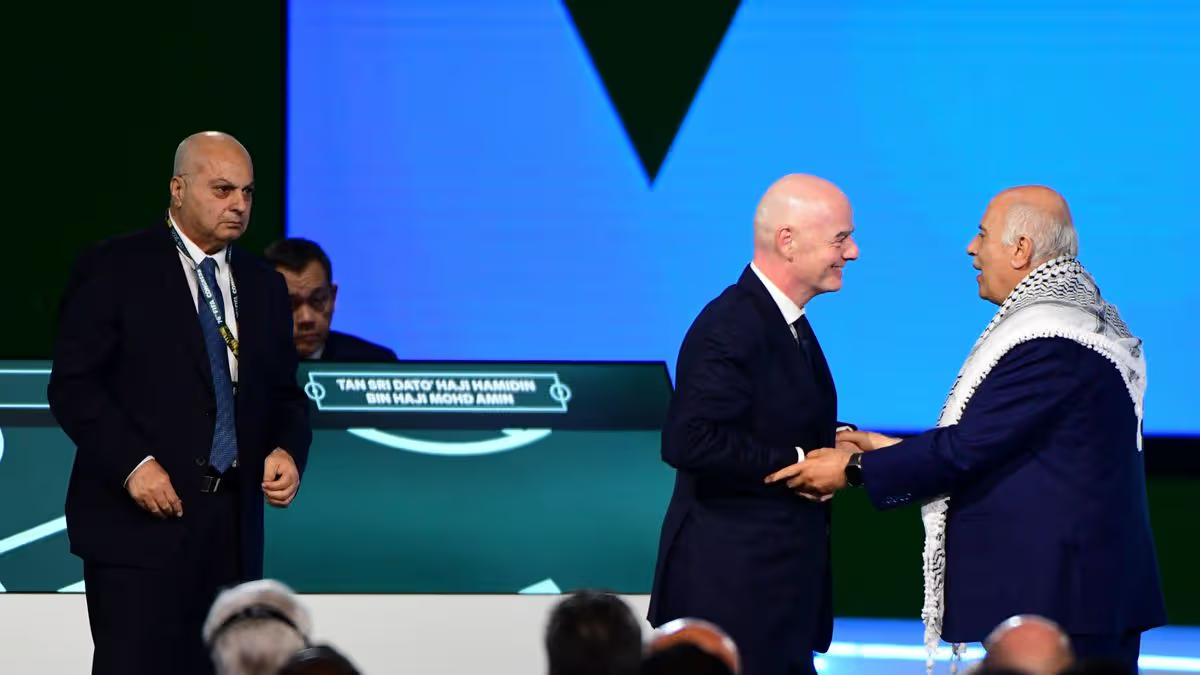
In the grand, often theatrical arena of global sports diplomacy, the 76th FIFA Congress in Vancouver was intended to be a celebration of football’s unifying power ahead of the 2026 World Cup. Instead, it became a stark stage for the painful political realities that the beautiful game cannot escape. At the heart of the discord was FIFA President Gianni Infantino, who, after confirming his intention to run for an unprecedented third term, attempted to orchestrate a symbolic handshake between the heads of the Israeli and Palestinian football associations. This gesture, meant to project an image of reconciliation and statesmanship, dramatically backfired. As cameras rolled, Palestinian Football Association President Jibril Rajoub refused to stand beside Israeli FA Vice-President Basim Sheikh Suliman. Instead, Rajoub addressed the assembly with a raw, emotional declaration: “We are suffering.” In that moment, the carefully managed spectacle of international sport collided with an unresolved humanitarian catastrophe, leaving Infantino visibly embarrassed and highlighting the profound limits of symbolic politics in the face of immense human suffering.
The context for this refusal is a conflict of devastating scale and duration. As the Congress met, the war in Gaza was approaching a grim third anniversary, a period marked by catastrophic loss of life and human suffering. Citing figures from the British Red Cross, the report notes a death toll exceeding 69,000, which includes 17,000 children, with at least 170,000 casualties. This is the backdrop against which Rajoub and his delegation operate; for them, a handshake is not a simple act of sportsmanship but a potential act of normalization with a political entity they accuse of atrocities. Palestinian FA Vice President Susan Shalabi’s subsequent comments to Reuters crystallized this stance, stating she could not shake hands with someone brought to “whitewash their fascism and genocide.” The attempted gesture, therefore, was not seen as a peace offering but as a painful trivialization of their ongoing national trauma, reducing a profound humanitarian crisis to a photo opportunity.
For Gianni Infantino, the failed handshake represents another in a series of public relations missteps that have characterized his tenure, where ambitious political maneuvering often meets complex geopolitical ground. Having ascended to the presidency in the wake of the Sepp Blatter scandals, Infantino has frequently positioned himself as a global dealmaker, most infamously defending the Qatar World Cup with his “Today I feel” speech. His attempt to broker a public display between Israel and Palestine fits this pattern—a high-profile, theatrical bid to cast himself and FIFA as forces for unity. Yet, by not fully grappling with the raw emotions and political convictions of the delegates involved, the move appeared tone-deaf and clumsy. His recovery attempt, urging the parties to “work together to give hope to the children,” while well-intentioned, rang hollow in the immediate aftermath of the confrontation, underscoring the immense gap between diplomatic platitudes and lived reality.
The Congress controversy was not an isolated incident but part of a broader tapestry of challenges threatening to overshadow the upcoming 2026 World Cup in North America. The event itself was marred by the conspicuous absence of any delegation from Iran, the only member association not represented. Reports indicated that Iranian officials were turned back at the Canadian border, a logistical and diplomatic snarl that casts a shadow over Iran’s scheduled participation in the tournament. Their place in Group G, alongside New Zealand, Belgium, and Egypt, remains under a cloud of uncertainty, intertwining visa issues with the volatile politics of the region. Infantino has publicly insisted Iran will compete, and even received a characteristically rambling endorsement from former U.S. President Donald Trump, who called Infantino a “friend” and said, “You do whatever you want.” Yet, the episode highlights how geopolitical tensions persistently intrude upon FIFA’s operations, challenging its claim to be an apolitical sanctuary for sport.
Beyond the immediate political fractures, the Congress also served as a reminder of FIFA’s perpetual balancing act between its sporting ideals and its commercial ecosystem. The report’s concluding shift to a promotional detail about broadcaster Sky’s upgraded television packages—bundling sports with streaming giants like Netflix and Disney+—feels jarring yet is fundamentally linked. This commercial engine funds the global spectacle, but the preceding drama illustrates that the game cannot be insulated from the world’s conflicts. The money, the media rights, and the political stakes are all inextricably linked. The vision of a seamless, unified World Cup festival is constantly tested by events like those in Vancouver, where the pain of the real world interrupts the curated narrative of global football.
Ultimately, the 2026 FIFA Congress will be remembered less for procedural milestones and more for a moment of unfiltered truth. Jibril Rajoub’s impassioned refusal and the palpable tension on stage served as a powerful metaphor. They demonstrated that football, for all its capacity to inspire and unite, cannot force reconciliation where deep wounds remain open. As the world’s eyes turn toward the 2026 World Cup, hoping for a festival of sport, the events in Vancouver are a sobering reminder. The beautiful game does not exist in a vacuum; it is a mirror reflecting our world’s most enduring conflicts, its most heartfelt sufferings, and the often-futile attempts to bridge divides with symbolism alone. The path to true unity requires not just staged handshakes, but a genuine, sustained engagement with the very hardships that the “We are suffering” cry so powerfully conveyed.