



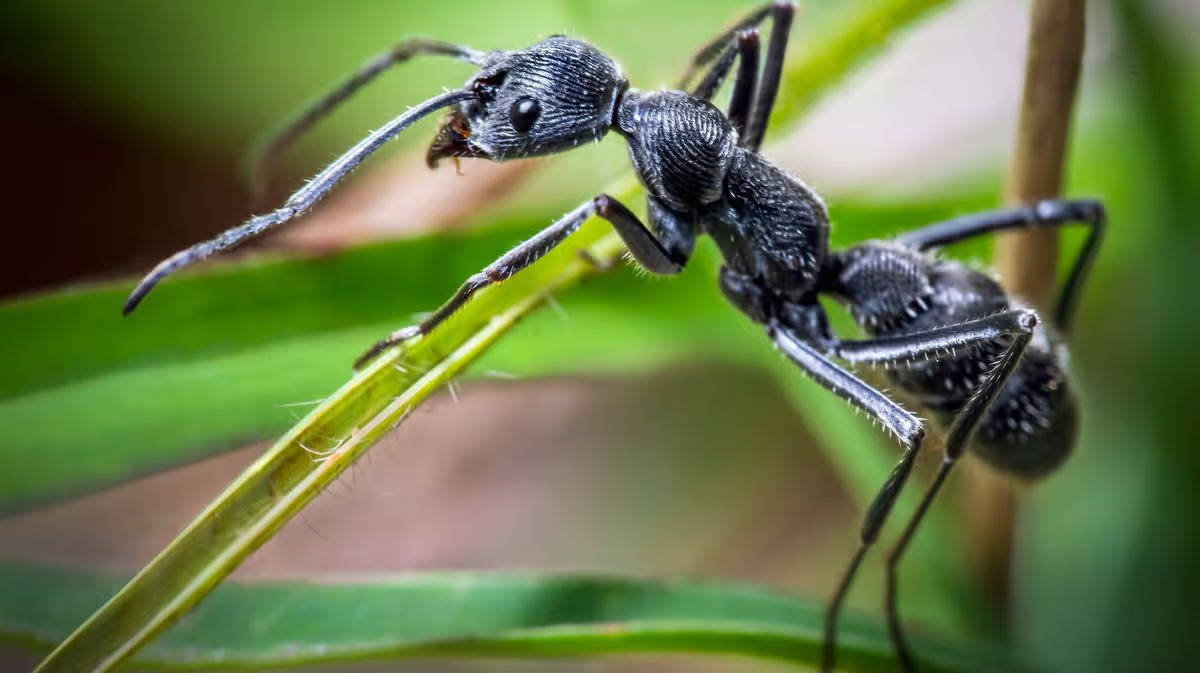
As the chill of winter retreats and the first true warmth of spring settles across the United Kingdom, a familiar annual phenomenon unfolds. From late March through April, gardens, patios, and even the interiors of homes begin to see the determined march of ants. This seasonal surge is not an invasion from afar, but rather the reawakening of local colonies from their winter dormancy. During the colder months, ants enter a state of reduced metabolic activity, often clustering deep within their nests to conserve energy. With the rising temperatures and longer days of spring, they emerge en masse, driven by a powerful instinct to forage and expand their colonies. This sudden, visible activity is why pest control services, such as Pest UK, report a significant spike in enquiries during April. Homeowners are often dismayed to find trails of these tiny insects winding across kitchen counters, gathering around pet food bowls, or forming bustling highways along garden paving slabs.
This springtime emergence is as much a matter of climate as it is of calendar. Ants are highly sensitive to temperature, and their early spring behavior is strategically linked to survival. As Pest UK experts note, while the air may feel pleasantly mild to us, the soil can remain surprisingly cold. This discrepancy often drives the first waves of ant scouts indoors, seeking the consistent warmth and potential food sources our homes provide. Furthermore, controlling ants in early spring presents a unique challenge. The ants’ metabolisms are still operating at a slower pace, meaning they feed less frequently. Any insecticide treatments that rely on ingestion can therefore take longer to become effective. Compounding this is the fact that the entire nest may not be active simultaneously; only a portion of the colony might be foraging initially, requiring time for the treatment to reach the queen and the broader population hidden deep within the nest.
A critical insight for anyone dealing with ants is understanding that the visible trail is often a collaborative effort between multiple colonies. Ants are master communicators, laying down chemical highways known as pheromone trails to signal profitable food sources. A strong trail leading to a dropped piece of fruit or a sticky spillage can attract ants from several different nests in the vicinity. This is why simply locating and destroying a single nest, perhaps in a garden wall or under a patio stone, may only provide temporary relief. The pheromone trail remains, and ants from other colonies will continue to follow it. Professional pest controllers approach this systematically, typically employing a combination of methods such as targeted insecticide baits, residual sprays, and insecticidal dusts. The goal is not just to kill the visible foragers, but to break the cycle of communication and ensure the treatment is carried back to the heart of multiple nests, ultimately eliminating the reproducing queens.
For those who prefer a DIY approach before calling in the professionals, a number of effective homemade solutions exist, utilizing common household items. One popular method, detailed by real estate expert Thach Nguyen, functions on the same principle as commercial bait traps: enticing the ants to carry poison back to their nest. The recipe combines a quarter cup of sugar, three-quarters of a tablespoon of a borax substitute (as pure borax is not readily available for public sale in the UK), and three-quarters of a cup of water. The sugar acts as a powerful attractant, while the borax substitute interferes with the ants’ digestive systems. Soaked cotton balls placed near ant trails become irresistible feeding stations. Foraging ants consume the mixture and, crucially, share it with the colony back in the nest, including the queen. This can lead to the collapse of the entire colony within a few days.
It is important to emphasize that the key ingredient in this homemade bait, borax (sodium tetraborate), must be sourced as a designated “borax substitute” from retailers like Amazon or hardware stores, as it is not marketed for domestic pest control in UK supermarkets. While effective, such mixtures should be used with caution, placed out of reach of children and pets. Alternative natural deterrents include creating barriers with substances ants avoid crossing, such as diatomaceous earth (a fine powder that damages their exoskeletons), lines of chalk, cinnamon, or citrus peels. Maintaining impeccable cleanliness—wiping up spills immediately, storing food in airtight containers, and managing waste—removes the attraction in the first place. Sealing obvious entry points like cracks in foundations, gaps around windows, and spaces around utility pipes can also significantly reduce indoor incursions.
Ultimately, the springtime appearance of ants is a natural part of the UK’s ecological rhythm, a sign of a warming world bustling with life. While they can undoubtedly become a nuisance, understanding their behavior is the first step toward effective management. Whether through professional intervention, carefully deployed homemade baits, or preventative household hygiene, the goal is coexistence rather than total eradication. By targeting the source of the problem—the central colony—rather than just the visible workers, and by removing the incentives for them to enter our homes, we can navigate ant season with minimal disruption, allowing us to enjoy the brighter days of spring without sharing our kitchen with uninvited six-legged guests.