




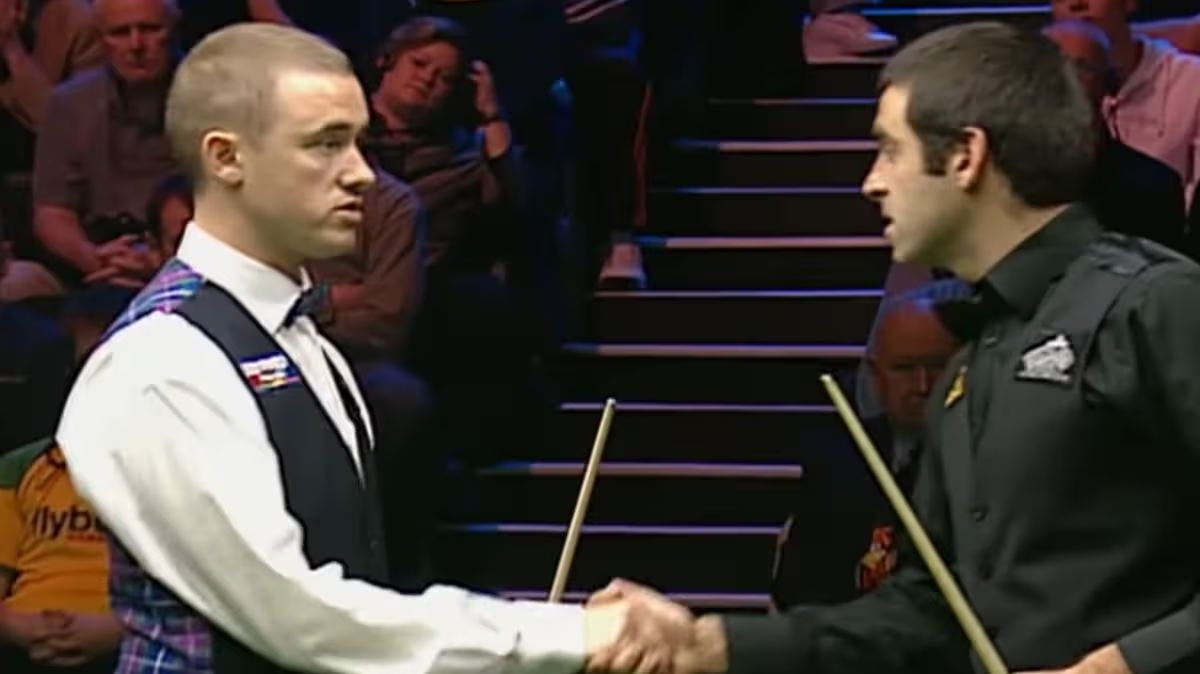
In the often genteel world of professional snooker, where sportsmanship is typically held in the highest regard, the fierce rivalry between Ronnie O’Sullivan and Stephen Hendry has occasionally boiled over into public acrimony. One of the most memorable and startling moments of needle occurred in 2002, when O’Sullivan, known as ‘The Rocket’, launched a seven-word verbal missile that left the usually unflappable Hendry blindsided. On the eve of their World Championship semi-final clash at the Crucible Theatre, O’Sullivan told reporters his most satisfying outcome would be to send Hendry home to Scotland, adding the stinging barb: “Well done, go back to your sad little life.” This was not mere pre-match hype; it was a deeply personal slight that revealed a simmering resentment dating back several years, catching Hendry completely off-guard and transforming their professional competition into something far more personal.
The root of O’Sullivan’s animosity stemmed from a specific incident during their previous Crucible semi-final encounter in 1999, involving the contentious “miss” rule. O’Sullivan felt Hendry had exploited a referee’s decision against him, calling for a ball to be replaced when O’Sullivan believed a genuine attempt had been made. This single act, in O’Sullivan’s view, was a breach of unspoken etiquette and respect between top players. It fundamentally altered his perception of Hendry, a player he had previously held in high esteem. That lingering frustration festered for three years, finally erupting in his blistering pre-match comments in 2002. For O’Sullivan, this was not just about winning a match; it was about delivering a form of poetic justice for a past grievance he felt had crossed a line.
For Stephen Hendry, the reigning king of snooker at the time with seven world titles to his name, the very public insult was a profound shock. He learned of O’Sullivan’s words when his road manager brought a newspaper to his hotel room, and the revelation left him bewildered. Hendry had believed the two shared a cordial, mutually respectful relationship. The attack felt deeply personal and unprovoked, introducing a rare and palpable sense of “needle” into one of his matches. This personal edge, however, seemed to elevate Hendry’s game to an almost mythical level during that 2002 semi-final. Reflecting on the match years later, Hendry confessed he never played better at the Crucible, describing it as a fantastic display of aggressive, attacking snooker from both men—a masterpiece born from intense personal friction.
Despite the bitterness of that era, the passage of time has healed these wounds, transforming one of snooker’s great rivalries into one of its most respected friendships. The dynamic between O’Sullivan and Hendry today is a testament to maturity and their shared legacy as the sport’s most successful players. O’Sullivan, who has since matched and surpassed Hendry’s record tally of world titles, now frequently appears as a guest on Hendry’s Cue Tips podcast, offering insights and banter. He has publicly anointed Hendry as the greatest player to ever pick up a cue, a monumental compliment from one genius to another. Their encounters now, such as a recent exhibition match under ‘Snooker 900’ rules, are characterized by camaraderie and a shared appreciation for their historic roles in the game.
This journey from animosity to amity highlights a universal truth in sports: intense competition, especially between two alpha personalities at the peak of their powers, can generate heat that feels very real in the moment. The pressure cooker of the World Championship, where legacies are forged, amplified every slight and every perceived disrespect. What seemed like an irreparable rift in 2002 has been contextualized by history as a fiery chapter in a much longer story. Their relationship is now built on a foundation of unparalleled mutual achievement—a combined 14 world championships—and the understanding that only they can truly comprehend the pressures and loneliness of dominating a sport for decades.
Ultimately, the story of O’Sullivan’s “sad little life” remark is more than a juicy piece of snooker trivia; it is a compelling narrative about rivalry, respect, and reconciliation. It showcases the human emotions that fuel elite athletes, proving that even the most calculated and composed competitors are driven by passion and perception. The fact that these two icons can now look back on that moment, not with lingering bitterness but with a sense of nostalgic rivalry, speaks volumes about their character. Their evolution from foes to friends enriches the tapestry of snooker history, reminding fans that the greatest stories in sport are not just about trophies and breaks, but about the complex, evolving relationships between the people who win them.