



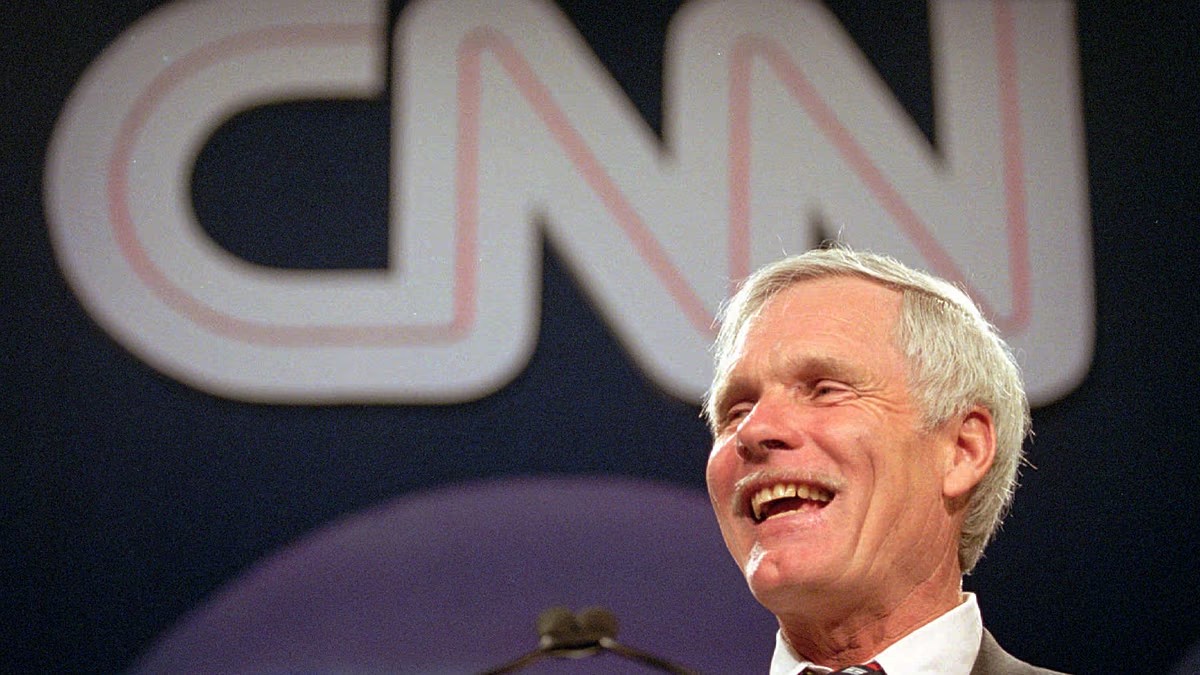
The world of media and philanthropy lost a truly colossal figure this week. Ted Turner, the visionary and often controversial entrepreneur who fundamentally reshaped how we consume news and information, has died at the age of 87. The announcement, fittingly delivered by his own creation, CNN, marked the end of a life that was as bold and unpredictable as the man himself. Known to the public by nicknames like “Captain Outrageous” and “The Mouth of the South,” Turner was a force of nature—a yachtsman, sports mogul, relentless philanthropist, and a media revolutionary who never seemed to operate by anyone else’s rules.
Turner’s most enduring legacy, without question, is the creation of the Cable News Network (CNN) in 1980. At the time, the concept of a television channel dedicated solely to news, operating 24 hours a day, was considered not just risky, but practically absurd by the established broadcasting giants. Yet Turner saw a future where information was constant and immediate. He upended the entire industry, moving news from scheduled bulletins into a continuous, living stream. This vision was spectacularly validated during the Gulf War in 1990-1991, when CNN correspondents, staying in Baghdad as others fled, provided the world with unprecedented live coverage of a conflict in real time. This principle of being on the ground for history’s pivotal moments defined the network, from the fall of the Soviet Union to events in Tiananmen Square, making CNN a global household name.
His ambitions, however, stretched far beyond the newsroom. Turner built an entire television empire that reflected his own eclectic passions. He expanded his portfolio to include TBS and TNT, bringing sports and entertainment to a national cable audience. With Turner Classic Movies, he championed the preservation and celebration of cinematic history, and with the Cartoon Network, he tapped into the universal language of animation and fun. This was a man who owned professional baseball and basketball teams in Atlanta, and who personally defended the America’s Cup in 1977, blending his business acumen with his personal zeal for competition and sport.
Parallel to his commercial pursuits was a profound commitment to philanthropy, particularly on a global scale. In a move that stunned the world, Turner pledged one billion dollars to support United Nations charities and causes, an act that cemented his role as a citizen of the world, not just a businessman. This generosity, combined with his very public personal life—including his marriage to actress Jane Fonda—completed the picture of a man who lived at a tremendous scale, equally capable of fierce boardroom negotiations and monumental acts of goodwill.
Yet, the story of Ted Turner is not without its notes of corporate poignancy. After selling his company to Time Warner in a landmark $7.3 billion deal, he found himself gradually marginalized, despite assurances of a continuing role. This phase of his life reminds us that even the most powerful visionaries can be overtaken by the structures they help build. In his later years, he faced the private challenge of Lewy Body Dementia, a degenerative disease. Despite these trials, his foundational impact remained untouched, a fact honored by current CNN leadership, who acknowledged him as “the giant on whose shoulders we stand” and “the presiding spirit of CNN.”
Ted Turner’s life was a testament to the power of relentless imagination and the courage to defy convention. He transformed our media landscape from a static, scheduled institution into a dynamic, ever-present companion. He proved that business success could be married with deep humanitarian commitment, and he lived with a passion that made him a legend both in and out of the public eye. While the constant news cycle he invented will continue without him, its origin point—and the audacious spirit that launched it—will forever be marked by the name Ted Turner.