




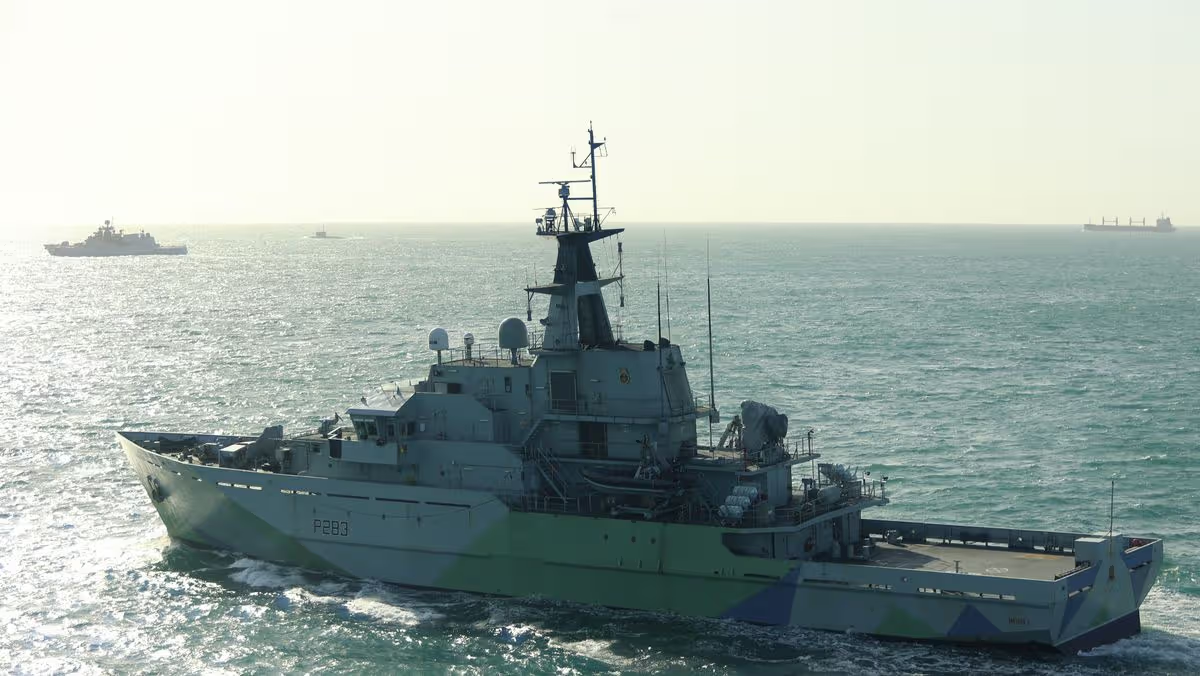
For the entire month of April, a tense and silent ballet unfolded in the grey waters off the coast of the United Kingdom. The Russian Navy’s frigate, the Admiral Grigorovich, a modern and capable warship, found itself under an unblinking, round-the-clock watch. This was not a fleeting encounter but a sustained and deliberate operation by the Royal Navy, one described by sources as among the most intense shadowing missions of the past decade. The mission, involving a rotating cast of the UK’s patrol ships—HMS Tyne, HMS Mersey, and HMS Severn—supported by the tanker RFA Tideforce and Wildcat helicopters, ensured there was not a single day in April where the Russian vessel or its companions moved without a British shadow. This persistent vigil, stretching from the Western Approaches to the North Sea, signified far more than routine monitoring; it was a direct and visible response to escalating Russian posturing and a stark symbol of the heightened tensions between London and the Kremlin.
The Admiral Grigorovich was not merely on a solitary cruise. Its activities provided a clear insight into Russian strategic movements. The frigate served as an escort, shepherding a small flotilla of around six Russian-flagged merchant and support vessels, and even a submarine, between the Atlantic, Mediterranean, and Baltic. Notably, it paused to resupply near critical national infrastructure, such as the Galloper wind farm off the Suffolk coast—a move interpreted as both a tactical necessity and a deliberate demonstration of presence near sensitive sites. This pattern of activity fits a well-established and concerning Kremlin strategy of using military assets to test NATO response times, probe defences, and gather intelligence on key maritime routes and energy installations, all while normalizing their presence in waters close to Allied nations.
This surface operation coincided with even more covert Russian activity beneath the waves. Just weeks prior, UK and Norwegian forces had intercepted a month-long underwater mission involving three Russian submarines, including specialist vessels from the secretive Main Directorate for Deep-Sea Research (GUGI). These submarines were caught surveying critical undersea infrastructure, such as data cables and energy pipelines, north of the UK. While no damage was caused, the intent was unmistakably one of hostile reconnaissance, mapping vulnerabilities for potential future disruption or sabotage. UK Defence Secretary John Healey issued a stern public warning to Moscow, stating, “We see your activity… and you should know that any attempt to damage them will not be tolerated and will have serious consequences.” The shadowing of the Grigorovich was, in part, the tangible manifestation of that warning—a show of vigilance and resolve.
The context for these encounters is a relationship that has grown progressively frostier since Russia’s full-scale invasion of Ukraine in 2022. The UK has been a leading provider of military aid to Kyiv, a stance that has drawn repeated threats and hostile rhetoric from Moscow. This naval shadowing echoes similar confrontations in the skies, where RAF Typhoon jets are routinely scrambled to intercept Russian spy planes approaching UK airspace. Each incident—whether in the air or at sea—forms a single point in a long campaign of pressure testing, where Russia seeks to identify weaknesses and demonstrate its reach, while NATO allies demonstrate their unwavering preparedness and collective deterrence.
Speaking on the prolonged April operation, Fleet Commander Vice Admiral Steve Moorhouse praised the Royal Navy crews for their “professionalism, resilience and operational readiness.” He emphasized that the sustained effort reflected the Navy’s ability to “generate combat-credible forces at readiness,” maintaining an “unbroken posture” through coordinated action. This language underscores that the mission was a successful demonstration of seamless, persistent maritime security. It was a proof of concept under real-world conditions, showing that the UK could tirelessly monitor a potential threat for weeks on end, seamlessly handing over watch between ships and aircraft without losing track.
Ultimately, the month-long tailing of the Admiral Grigorovich transcends a simple story of one ship following another. It is a microcosm of the new, ongoing cold war at sea. In an era where open conflict between nuclear powers is to be avoided, competition plays out in these grey zones—in the shadowing of warships, the mapping of cables, and the testing of air defences. The Royal Navy’s patient, professional, and persistent response sent a clear, dual message: to the British public, it was a reassurance of constant vigilance; to the Kremlin, it was a signal that every move is being watched, every provocation noted, and that the UK’s maritime frontiers remain firmly and diligently guarded. The waves may have appeared calm on the surface, but beneath them churned the deep currents of a geopolitical standoff, with watchful eyes ensuring it did not escalate beyond a tense and silent dance.