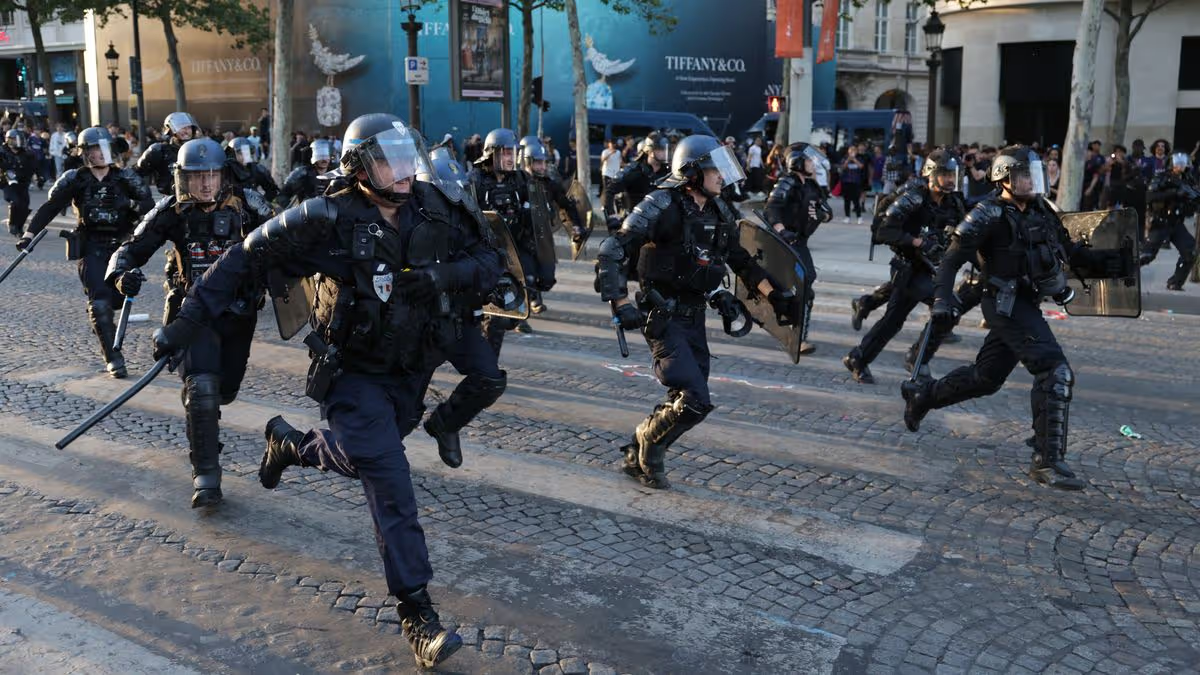




On a balmy Saturday afternoon in late May 2026, the eyes of the football world were fixed on Budapest, where Paris Saint-Germain and Arsenal contested the UEFA Champions League final. Yet, nearly a thousand miles away in Paris itself, a very different and deeply troubling contest was unfolding on the streets. As Arsenal’s Kai Havertz netted an early goal within the first five minutes, a corresponding spark of chaos ignited in the French capital. Almost simultaneously with the roar in the Hungarian stadium, clashes erupted between Parisian police and masses of PSG supporters who had gathered across the city to watch the match. The vibrant atmosphere of anticipation curdled into violence near the Parc des Princes stadium and beyond, marking the beginning of a long, tense night that would see the city’s celebration of sport overshadowed by disorder and fear.
The epicenter of the unrest quickly became the historic heart of Paris, in areas like Châtelet, nestled between the iconic Notre Dame Cathedral and the Louvre Museum. Here, thousands of fans had congregated outside bars and cafés, their faces lit by large television screens broadcasting the final. Witnesses described how the trouble began in earnest the moment Arsenal took the lead, with frustration boiling over into aggression. Chairs and bottles were hurled at lines of police officers, who responded with baton charges and clouds of tear gas to disperse the crowds. The scenes were a jarring contrast to the cultural grandeur of the surroundings, as the acrid smell of gas mixed with the sweltering summer heat and the sounds of the match broadcast, creating an atmosphere of palpable tension.
As the match progressed, so did the scale and audacity of the disturbances. In a dramatic turn, some PSG supporters scaled scaffolding on buildings near the prestigious Rue de Rivoli, a major shopping thoroughfare, taunting officers from above and leading to dangerous standoffs as police worked to bring them down. Elsewhere, skirmishes flared when some establishments, fearing the escalating violence, made the decision to turn off their televisions, further inflaming the crowds. Throughout the city, the terrifying bangs of fireworks—some reportedly aimed at police officers—echoed between buildings, punctuating the night with sounds of conflict rather than celebration. A massive security force of some 5,000 police and gendarmes was deployed, methodically conducting stop-and-searches, confiscating weapons and fireworks, and struggling to maintain a fragile order.
The final whistle in Budapest, confirming a PSG victory, did not bring peace to Paris; instead, it fueled further rampages by elated yet unruly fans. The victory celebrations morphed into destructive riots, with hooded youths seen engaging in running battles with riot police clad in full protective gear. The iconic Champs-Élysées, so often a venue for national triumph, became a stage for chaos. The situation grew particularly grave when a car, amidst the confusion and dense crowds, ploughed into a group of fans, a shocking incident that underscored the very real dangers of the night. By the time the chaos had subsided, authorities reported 39 arrests and an astonishing 1,600 people stopped and searched, a testament to the widespread nature of the unrest.
Tragically, this scene was not an isolated incident but part of a deeply worrying pattern of football-related violence in France. Just one year prior, PSG’s journey to the 2025 final was similarly marred by street battles, resulting in 43 arrests. More hauntingly, the club’s actual victory in that 2025 final was forever soured by post-match riots that led to two deaths and 500 arrests. This recurring narrative transforms what should be pinnacle moments of sporting achievement into occasions of public safety crisis, leaving communities on edge and authorities questioning how to break the cycle. The shadow of past tragedies loomed large over the 2026 events, a grim reminder that the human cost of such disorder is intolerably high.
In the end, the night of May 30, 2026, presented a stark dichotomy. In one reality, PSG players lifted the Champions League trophy, a hard-fought reward for athletic excellence. In another, parallel reality on the streets of their home city, their fans created a spectacle of fear, forcing a massive police mobilization and leaving a trail of damage and trauma. This contrast forces a sobering reflection on the culture surrounding the modern game. It highlights a urgent challenge for clubs, authorities, and society itself: to harness the incredible passion of football fandom and channel it away from destructive ends, ensuring that the beautiful game is celebrated in a spirit that honors, rather than tarnishes, the communities it inspires. The final score on the pitch was recorded in history, but the more complex and vital score of public safety and civic peace remains very much unsettled.