



In the relentless pursuit of more effective cancer treatments, a beacon of hope has emerged for patients facing one of the most challenging forms of the disease. A groundbreaking international trial, spearheaded by scientists at The Institute of Cancer Research (ICR) in London and conducted across 55 hospitals in 11 countries, has yielded what doctors are calling “unprecedentedly strong responses.” The focus is a novel triple-action injectable drug, amivantamab, which is showing remarkable promise in treating advanced head and neck cancers that have stubbornly resisted all other conventional therapies. For patients like Carl Walsh, who had exhausted standard options, this experimental treatment has transformed a desperate prognosis into a renewed chance for life.
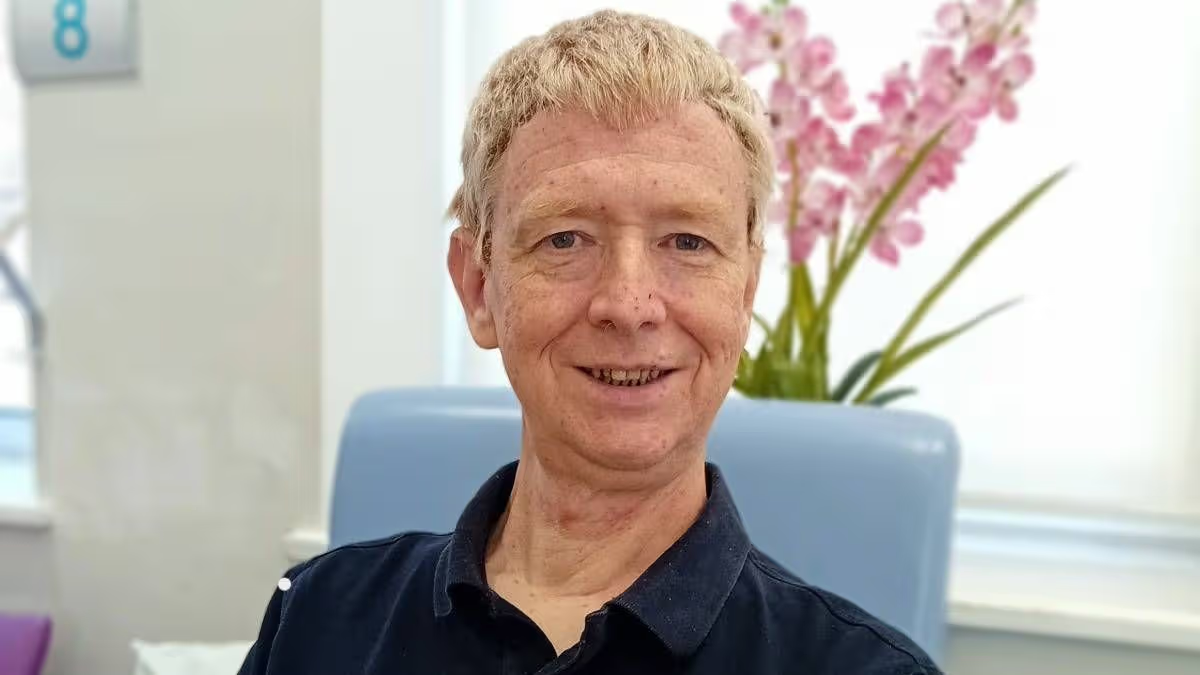
Carl’s story vividly illustrates the profound impact of this research. At 56, he faced the severe daily realities of advanced tongue cancer: difficulty speaking, agonizing pain, and an inability to eat solid food, surviving on a limited diet of soups and nutritional drinks. After initial chemotherapy and immunotherapy failed, his outlook was grim. Entering the OrigAMI-4 trial at The Royal Marsden hospital offered a lifeline. After just two cycles of the amivantamab injections, administered every three weeks, his diet began to normalize. Within six months, he celebrated a return to a full diet, his most cherished moment being “the first big steak.” The swelling and pain subsided significantly, his speech returned completely, and he regained the ability to work and communicate normally. Now on his seventeenth treatment cycle, Carl embodies the trial’s success, stating simply, “I now feel able to live a normal life.”
The scientific ingenuity behind this recovery lies in the drug’s multifaceted mechanism. Amivantamab is engineered as a precision triple-threat. Firstly, it blocks a crucial protein called EGFR, which many cancers exploit to grow and proliferate. Secondly, it inhibits a second pathway, MET, that tumour cells often activate as an escape route to evade targeted treatments. Finally, and perhaps most innovatively, the drug helps rally the patient’s own immune system to recognize and attack the cancer. This combined approach—directly starving the tumour of growth signals, cutting off its escape routes, and mobilizing the body’s natural defences—appears to be uniquely effective against resilient cancers.
The results from the trial, presented at the American Society of Clinical Oncology’s annual conference, are statistically compelling and deeply significant for a patient group with extremely limited options. The study involved 102 patients with aggressive head and neck cancers not linked to HPV, whose disease had progressed despite both chemotherapy and immunotherapy—a profile known for a poor prognosis. Among those receiving amivantamab, 42% (43 patients) experienced significant tumour shrinkage. Even more astonishing, within that group, 15 patients saw their tumours disappear entirely. These individuals, who had typically faced a rapidly declining future, survived for an average of 12.5 months after starting the injections, a considerable extension of life and quality of life in this clinical context.
The enthusiasm from the medical community underscores the potential scale of this breakthrough. Professor Kevin Harrington, an expert at the ICR and a consultant at The Royal Marsden, emphasized that these responses are unprecedented for this resistant patient population. He noted that this treatment “has the potential to benefit many thousands of patients [in the UK and Europe] each year,” a vital consideration given that approximately 12,800 people are diagnosed with head and neck cancer annually in the UK alone. Professor Kristian Helin, ICR chief executive, highlighted that the study shows how rigorous research can lead to “meaningful advances, even for patients with very limited treatment options,” representing a “significant step forward.”
Looking ahead, the journey of amivantamab is far from over. The drug, manufactured by Johnson & Johnson, has already gained NHS approval for certain types of non-small-cell lung cancer, validating its safety and efficacy profile. Its potential is now being explored in approximately 60 clinical trials worldwide, investigating its use not only in lung cancer but also in colorectal, brain, and gastric cancers. For the field of oncology, this trial represents a powerful testament to the evolution of cancer therapy—moving beyond single-target approaches to intelligent, combination biologics that outmanoeuvre the cancer’s adaptability. For patients like Carl Walsh, it represents something far more personal: the restoration of everyday joys, from a steak dinner to clear conversation, and the precious return to a normal life.