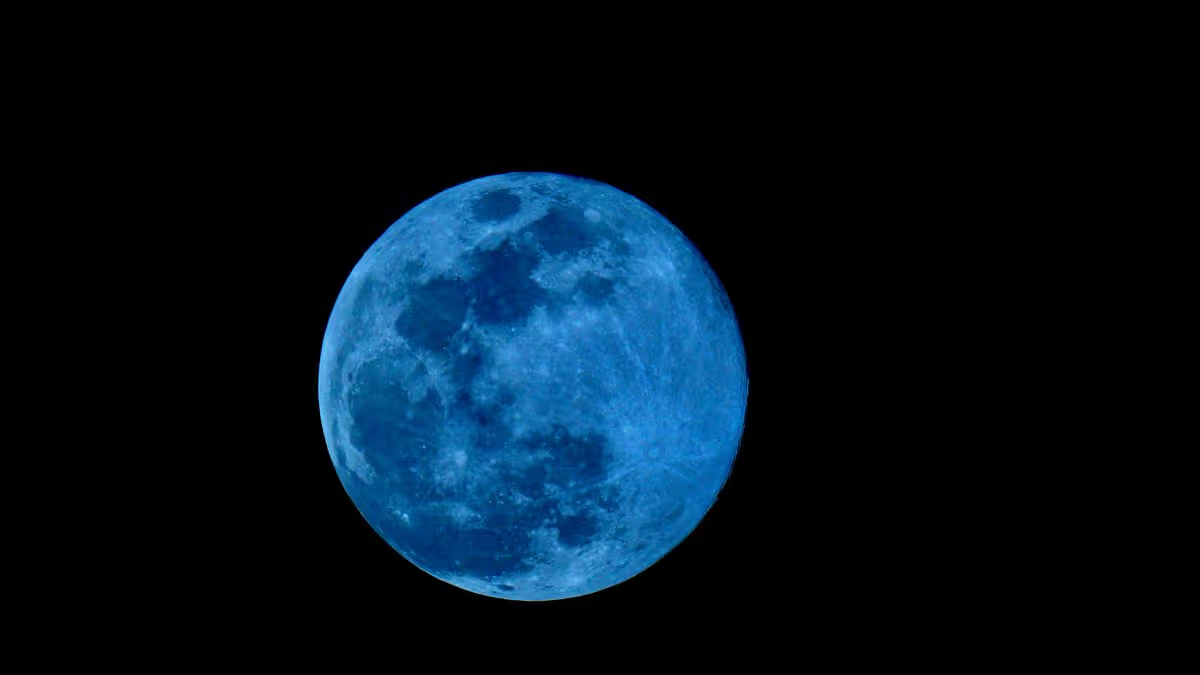




This weekend offers a rare celestial treat for stargazers: a blue moon. While the phrase “once in a blue moon” suggests an event of great rarity, it refers specifically to the second full moon occurring within a single calendar month. This particular phenomenon last graced our skies in August 2023, and it will next be visible on the night of Saturday, May 18th, 2024. Weather permitting, observers across the UK will be able to witness this special lunar event, which serves as a beautiful reminder of the rhythmic, yet occasionally surprising, dance of our cosmic neighbors.
Despite its evocative name, a blue moon is not typically blue in colour. As astronomy expert Alan Jones from 365 Astronomy explains, the term is purely calendrical. Our lunar cycle is roughly 29.5 days, while most calendar months are 30 or 31 days. This slight mismatch occasionally allows two full moons to be squeezed into one month, with the second earning the “blue” title. This weekend’s full moon will share the same characteristic grey-white hue of any other, etched with the familiar dark patches of the lunar maria. Its special status lies not in its colour, but in its timing, offering an extra dose of lunar brilliance within the span of a single month.
This May’s blue moon carries an additional layer of interest for astronomy enthusiasts, as it coincides with what is known as a “micromoon.” This occurs when a full moon happens near the apogee, the point in its elliptical orbit where it is farthest from Earth. As a result, it may appear slightly smaller and dimmer in the sky compared to a supermoon, which is the opposite phenomenon. While this difference is subtle to the naked eye, it highlights the moon’s non-circular path around our planet. For optimal viewing, the moon will reach peak illumination in the very early hours of Sunday, but the best opportunity for most observers will be on Saturday evening after sunset, as it rises low in the southeastern sky.
One of the most captivating aspects of any moonrise, including this blue moon, is the potential for dramatic colour shifts. As Alan Jones notes, when the moon sits near the horizon, its light must travel through a thicker layer of Earth’s atmosphere. This atmospheric filter scatters the shorter, bluer wavelengths of light, allowing the longer red and orange wavelengths to dominate. Consequently, a rising or setting moon can glow with stunning amber, copper, or even deep reddish hues. This, combined with the famous “moon illusion” that makes a low-hanging moon appear larger, can create a truly breathtaking sight, especially when framed by trees, buildings, or hills on the horizon.
For those eager to observe or photograph this event, the blue moon presents a perfect, accessible target. Casual stargazers can simply find a location with a clear view of the southeastern horizon, away from bright city lights. A simple pair of binoculars will dramatically enhance the view, revealing craters and lunar seas in striking detail. For photographers, incorporating terrestrial elements into the shot can convey the moon’s scale and create a compelling composition. Smartphones on tripods, using manual settings to reduce exposure, can capture impressive images. More dedicated astrophotographers might use telescopes to isolate the lunar disc, capturing the rugged beauty of its surface in crisp detail.
So, while this moon won’t be tinted blue, its rarity and celestial context make it a noteworthy occasion. It invites us to pause, look up, and engage with the night sky. In an age of constant artificial light, such events reconnect us with the natural rhythms that have guided humanity for millennia. Whether you step outside for a quiet moment of reflection, share the experience with family, or attempt to capture its image, the blue moon is a gentle prompt to appreciate the wonder happening right above our heads. Mark your calendar for Saturday night, hope for clear skies, and enjoy this “once in a blue moon” spectacle.