



In the annals of sporting history, few tales are as bizarre and intrinsically British as the theft of the Jules Rimet Trophy just months before the 1966 World Cup was due to kick off on home soil. As current manager Thomas Tuchel and the England squad prepare their own bid to bring football’s ultimate prize home, a story from six decades past re-emerges, revealing not just a brazen crime, but a clandestine deal that arguably saved the tournament and a government’s reputation. The son of a key figure in the drama has come forward with a remarkable account, suggesting that the recovery of the stolen Cup was not a matter of canine luck, but of backroom negotiation, orchestrated by his own father.
The heist itself was almost laughably simple. In March 1966, the solid gold trophy, on loan to a stamp exhibition at Westminster’s Methodist Central Hall, was protected by little more than a thin chain and eight screws. John McLarens, a 20-year-old part-time security guard and sometime actor, discovered the empty plinth. The theft sent shockwaves around the world, plunging Prime Minister Harold Wilson’s government, the Football Association, and Scotland Yard into a crisis of international embarrassment just days before a general election. The pressure to recover the symbol of global football was immense, with the very credibility of the host nation hanging in the balance.
The investigation, led by Flying Squad detective Len Buggy, initially stumbled until a ransom demand arrived for FA chairman Joe Mears. A man calling himself “Jackson” sent the trophy’s removable lining and a note demanding £15,000. Buggy, posing as Mears’ assistant, arranged a meeting in Battersea Park, resulting in the arrest of 46-year-old Ted Betchley. Betchley, however, insisted he was merely a middleman. Here, the story takes its pivotal turn, according to Frank Baldwin, whose father Freddie was Betchley’s solicitor. Freddie Baldwin was a notable figure, having represented Christine Keeler during the Profumo scandal, and was no stranger to high-stakes legal wrangling. Frank Baldwin posits that his father brokered a quiet arrangement: a lighter sentence for Betchley in exchange for the trophy’s safe return. “I think my father rescued the World Cup,” Frank states, suggesting the alternative—a missing trophy at the final—could have been politically catastrophic.
This theory of a covert pact finds compelling support in the timeline of events. Just four days after Betchley’s arrest, and before his trial, the trophy was miraculously “found” by David Corbett’s dog, Pickles, in a south London street. Corbett received a £6,000 reward, but the circumstances were suspiciously convenient. Notably, the front page of the Sunday Mirror was prepared the night before Pickles’ famous walk, confidently predicting the Cup’s return within 48 hours—a tip that likely came from police sources aware of an impending resolution. Furthermore, National Archives records reveal that Freddie Baldwin was also the solicitor for Sidney Cugullere, the career criminal later identified by the Daily Mirror in 2018 as the actual mastermind of the theft.
Sidney Cugullere, who died in 2005, was a south London villain who, along with his brother Reg, finally realized the infamous trophy was too hot to handle. As a football fan, he reportedly refused to melt it down. His nephew Gary confirmed the family’s involvement, noting his uncle Sid often joked he was “the first Englishman to lift the World Cup.” The fact that both Cugullere brothers had trophy-shaped wreaths at their funerals speaks to their peculiar pride in the caper. Frank Baldwin’s belief that his father acted as a crucial intermediary between the thieves, Betchley, and the police paints a picture of a pragmatic solution born of desperation. The authorities needed the Cup back at any cost to avert national disgrace, and the thieves needed a way out.
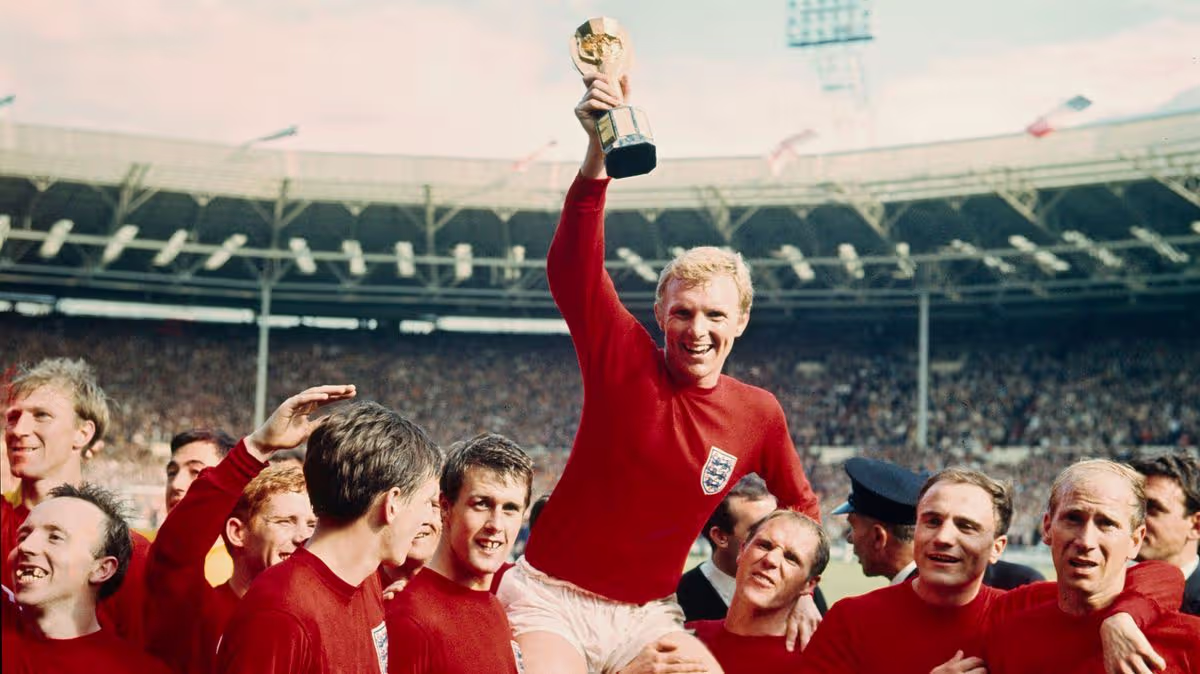
Thus, the 1966 World Cup final, where Bobby Moore hoisted the gleaming trophy aloft, was made possible not only by Geoff Hurst’s hat-trick but by a shadowy agreement struck in London’s underworld. The Jules Rimet Trophy would be stolen again from Brazil in 1983 and is now presumed melted down, a fate it narrowly avoided in England. This extraordinary story, half a century old, is a reminder that behind the most iconic moments of national celebration, there often lies a tangled web of human drama, desperation, and quiet deals struck in the dark—a peculiar prelude to glory, orchestrated by a lawyer, a detective, and a gang of thieves who, for once, did the nation an unintended favour.