


The story of Emma Adams, known to her many followers as ‘Em’, is not merely a news headline about another cancer statistic. It is a profoundly human narrative of love, courage, and the raw vulnerability of a life cut tragically short. An influencer and mother from Ipswich, Emma did not quietly retreat from the public eye when diagnosed with breast cancer in 2023. Instead, she chose to document her journey with unflinching honesty, transforming her personal battle into a source of connection and strength for millions. Her platform became a space not for curated perfection, but for the real, agonizing, and sometimes hopeful reality of living with a terminal illness. This choice to share set the stage for a final act of breathtaking bravery—a pre-recorded farewell message to be shared after her passing on April 29th, a video that would resonate far beyond her own circle, viewed over five million times by a global audience mourning a woman they felt they knew.
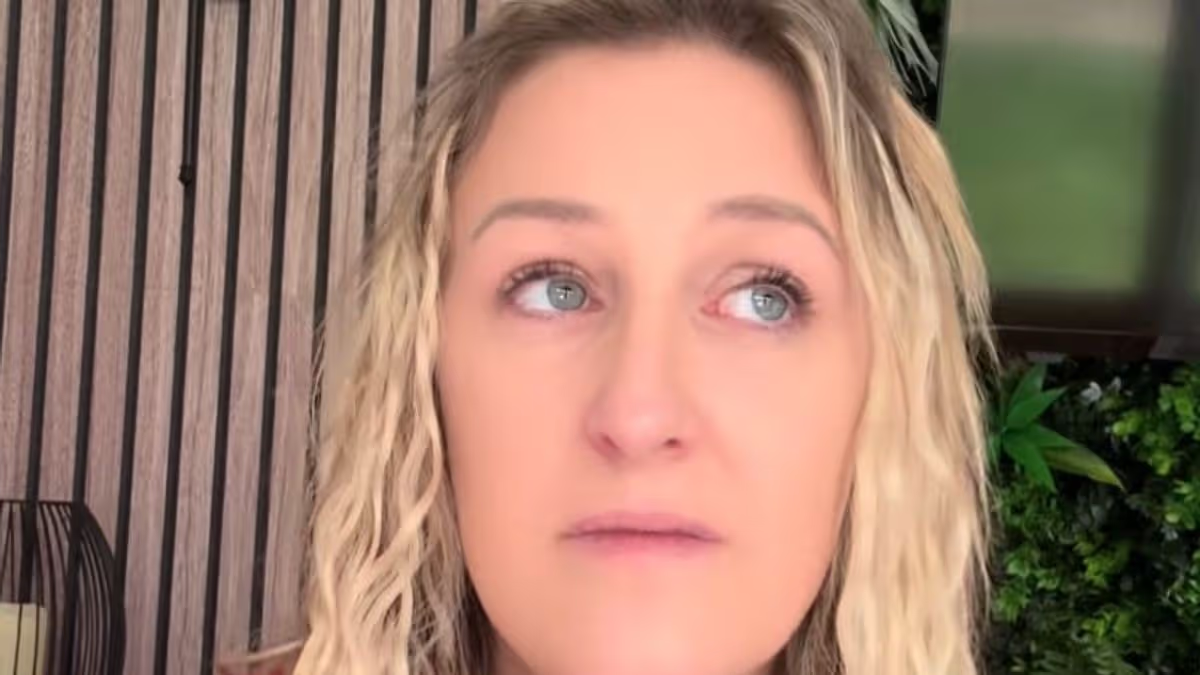
In that heartbreaking final clip, Emma’s strength was matched only by her profound love, most poignantly directed at her young daughter, Izzy. Holding back tears, she spoke directly to the camera, and thus directly to Izzy’s future self: “Izzy, I love you so, so much. You mean the absolute world to me. I hope that you live the best life that you can with the strength that I know you have.” In these simple words lies a universe of a mother’s hopes, fears, and eternal devotion. She sought not just to say goodbye, but to implant a message of resilience and encouragement that Izzy could carry forever. Emma then turned to her friends, offering gratitude that painted a picture of the community that sustained her: “I’m so grateful for all of my friends, for being my wings when I haven’t been able to fly.” This beautiful metaphor captures the essence of true friendship—the lift, the support, the carrying forward when one’s own strength has ebbed away.
Emma’s message was strikingly candid about her own suffering and her wish for peace, both for herself and for those she left behind. She acknowledged the difficulty of recording the video, a task harder than she had imagined, and expressed a hope that her passing would bring “some peace” to her loved ones, allowing them to live “knowing that I am happy and I am no longer in pain.” Her sign-off, “I’ll be seeing you,” was less a final closure and more a tender promise of enduring memory. The announcement of her death, shared by her heartbroken friends, called her an “incredible mum, friend, daughter and sister” and celebrated her as “kind, generous, strong,” a soul who had “touched so many of us in ways we will never forget.” These were not hollow platitudes, but affirmations born from the reality of a life lived with open-hearted courage.
The public response to Emma’s story was a tidal wave of collective grief and respect, underscoring how her vulnerability had forged deep connections. Thousands of comments and tributes flooded social media, a digital memorial for a woman who had made the private agony of terminal illness feel shared and seen. Her journey highlighted the dual role of social media in modern life: it can be a place of superficial comparison, but also, as Emma demonstrated, a powerful tool for authentic human storytelling and community building in the face of life’s darkest challenges. She used her influence not for commercial gain, but for a far more precious currency: empathy, awareness, and a legacy of facing the unthinkable with grace.
Emma’s passing inevitably casts a stark light on the broader context of cancer care in the UK, where, according to Cancer Research UK, there are around 59,413 new cases of breast cancer each year. Her story personalizes the urgent national conversation about early diagnosis and accessible treatment. In a timely parallel, just weeks after Emma’s death, Health Secretary Wes Streeting—a kidney cancer survivor himself—spoke pointedly about the need for systemic change, announcing a £237 million investment into new and expanded Community Diagnostic Centres (CDCs). “I was one of the lucky ones,” Streeting stated. “But it shouldn’t be a question of luck. The NHS should be there for all of us when we need it, catching illness earlier so we can treat it faster.” This drive to move vital checks closer to people’s homes is a critical step in a generation-long expansion of NHS diagnostics, aimed at turning timely diagnosis from a matter of fortune into a standard of care.
Ultimately, Emma Adams’ legacy is a mosaic of intimate love and public advocacy. She was a mother leaving a whispered strength for her daughter; a friend acknowledging the wings that held her aloft; and a public figure who used her final breaths to say a conscious, loving goodbye to a world she had touched. Her story transcends the clinical details of her illness, becoming a timeless reminder of the power of human connection, the importance of living and loving authentically, and the urgent, ongoing fight to ensure that for everyone facing such a diagnosis, the outcome relies less on luck and more on the unwavering support of a system designed to give every person a fighting chance. In her courage, she asked us to remember her, and in remembering, to hold our own loved ones closer and to demand a future where more families are spared such an early farewell.