




(1)
While spring has been steadily building its presence across the United Kingdom, recent long-range forecasting data hints that winter might not be entirely ready to release its grip. According to specialized weather models consulted by WXCharts, there is a chance of an unseasonal and surprising wintry outbreak during the first week of May. The maps, generated from the European Centre for Medium-Range Weather Forecasts (ECMWF) model, suggest a scenario where bands of precipitation, carried on a northerly airflow, could deliver snowfall to parts of the country. This potential event is framed around a specific timeframe, currently pinpointed to span approximately 30 hours between the 5th and 6th of May. For many, the very notion of snowfall in May feels contradictory, a brief backward step into the chill after the burgeoning warmth of April. It serves as a potent reminder of the dynamic and sometimes unpredictable nature of British weather, where atmospheric patterns can still conjure wintry conditions long after the official start of spring.
(2)
The driver for this potential cold snap, as illustrated by the forecast models, is a large area of low pressure expected to position itself over Scandinavia. This setup acts like a meteorological pump, drawing colder air from the Arctic regions southwards across the North Sea and directly towards the UK. This frigid air mass is the key ingredient, providing the necessary chill to turn what would typically be spring rain into wintry showers, sleet, and snow. Scotland, situated directly in the path of this northerly flow, is anticipated to bear the brunt of any such outbreak. Areas like Aberdeen and the Highlands are highlighted as the most likely to experience the heaviest and most persistent snowfall, which could lead to disruptive travel conditions and a temporary, stark white blanket over landscapes that are just beginning to green. The situation underscores how the country’s northern reaches remain most vulnerable to these late-season incursions of polar air.
(3)
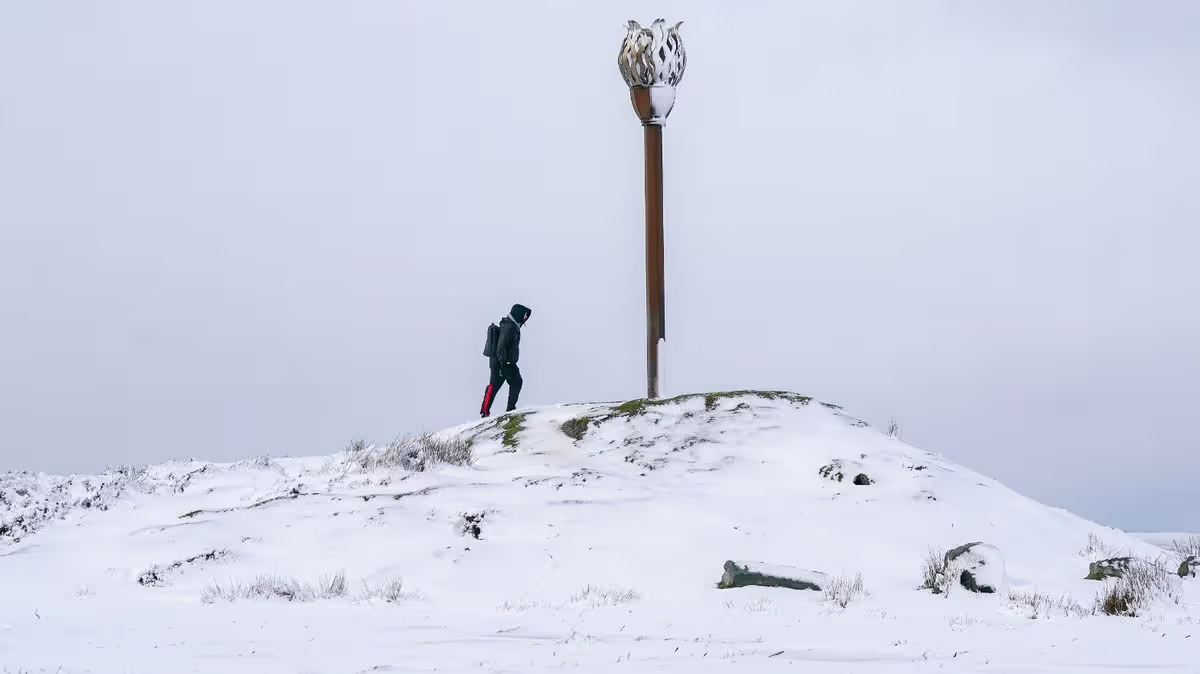
Crucially, the forecast maps indicate that this system’s influence would not be confined solely to Scotland. The bands of wintry precipitation are shown extending their reach southward into northern England. Cities like Newcastle could see a mix of rain, sleet, and snow showers. Perhaps more strikingly, the projections suggest the snow potential could stretch as far south as the Midlands, with elevated terrain in Derbyshire—specifically parts of the Peak District—noted as possible recipients of settling snow, particularly if temperatures drop sufficiently overnight. Similarly, the higher fells of Cumbria might experience brief periods of heavy, blustery snow. This highlights the pivotal role of altitude in such marginal wintry events; while valley bottoms and urban centres may see only cold rain, the surrounding hills and moors can be transformed into a fleeting winter scene, illustrating the dramatic microclimates that exist within relatively short distances.
(4)
In contrast to the unsettled picture further north, the forecast for southern England, including London and the Home Counties, is projected to be far more benign. Here, the influence of the Scandinavian low and its associated cold pool is expected to be significantly weaker. The maps suggest these regions would remain predominantly dry, with perhaps only very isolated light showers and some bright or sunny intervals. This stark north-south divide is a common feature in UK weather patterns, especially during spring. It means that while headlines may speak of a “UK snow blast,” the reality for millions in the south would likely be a cool but largely uneventful spell of weather, a world away from the wintry conditions potentially affecting hills just a few hundred miles to the north.
(5)
It is absolutely vital, however, to treat these specific snow forecasts with a healthy degree of caution. Leading meteorological institutions, including the UK’s own Met Office, consistently emphasise the significant uncertainties involved in detailed weather predictions several weeks ahead. The Met Office’s official long-range outlook for the period covering the end of April and start of May makes no mention of snow. Instead, it suggests high pressure is likely to remain influential near or over the UK, leading to generally dry conditions with a mix of cloud and sunshine, and temperatures for most continuing to be above average for the time of year. This divergence in outlooks highlights the complexities of long-range forecasting. Experts note that ground temperatures in May are typically much warmer than in winter, meaning any snowfall at lower levels would struggle to accumulate and would likely melt quickly. The “chaotic” nature of the atmosphere, where small, unpredictable changes can have major downstream effects, makes precise snowfall predictions for a date weeks away inherently uncertain.
(6)
In essence, the WXCharts data presents one plausible—and certainly eye-catching—scenario for early May, a reminder that winter’s echoes can sometimes be heard well into spring. It points to a meteorological possibility, not a certainty. As with all long-range weather models, this snapshot will evolve and change as the event draws closer and forecasters gain more certainty. For now, it serves as an interesting talking point and a prompt for residents, especially in northern and upland areas, to simply be aware that a brief return to wintry conditions cannot be entirely ruled out. The coming weeks will see forecasters closely monitor the developing atmospheric patterns, refining their predictions to provide the public with a clearer and more reliable picture as we approach the start of May.