

For three years, my work on returning Ukraine’s stolen children has revealed a pattern so methodical it can only be described as a state-run system. This system operates on a foundational lie, one repeated with chilling consistency: Russia does not abduct children, it “rescues” them. It does not occupy territories, it “liberates” them. It does not erase Ukrainian identity, it “protects children from nationalist indoctrination.” This vocabulary is always an inversion of reality, a deliberate cognitive operation designed not just to confuse the world, but to reframe a crime as a virtue. The goal is to make the unthinkable palatable, to cloud the clear waters of truth with the murky silt of propaganda. It is a performance aimed at an international audience, leveraging our innate desire for neutrality to suggest that “the truth must be somewhere in the middle,” even when one side is documenting graves and the other is fabricating fairy tales.
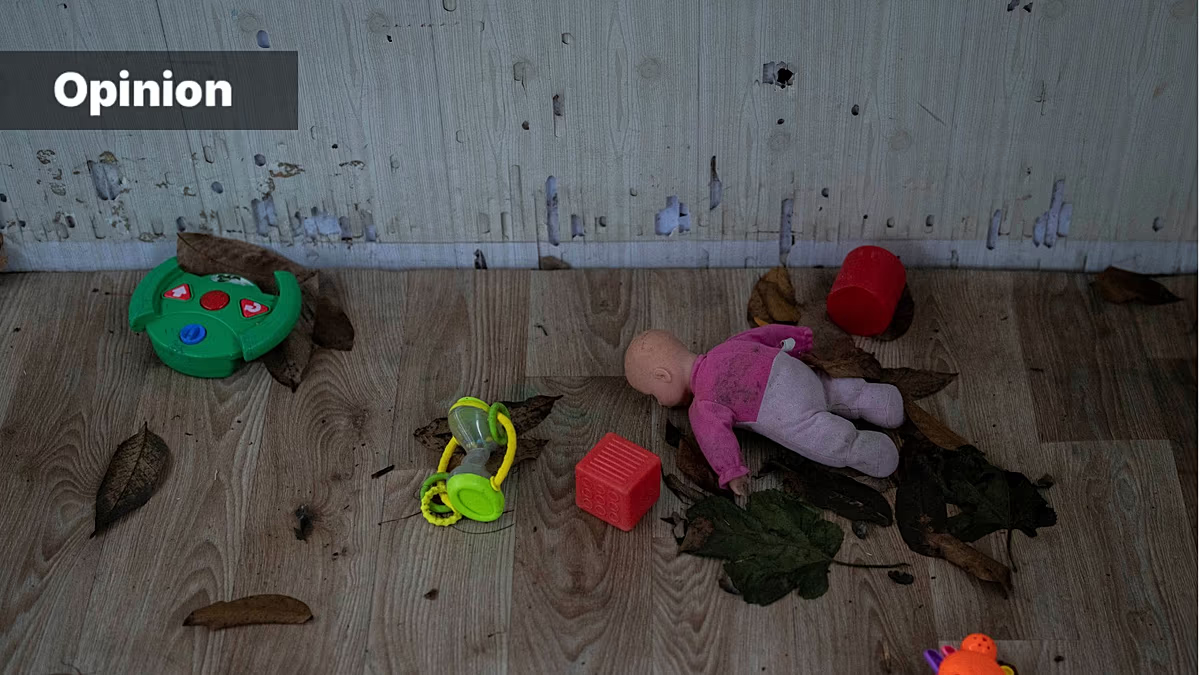
At the heart of this system is a brutal, transactional logic captured in the Russian word “tovar,” meaning “goods.” When Russian forces seize Ukrainian land, the children living there become, in the state’s view, state property—assets to be managed, transferred, and repurposed. As of April 2026, Ukraine’s Ministry of Justice has documented over 20,570 specific cases of deportation and forcible transfer, while human rights groups fear the true number under Russian control reaches into the hundreds of thousands. These children are scattered: placed with Russian families, in orphanages, or in so-called “rehabilitation” camps. The process is one of systematic erasure: Ukrainian documents are replaced with Russian ones, surnames are sometimes altered, speaking Ukrainian becomes a punishable offense, and contact with family or friends in free Ukraine is treated as a crime. This is not chaos; it is a bureaucratic machinery of identity theft.
The architects of this system are often its most revealing witnesses. Consider Maria Lvova-Belova, Russia’s own Children’s Rights Commissioner, who took 15-year-old Filipp Holovnia from Mariupol into her own home. She later appeared on Russian television, not with remorse, but with complaint. She spoke of how Filipp’s pro-Ukrainian views, his singing of Ukrainian songs, and his declaration of love for Ukraine “complicated the family atmosphere.” She described with evident relief how she “overcame this behaviour” and “gradually, his consciousness began to change.” Here, in her own words, is a confession to the deliberate destruction of a child’s identity—the very act scholar Raphael Lemkin identified as a hallmark of genocide. The staggering gap between her narrative of “rescue” and the reality of forced assimilation is the purest essence of this propaganda. It is a deceit so profound it deceives the deceiver, allowing perpetrators to see themselves as saviours.
The human cost of this “rescue” is measured in shattered lives and permanent scars. Take the story of Oleksandr Yakushchenko and his sister Khrystyna. After Russia’s occupation of Kherson, they were taken from their orphanage, separated in violation of Russia’s own family code, and placed with different foster families in Russia. Oleksandr, stripped of his passport, sent a desperate voice message: “Nobody here gives a damn about me. I’m just ruining everyone’s life.” In January 2024, at age 18, he died by suicide. Reports indicate his foster family said at his hastily arranged funeral, “Thank God he’s dead. Fewer problems.” Meanwhile, the local authorities published a glowing article about his foster family titled, “There is enough love for everyone.” Khrystyna, placed in a correctional boarding school, was not allowed to say goodbye to her brother. She remains there, known to the Russian state but held as property. This is the brutal interior of the system: siblings forever torn apart, a life extinguished, and a bureaucracy that spins a narrative of care over a reality of cruelty.
The ultimate goal of this repurposing extends beyond assimilation to militarization. In occupied regions, children are funneled into state-funded youth movements like Yunarmiya and paramilitary programs like Zarnitsa 2.0, where they are trained in weapons handling, drone operation, and cyber warfare. Participation is effectively mandatory, as refusal marks a family as disloyal. This is a conveyor belt designed to produce future Russian soldiers. For those who resist, the punishment is severe. Teenagers like Viktor Azarovskyi, Oleh Shokol, and Denys Vasylyk from Melitopol were arrested, charged as Russian citizens with terrorism, and sentenced to lengthy prison terms. They were offered a grotesque choice: spend their youth in a Russian prison or secure freedom by taking up arms against their own homeland. This is the final, cynical stage: first, erase the Ukrainian child; then, create a Russian citizen; finally, coerce them into becoming a weapon against Ukraine.
So, what remains? Oleksandr is buried in foreign soil. Khrystyna is trapped in an institution. Viktor faces an impossible choice. Filipp endures the psychological trauma of having his will broken by his official “protector.” These are not abstract statistics or case files. They are certainly not “tovar.” They are children with names, a language, and a homeland—none of which belong to the state that took them. The question of Russia’s intent has been answered by Russia itself: in Lvova-Belova’s smug testimonies, in the budget lines for militaristic camps, in the legal farces trying children as terrorists. Our obligation is to reject the inverted lexicon of rescue and call this what it is: a systematic campaign of child deportation, identity erasure, and cultural genocide. To see these children as goods is to accept the aggressor’s logic. To remember their names and demand their return is to affirm their humanity.