



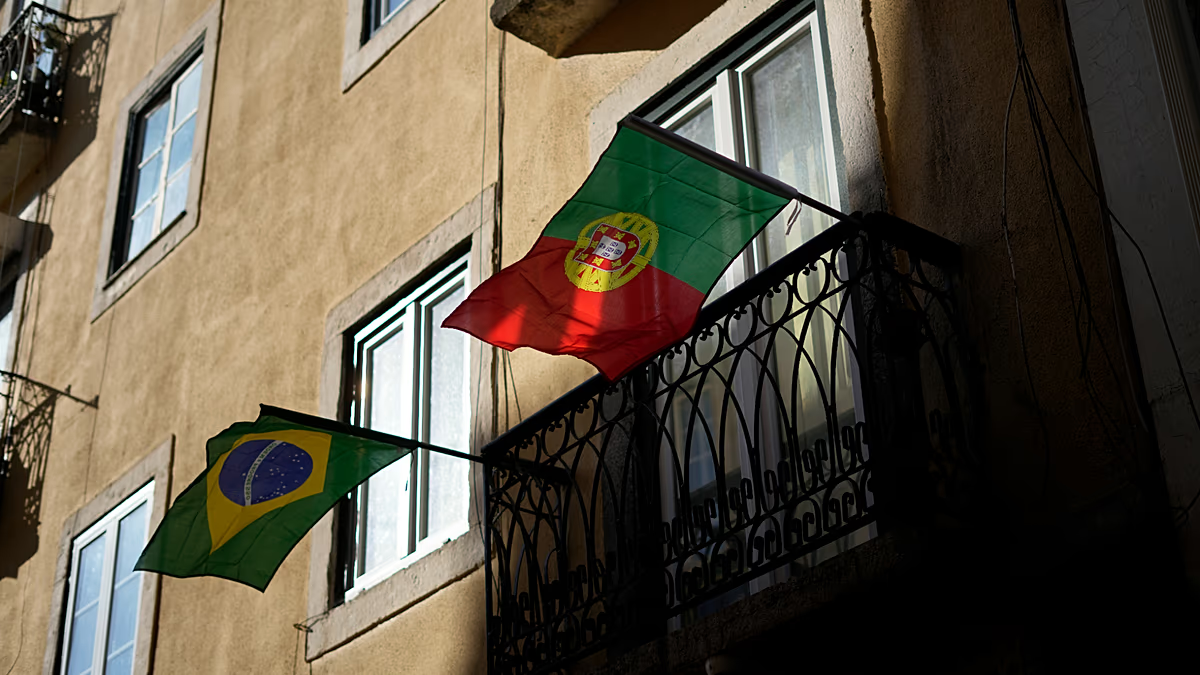
Today marks a global celebration of one of the world’s most dynamic and widespread languages: Portuguese. World Portuguese Language Day, established in 2009 by the Community of Portuguese Language Countries (CPLP) and formally recognized by UNESCO in 2019, honors a linguistic bridge connecting over 265 million people across five continents. It is a distinction held by no other non-official United Nations language, underscoring its unique cultural and diplomatic significance. Portuguese is not merely the tongue of Portugal and Brazil; it is the official language of nine sovereign states, from Angola and Mozambique in Africa to Timor-Leste in Asia, and holds official status in Macau. This geographical dispersion paints a picture of a language born from historical voyages that now thrives as a living, unifying force among vastly different nations and cultures.
The momentum behind Portuguese is undeniable, with projections suggesting its speakers will near 400 million by 2050, potentially exceeding half a billion by the century’s end. These figures position it as the fourth most spoken language globally, a fact that fuels a concerted, decade-long diplomatic ambition: to see Portuguese join the six existing official languages of the United Nations (English, French, Spanish, Russian, Arabic, and Chinese). As Florbela Paraíba, President of the Camões Institute, notes, this status would be a “seal of recognition,” placing it on an equal footing and amplifying the global voice of the Lusophone world. The journey toward this goal is already well underway; Portuguese serves as an official or working language in 32 international organizations, including the African Union, the European Union, and the World Health Organization, proving its utility on the world stage.
However, the path to UN recognition involves more than demographic strength or political will; it presents tangible logistical and financial considerations. Granting official status would require the translation of all UN documents into Portuguese and the recruitment of corresponding human resources, an undertaking estimated to cost millions of euros annually. Despite this, advocates argue that the investment is justified by the language’s accelerating global relevance. Portuguese is a digital powerhouse, ranking as the fifth most used language on the internet with staggering growth, and among the top on platforms like Facebook. This digital vitality mirrors a swelling interest in learning Portuguese, driven not only by diaspora communities but increasingly by professional aspirations in diplomacy, business, and international cooperation, particularly in nations like China.
The institutional framework for promoting the language is robust and expanding. The Camões Institute, for instance, maintains a vast network of hundreds of teachers from Europe to Africa to the Americas, supporting tens of thousands of students. This educational mission underscores that Portuguese is “a language on the rise,” its appeal rooted in both cultural richness and pragmatic advantage. The case for its elevation is strengthened by demonstrating this active, global commitment to its propagation. Each new learner and each academic partnership adds weight to the argument that Portuguese is not a regional artifact but a growing transnational tool for communication and understanding.
Beyond linguistics, the economic and strategic heft of the Portuguese-speaking community cannot be overlooked. Collectively, the CPLP nations represent an economy of approximately 2.7 trillion euros—a bloc that would rank among the world’s largest. Their combined territories encompass vast maritime zones critical for global trade, significant freshwater reserves, and major energy producers like Brazil, Angola, and Mozambique. While the economic integration of these countries is still deepening, the shared language provides a natural conduit for boosting trade, investment, and political collaboration. Portuguese thus evolves from a cultural heritage into a strategic asset, facilitating connections across continents and making proficiency in the language a valuable skill for professionals engaging with this influential economic space.
Ultimately, the quest for Portuguese to become a UN official language by 2030 is a multidimensional endeavor. It is sustained by compelling demographics, digital growth, educational outreach, and emerging economic unity. It is a goal that, as Paraíba emphasizes, depends on the convergent efforts of all Lusophone nations and the global community that values the language. This ambition reflects a broader vision: to fully assert the Portuguese-speaking world’s place in a rapidly evolving international order. For now, the language continues its ascent, carried by the voices of millions and the collective determination of a community ready to share its unique perspective with the entire world.