


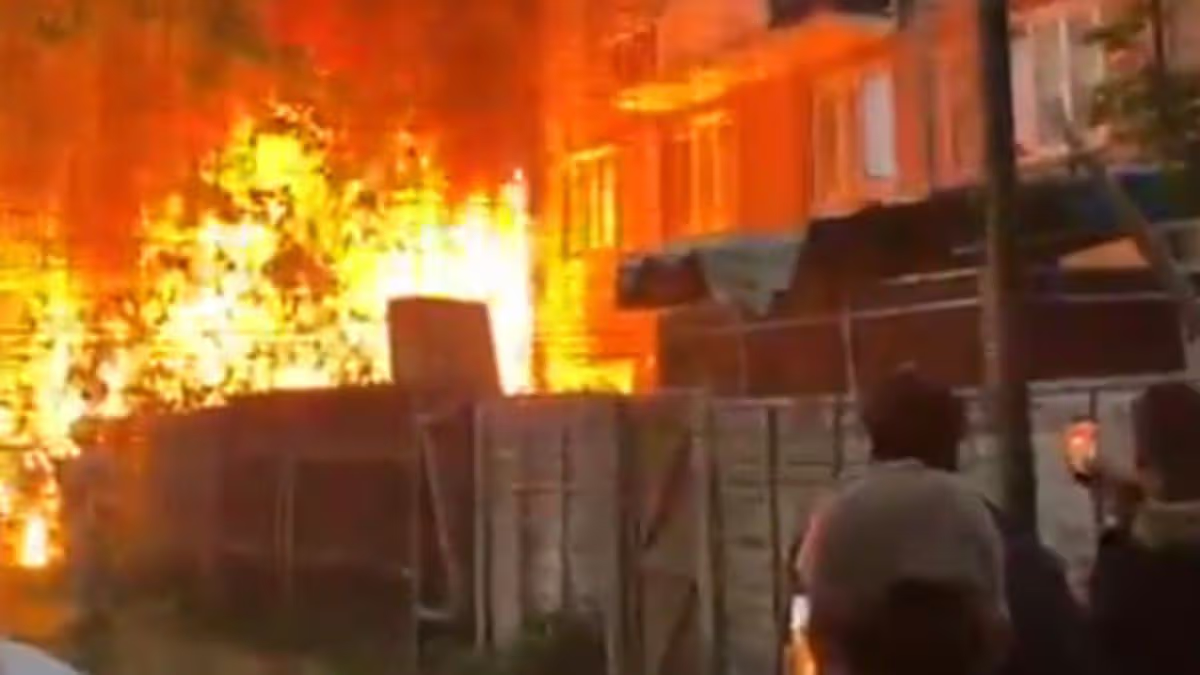
London’s fire engines are rarely idle. On the evening this call came in, they were scattered across the capital, crews finishing training, checking equipment, or perhaps just beginning a quiet moment. Then, at 8:04 p.m., a sharp, clear alert broke that rhythm. In the control room, an officer’s screen lit up with a new incident: a fire was reported at a block of maisonettes. Maisonettes—a distinct type of London housing, often two-story units stacked within a larger building, combining the feel of a house with the efficiency of a flat. Each one is a private home, a nest of family life, memories, and belongings. The phrase “affecting a block” meant this was not a solitary unit; the fire had the potential to breach boundaries, to spread. The control officer, trained to translate addresses into urgent geography, knew immediately this was a scenario requiring speed, weight, and precision. With a calm urgency, they began the process of summoning help, not from one place, but from several. The first call went to Stoke Newington fire station.
The station in Stoke Newington, a busy area in the borough of Hackney, would likely have been the closest, the logical first responder. But the control officer’s strategy was not about sending one crew; it was about building a force. Almost simultaneously, alerts flashed to stations in Tottenham and Homerton. Tottenham, in North London, and Homerton, in East London, each represent a deep reservoir of experience and equipment. Calling them meant the officer was thinking beyond the initial knock-down of the fire; they were planning for search and rescue, for containing the blaze, for providing relief and support to the first crews on scene. And the instruction did not stop there: “and surrounding fire stations.” This was a deliberate escalation, a recognition that a fire in a residential block is a complex, evolving emergency. It meant stations in Islington, perhaps in Walthamstow or Bethnal Green, were now on standby, their crews alerted, their engines ready to roll if the situation worsened. Within minutes of that first call, a network of emergency response was activated across northeast London, a web of readiness centered on one unknown address.
For the firefighters at those stations, the announcement triggers a well-practiced transformation. The station’s atmosphere shifts from routine to focused intensity. Crews move with a purposeful speed that is not rushed but efficient. They pull on their heavy-duty boots and their iconic yellow fire tunics, each suit designed to withstand extreme heat and offer a layer of protection against the unpredictable. Helmets are secured, breathing apparatus checks are performed. The fire engine itself, a massive red vehicle crammed with technology and tools—ladders, hose reels, cutting gear, medical supplies—is given a final glance. Then, with doors closing and the distinctive blue lights beginning to pulse, the first engine from Stoke Newington pulls out onto the evening streets. Its route, pre-planned by the control room, is a dash through London’s traffic. The crew inside are not just drivers and technicians; they are a team. The officer in charge is mentally running through procedures, while others might be reviewing building layouts for maisonettes, thinking about access points, about where families might be, about the behavior of fire in confined, multi-level spaces. Their faces, seen through the windows as they pass, are set with concentration.
Following them, from different directions, come the engines from Tottenham and Homerton. They converge like arteries toward a heart, each adding to the growing resource pool at the scene. As the first engine arrives, the firefighters’ training instantly engages with reality. They see the block: perhaps a post-war brick building, three or four stories high, with separate entrances for each maisonette. Their eyes search for the tell-tale signs—smoke pouring from a window, the flicker of flame behind glass, the gathered, anxious residents on the pavement. Their first task is always to establish command and communicate back to control: confirming the location, assessing the visible scale, reporting if people are trapped. This initial information is gold; it allows the control officer to adjust the response, to tell the approaching Tottenham and Homerton crews exactly what to prepare for, or to call in those “surrounding” stations if needed. The firefighters then begin their attack, a ballet of danger and skill. Some will deploy hoses, aiming to suppress the fire directly. Others will form an entry team, putting on their breathing masks and venturing into the smoke-filled building to search for anyone inside, to tackle the fire at its core. Their world inside becomes one of noise, heat, limited visibility, and absolute reliance on each other.
Behind this physical bravery is the silent, critical work of the control room. The officer who sent the initial crews is now managing a live incident. They are the hub of all information: listening to radio updates from the scene, tracking the location and status of every fire engine involved, liaising with other emergency services like police and ambulance, and ensuring the firefighters have everything they need. If a crew requests a specialist tool or more water pressure, the control officer makes it happen. If the incident commander at the scene reports that the fire is spreading to adjoining maisonettes, the control officer can immediately dispatch the next wave of engines from those surrounding stations. They are also the point of contact for worried families, for journalists, for local authorities. Their role requires a cool head, an ability to hold multiple strands of a crisis together, and a deep understanding of firefighting tactics. They are the unseen strategist, making sure the bravery on the ground is supported by flawless logistics and coordination.
Ultimately, this summary of a London Fire Brigade report is not just a timeline of a response; it is a glimpse into a vast, human system of care. It begins with a single call from a terrified resident or a passerby seeing smoke. That call is received by a professional who hears not just words, but the potential for tragedy. That professional then activates a community of specialists—the firefighters from Stoke Newington, Tottenham, Homerton, and beyond—who willingly place themselves in harm’s way. Their goal is singular: to protect life and property. They operate in a world of heat, smoke, and structural uncertainty, guided by training and teamwork. And behind them, in the control room, a network of support ensures they are never alone in that effort. What reads as a brief, factual bulletin—“crews mobilised to the scene”—is, in reality, a story of immediate human action, of a city’s protective mechanism kicking into gear, and of ordinary people doing extraordinary things to safeguard their neighbors. It is a reminder that behind every emergency statistic are countless decisions, acts of courage, and a seamless collaboration aimed at one thing: bringing calm back to chaos.