



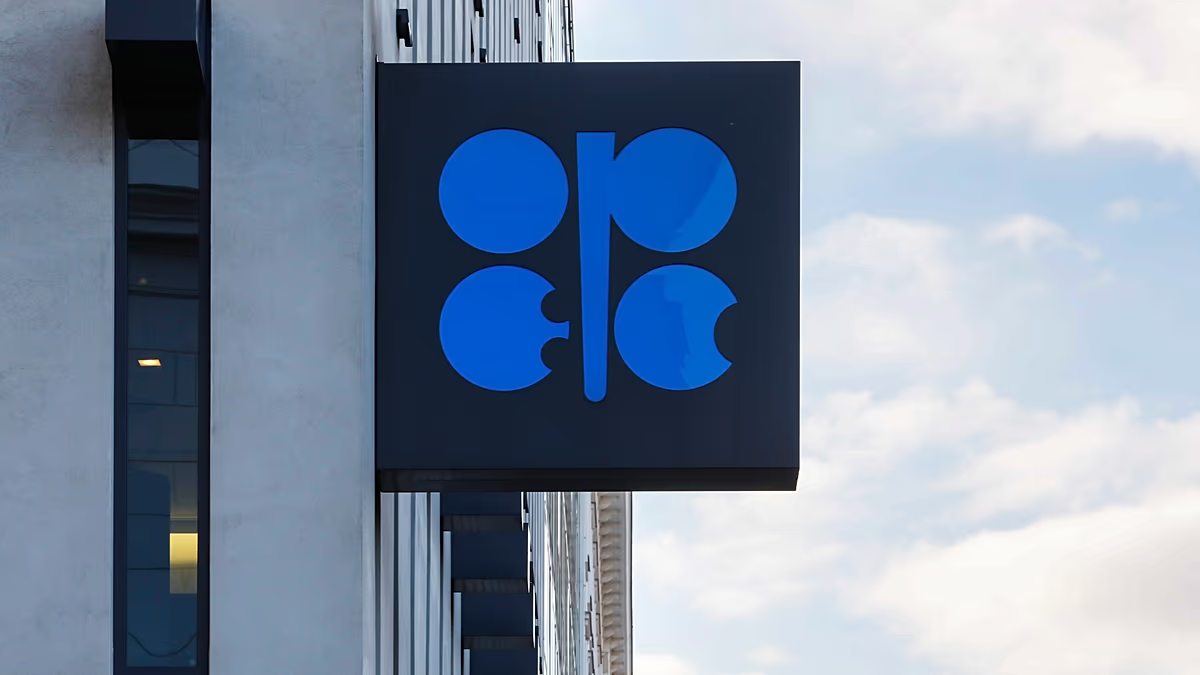
A Strategic Departure: The UAE Leaves OPEC and Charts a New Course
In a significant move that had been building for years, the United Arab Emirates formally announced its departure from the Organization of the Petroleum Exporting Countries (OPEC), effective May 1. The decision, while not entirely surprising to industry observers, marks a pivotal moment in global energy politics and regional dynamics. It stems from a deep-seated frustration in Abu Dhabi over the production quotas imposed by the cartel, which the UAE felt unfairly capped its output despite massive national investments to expand its production capacity. For a nation that had strategically poured resources into boosting its oil and gas infrastructure, the restriction of adhering to OPEC’s allotted share became increasingly difficult to justify. As analyst Bill Farren-Price noted, the UAE made a conscious choice to expand its production and now sees “little value in restraining themselves” when they have the means to produce more. This exit is, at its core, a declaration of economic intent—a sovereign decision to prioritize national ambition over collective discipline.
The tensions that led to this rupture have been simmering within both OPEC and its extended alliance, OPEC+, for some time. In these forums, the need for group cohesion and market management through production limits has increasingly clashed with the individual ambitions of member states seeking to maximize their revenue and market share. The UAE’s planned production capacity had grown to significantly outstrip its OPEC-assigned quota, creating a tangible gap between its potential and its permitted output. Frédéric Schneider pointed to this as the most obvious driver: “the UAE wants to export more oil.” This isn’t merely about pumping more barrels; it’s a reflection of a broader, more independent geopolitical and economic stance. The move signals that the UAE is increasingly ready to carve its own path, relying less on traditional regional groupings like OPEC, and even the Gulf Cooperation Council (GCC), in pursuit of its strategic interests.
While the UAE’s departure does not signal the immediate demise of OPEC, it undoubtedly adds considerable pressure to a system already under strain from market volatility, the energy transition, and internal disagreements. Energy analyst Andrei Covatariu observed that the decision, while not unexpected, raises fundamental questions about the future of OPEC’s traditional quota model. For a producer like the UAE, with substantial spare capacity and ongoing investments to monetize its resources, the “commercial logic of accepting production limits becomes less convincing,” especially while global demand and oil prices remain robust. The immediate market impact may be muted, as the physical supply of oil does not change overnight. However, the longer-term implications are profound. It introduces a new element of uncertainty and could precipitate a deeper crisis within OPEC if other members with similar frustrations reconsider their commitments. For now, heavyweights like Saudi Arabia and Russia are expected to remain the dominant forces within OPEC+, even as the group’s collective influence is somewhat diminished.
Beyond the global oil market, this decision casts a spotlight on the evolving nature of coordination within the Gulf region itself. The UAE’s exit underscores and reinforces existing, though often muted, divisions within the GCC. While these nations share deep security concerns, their economic visions and national strategies have increasingly diverged. Schneider emphasized that coordination on issues like oil policy has often been limited in practice. Covatariu noted that this move follows Qatar’s own departure from OPEC in 2019, suggesting a pattern where Gulf states are more assertively prioritizing their sovereign economic strategies over collective frameworks. This does not necessarily mean an outright political rift; instead, it reflects a calculated reassessment of alliances in a changing world. The response from neighboring Gulf states is likely to be cautious, focused on managing the fallout and preserving overall regional stability even as they navigate this new landscape of more independent actors.
Analysts expect a period of recalibration rather than an immediate rupture. The remaining OPEC members, particularly its core Gulf allies, will likely seek to consolidate and present a united front to maintain market stability. As Farren-Price put it, they will likely “circle the wagons and consolidate.” The UAE, for its part, will now operate with greater freedom to leverage its expanded production capacity, potentially seeking new bilateral partnerships and market opportunities outside the OPEC framework. Its strategy appears to be one of confident independence, betting that its economic strength and strategic investments will serve it better outside the constraints of the cartel. This represents a bold gamble that its national interest is best served by unilateral flexibility rather than collective bargaining.
In conclusion, the UAE’s exit from OPEC is more than a simple organizational change; it is a symptom of a shifting world order in energy and geopolitics. It highlights the growing challenge for traditional cartels to manage the competing ambitions of their members in an era where national interest often trumps collective action. The move empowers the UAE but weakens the structural integrity of OPEC, introducing a new variable into an already complex global energy equation. As the world watches, the aftermath will test the resilience of old alliances and reveal whether this decision empowers a new model of energy statecraft, one defined by sovereign ambition and strategic autonomy over collective discipline. The waves from this decision will be felt in boardrooms and government palaces for years to come, redefining relationships and strategies in the crucial global oil market.