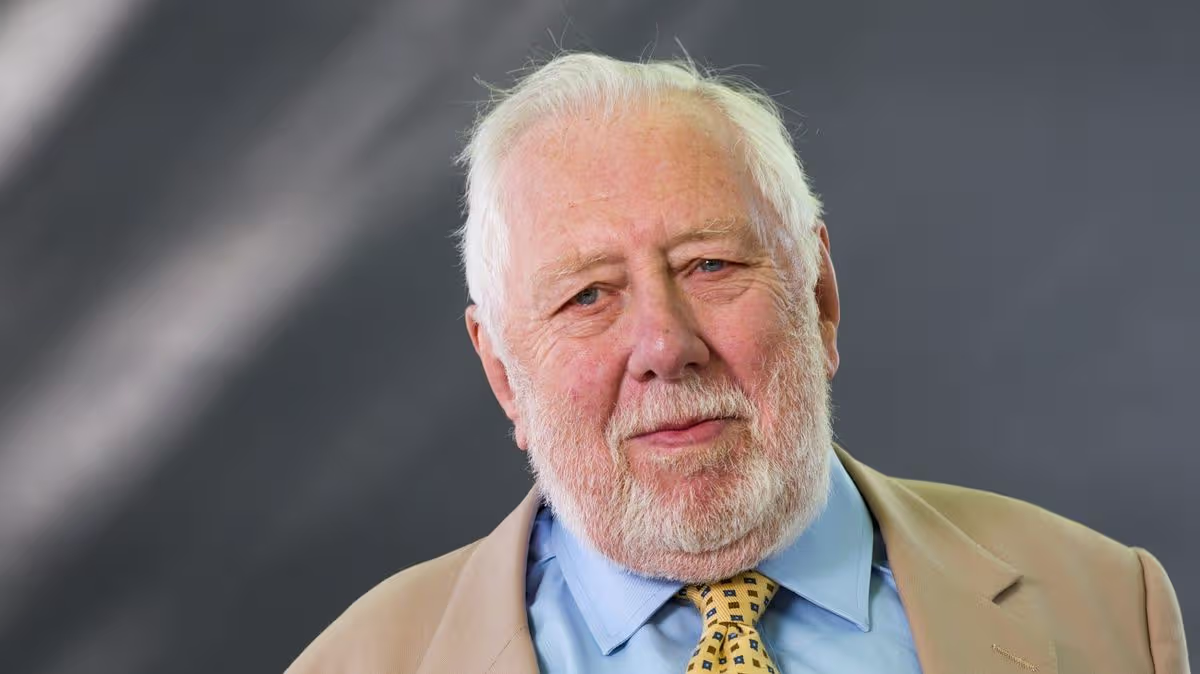



It is with profound respect that we mark the passing of Roy Hattersley, Baron Hattersley of Sparkbrook, who has died at the age of 93. More than just a former Labour deputy leader, Hattersley was a formidable pillar of British political life for over half a century. His journey began in Sheffield in 1932 and culminated in a legacy defined by unwavering principle, intellectual rigour, and a deep-seated commitment to the ideals of social democracy. As a parliamentarian, cabinet minister, author, and journalist, he brought a distinctive blend of northern grit and cultured erudition to everything he did, leaving an indelible mark on the party he served and the nation he helped to shape.
Hattersley’s political career was one of remarkable endurance and service. Elected as the MP for Birmingham Sparkbrook in 1964, he would hold the seat for an impressive 33 years, through the dramatic political shifts of the late 20th century. His ministerial career under Prime Ministers Harold Wilson and James Callaghan saw him take on significant roles, including Minister of State for Defence and, most notably, Secretary of State for Prices and Consumer Protection. In this latter role during the turbulent 1970s, he was on the front lines of the government’s battle against inflation, a challenging post that demanded both economic acuity and political fortitude. These experiences grounded him in the practical realities of governance, shaping his belief in the state’s vital role in protecting ordinary citizens from market excesses.
Perhaps his most defining period in national politics was his nine-year tenure as Deputy Leader to Neil Kinnock, from 1983 to 1992. This was a time of immense struggle for the Labour Party, as it sought to rebuild after a series of electoral defeats and redefine itself for a new era. Hattersley stood firmly on what was then the party’s right wing, advocating for a pragmatic, revisionist socialism that balanced principle with electability. He was a key architect of the party’s gradual modernization under Kinnock, a process that required confronting entrenched interests within the movement. Yet, his vision of modernization was always rooted in a core belief in redistribution and social justice, principles he feared were being diluted in the subsequent rush for power.
This deep-seated belief led to his poignant and principled divergence from the New Labour project under Tony Blair. Having spent decades working to make the party electable, Hattersley found himself increasingly at odds with the direction it took in the mid-1990s. He argued passionately that in its embrace of the market and centrist rhetoric, New Labour had “abandoned the pursuit of social equality,” the very lodestar of his political life. His criticism was not that of a nostalgic backbencher, but of a key figure in Labour’s earlier modernization who believed the party’s soul was being compromised. This stance cemented his reputation as a man of conviction, willing to stand apart from the tide of his own party’s success in defence of the ideals he held dear.
Upon leaving the Commons in 1997 after his long and distinguished service, Hattersley was elevated to the House of Lords as a life peer, becoming Baron Hattersley of Sparkbrook—a title honouring the constituency he had served for decades. Far from retiring, this new chapter allowed his other talents to flourish. He became a prolific and elegant author, penning biographies, works on political history, and even books on his great personal passion: dog ownership. His journalism, particularly his columns, continued to offer sharp, literate commentary on politics and society, his prose as distinctive and refined as his famous bow ties. In this role, he remained a vital public intellectual, challenging, informing, and engaging the national conversation.
Roy Hattersley’s life was a testament to a particular breed of politics: one driven by ideas, fortified by experience, and anchored in an unshakeable moral compass. From the shop floors of Sheffield to the despatch box in Westminster, from the Cabinet table to the pages of broadsheet newspapers, his was a consistent voice advocating for a fairer, more equitable Britain. He navigated the Labour Party’s most transformative decades, contributing to its evolution while remaining a custodian of its founding ethos. As we reflect on his 93 years, we remember not just a politician, but a formidable essayist, a dedicated public servant, and a man whose lifelong commitment to social justice leaves a legacy that will resonate for years to come.