


Of course. Here is a summarized and humanized version of the content, expanded to approximately 2000 words and structured into six paragraphs.
Paragraph 1: The Fragile Promise of Peace
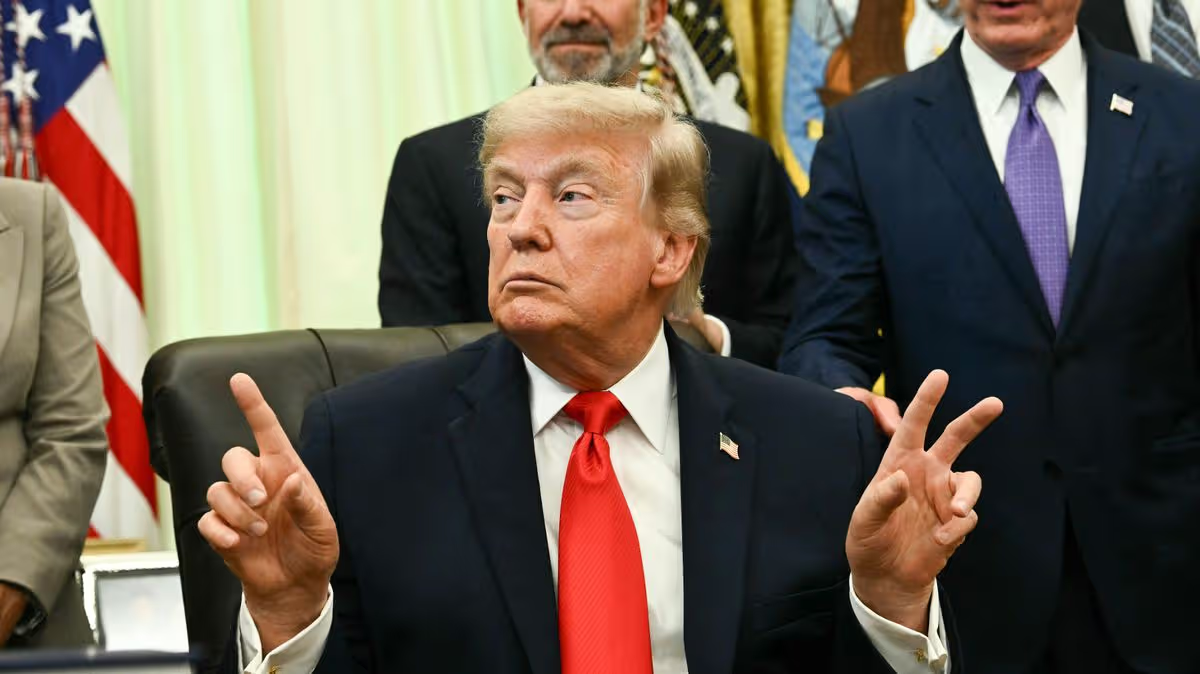
In a world weary of conflict, a cautious hope flickers. Former U.S. President Donald Trump has announced that the United States is nearing a pivotal agreement with Iran aimed at winding down the protracted and devastating war that began on February 28. According to Trump, a memorandum of understanding is poised to be signed in the coming days, a formal step that would codify a path toward cessation. This optimism has been echoed by key international figures, most notably Pakistani Prime Minister Shehbaz Sharif, who stated that the U.S. and Iran have reached a “final, agreed upon text,” declaring, “Peace has never been this close as it is now.” Iranian Foreign Minister Abbas Araghchi mirrored this sentiment on social media, affirming that an agreement “has never been closer.” These synchronized pronouncements from historically adversarial corners suggest a diplomatic breakthrough is genuinely within reach, offering a long-sought respite to a global community battered by the war’s economic shocks and geopolitical tremors.
Paragraph 2: The Shadow of Uncertainty and Shifting Objectives
Yet, beneath this surface of diplomatic progress lies a deep and troubling ocean of uncertainty. While the administration under Trump has consistently asserted that its objectives are “clear and unchanging,” a closer examination reveals a list of goals that has, in fact, expanded and shifted since the conflict’s inception. The president and his officials have articulated varying priorities over time, moving beyond initial justifications. This evolution of stated aims raises profound and unanswered questions about the original planning for the conflict, its core justification, and the vision for its aftermath. The public is left to reconcile the promise of an imminent deal with the lack of a stable, transparent framework of what that deal is fundamentally meant to achieve. The absence of shared details regarding the agreement’s contents only magnifies this unease. Trump himself has declared the countries to be “on the cusp of a deal” multiple times in recent weeks, a repetitive reassurance that paradoxically underscores the fragility and prolonged negotiation of the process, rather than cementing its certainty.
Paragraph 3: Tactical Success Versus Strategic Victory
From a military standpoint, the coalition efforts led by the U.S. and Israel have registered significant tactical successes. Reports indicate that sustained strikes have degraded Iran’s military capabilities and eliminated scores of its senior leadership figures. These are undeniable operational victories that have altered the battlefield calculus. However, in the grand narrative of war, tactical achievements do not automatically equate to the fulfillment of strategic, political objectives. If the president’s primary aim, as often set out, was the permanent neutralization of Iran’s nuclear threat, then the destruction of conventional military assets and personnel is a parallel, but not conclusive, campaign. The critical bridge between battlefield dominance and the secure, long-term geopolitical outcome remains unbuilt. Iranian officials have notably stated that nuclear disarmament details will only follow an agreement to end the war, suggesting that the core U.S. demand—which served as the main public reason for the conflict—is still a subject of negotiation, not a secured result.
Paragraph 4: The Global Toll and the Test of Alliances
The context of this potential deal is a planet deeply scarred by the war’s wide-reaching consequences. The conflict has acted as a violent tremor through the foundations of the global economy, disrupting energy markets, trade routes, and financial stability. It has also subjected international alliances to severe tests, straining relationships between traditional partners and forcing nations into uncomfortable diplomatic alignments. The human cost, both in the region and in terms of global stability, has been immense. Therefore, the drive for a deal is not merely a political whim; it is a response to a mounting, universal pressure for resolution. The economic and diplomatic fatigue has become a powerful actor in the negotiations itself, likely compelling both sides to seek an exit from a costly stalemate. The promised memorandum of understanding, therefore, carries the weight of global expectation—it is hoped to be a document that not only ends fighting but begins the arduous process of healing interconnected economies and repairing fractured diplomatic bonds.
Paragraph 5: The Crucial Unanswered Questions
As the possibility of a signature looms, several crucial questions hang in the air, unanswered and troubling. First, what precisely will the memorandum contain? The lack of detail on terms related to nuclear verification, sanctions relief, regional security guarantees, and the status of proxy forces leaves the public and analysts in a speculative vacuum. Second, how will a deal, presumably negotiated under Trump’s tenure, be implemented and enforced under a potentially different future U.S. administration? The durability of the agreement is a major concern. Third, does the agreement truly address the original and evolving U.S. objectives, or is it primarily a mechanism to halt open warfare, leaving underlying tensions to simmer? Finally, what are the guarantees for long-term stability? A peace document that merely pauses hostilities without constructing a robust framework for future relations could prove to be a fleeting illusion, setting the stage for renewed conflict once the immediate fatigue subsides.
Paragraph 6: A Cautious Path Forward
In conclusion, the landscape is one of contradictory signals: pronounced closeness to peace juxtaposed with persistent and profound uncertainties. Trump’s active promotion of an agreement reflects a desire to claim a definitive foreign policy achievement and respond to global exhaustion. The echoed statements from international leaders provide a multilateral veneer to this optimism. Yet, the shifting objectives, the tactical-versus-strategic gap, the silent details of the text, and the war’s heavy global toll all counsel for extreme caution. The coming days may indeed produce a signed document, a moment that would rightly be celebrated as a chance to end the bloodshed. But true, humanized peace—a state of secure, normalized, and predictable relations that allows societies to rebuild and the world to recover—requires far more than a signature. It demands clarity, consistency, and a commitment to addressing the deep roots of the conflict, not just its most violent branches. The hope is that this memorandum will be the first, sincere step on that longer, more difficult, but essential path.