



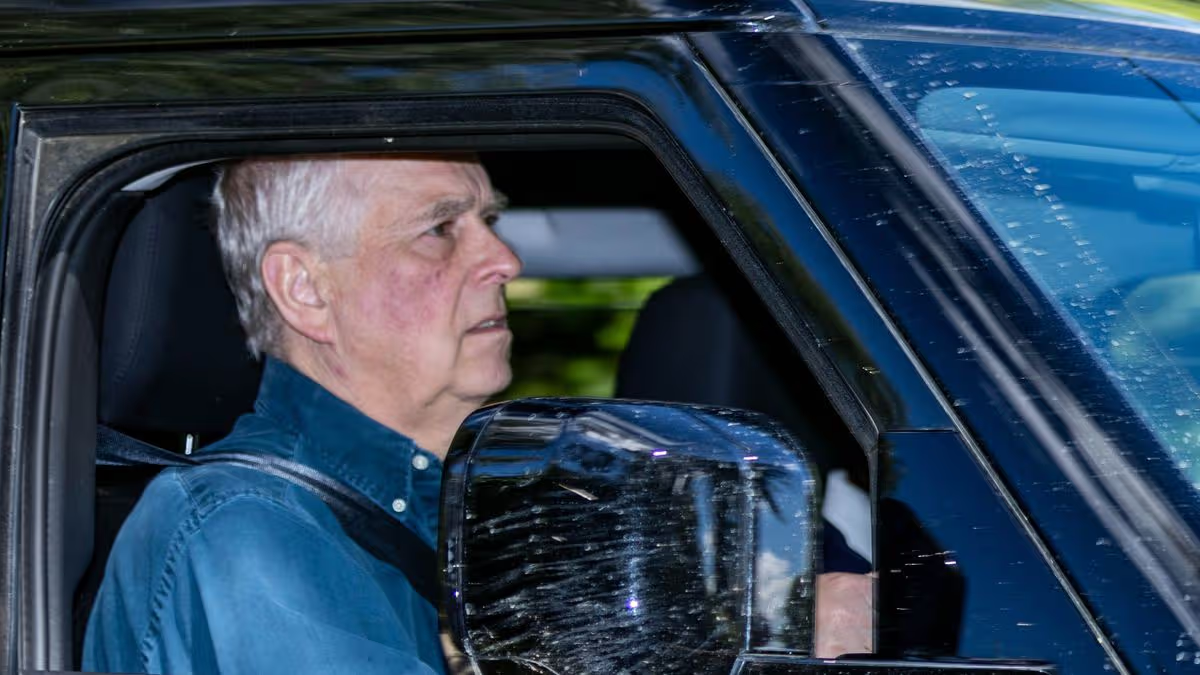
On a day dedicated to the grandeur and unity of the British monarchy, a solitary figure on the Sandringham estate served as a stark reminder of a royal chapter that has emphatically closed. Just hours before the King’s official birthday parade, Trooping the Colour, the former Duke of York, Andrew Mountbatten-Windsor, was photographed near his new home, driving his car. The most notable feature of this otherwise mundane sighting was a significant bruise, now in the process of healing, that dominated the right side of his face. This marked the second public appearance in a week where the bruise was center stage, having previously been seen as a vivid red mark stretching from his eye to his cheek and mouth. The injury had ignited a flurry of public speculation, though sources close to him reportedly attributed it to a “non-serious medical condition.” His reappearance, following a security scare the previous month, placed him once again in the public eye, but entirely separate from the day’s impending celebrations.
This private sighting stood in direct contrast to the spectacle unfolding in London. As Andrew navigated the quiet lanes of Norfolk, the capital was preparing for a breathtaking display of pageantry. Trooping the Colour, the annual ceremony marking the sovereign’s official birthday, is a vibrant testament to tradition, military precision, and familial unity. The event kicked off with a magnificent carriage procession down The Mall, a scene of regal splendor designed to uplift the nation. This year, the sight was particularly poignant, as it featured not only King Charles and Queen Camilla, but also the Princess of Wales, Catherine, alongside her three children: Prince George, Princess Charlotte, and Prince Louis. The young princes and princess, waving from the carriage, offered a powerful symbol of continuity and the monarchy’s future, their presence a heartening element of the day’s narrative.
The ceremony itself is a deeply symbolic military exercise, where the flag, or “colour,” of a battalion is paraded before the monarch and the public. It is a display of loyalty and readiness, with guardsmen in scarlet tunics and bearskin caps executing drills honed through weeks of rigorous practice. The royal family’s deep ties to the armed forces were also prominently on display, with key members participating in their roles as Colonels of various regiments. The Prince of Wales, as Colonel of the Welsh Guards, the Princess Royal, Colonel of the Blues and Royals, and the Duke of Edinburgh, Colonel of the Scots Guards, all rode in the procession, embodying the institution’s long-standing connection to military service. This collective participation underscores a functioning, dutiful core within the family, focused on service and national celebration.
All of this—the carriages, the marching bands, the waving children—builds towards the most iconic moment of the day: the royal family assembled on the balcony of Buckingham Palace. It is a carefully curated image of togetherness, a visual summary of the working monarchy for a global audience. The appearance of Kate, George, Charlotte, and Louis was especially significant, signaling a return to public duties and a stable, forward-looking family unit. As they stood together, awaiting the roar of aircraft, the balcony scene presented a unified front, a deliberate and uplifting portrait meant to inspire affection and respect. It is here that the monarchy consciously reinforces its role as a focal point for national pride.
Yet, the subdued image of Andrew, bearing a fading bruise and navigating life away from the spotlight, cannot be divorced from this context. His appearance coincided with reports that he was generating income by sub-letting cottages on the grounds of his former home, Royal Lodge, a property for which he paid a nominal “peppercorn” rent. This detail, alongside his visible injury and isolated status, paints a picture of a man grappling with a profoundly altered reality. While the core family presented a spectacle of unity on the balcony, his situation highlighted the consequences of personal scandal and the institution’s necessary, if harsh, mechanisms for self-preservation. His story now runs on a parallel, separate track—one of private residence, financial maneuvering, and physical marks that prompt public curiosity.
Thus, June 13th presented two very different visions of royalty. In London, there was a brilliant, choreographed display of tradition and hopeful continuity, a monarchy adapting and presenting its best face to the world. In Norfolk, there was a quiet, almost melancholic snapshot of a man once at the heart of that institution, now living with the visible and metaphorical scars of his fall from grace. The bruise on his face, however minor its medical cause may have been, became an unintentional symbol of this contrast—a private mark on a very public day, reminding all that behind the unified balcony scenes and marching soldiers, complex and often painful human stories continue to unfold, far from the cheering crowds and the fly-past.