


Here is a humanized and expanded summary of the reported development.
Amid the relentless churn of the 24-hour news cycle, a fragile glimmer of possibility emerged from the long-shadowed conflict between the United States and Iran. According to reports from several diplomatic sources, negotiators for the two nations, communicating through intermediaries in a neutral third country, had painstakingly crafted a preliminary memorandum of understanding. This document was not a grand peace treaty nor a dramatic reconciliation; its terms were deliberately narrow, focusing on the immediate and practical. In essence, it proposed an extension of the existing, tenuous ceasefire that had temporarily quieted the overt hostilities between U.S. forces and Iranian-backed militias in Iraq and Syria. The reported MOU represented a classic diplomatic maneuver: a modest, reciprocal step designed not to solve decades of enmity, but to create a slightly wider buffer zone against the precipice of wider war. It spoke to a shared, if unspoken, exhaustion with the constant drumbeat of drone strikes and rocket attacks, and a mutual understanding that uncontrolled escalation served neither side’s strategic interests. For weary diplomats and conflict-weary civilians in the region, it was a document born not of trust, but of a cold, pragmatic calculation that even a temporary, paper-thin truce was preferable to the alternative.
The mechanics of such an agreement reveal the profound depths of the estrangement. The United States and Iran have had no formal diplomatic relations for over four decades. Every discussion is a complex ballet performed through go-betweens—often officials from Oman, Qatar, or Switzerland—who shuttle messages back and forth. The creation of a preliminary MOU under these conditions is a monumental achievement in itself. It suggests that, away from the fiery rhetoric of public pronouncements, channels of communication, however clogged and indirect, remain open. The negotiators, experts in the granular details of regional security, likely focused on tangible, verifiable actions: a cessation of attacks on specific bases, a pause in certain patrol patterns, perhaps even an informal understanding on the inspection of commercial shipping in the Gulf. This was the unglamorous work of crisis management, a desperate bid to install circuit breakers into a system perpetually on the verge of overload.
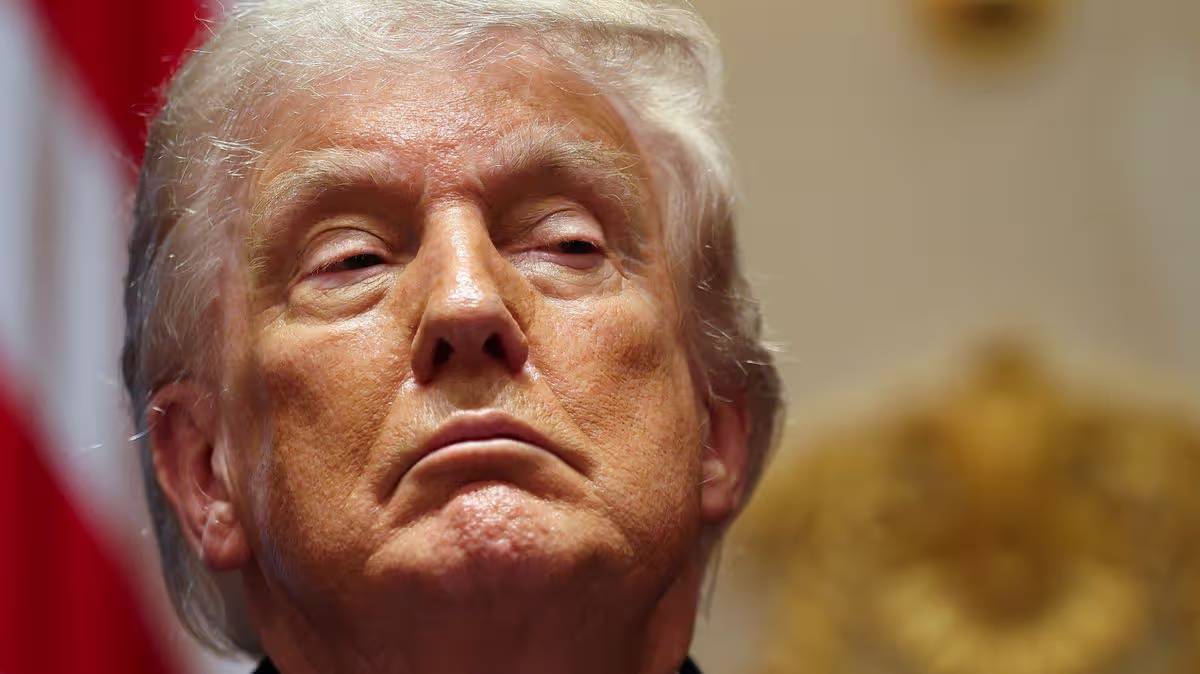
However, in the hyper-charged arena of American politics, and particularly in the context of an impending presidential election, no foreign policy move exists in a vacuum. The reported MOU, a delicate seedling of diplomatic progress, was immediately exposed to the volatile climate of domestic partisan warfare. The reaction from former President Donald J. Trump, as reported by sources close to him, was swift and unequivocal. He framed the preliminary agreement not as a prudent step towards de-escalation, but as a profound symbol of weakness and capitulation. In his narrative, any formalized understanding with Tehran, however limited, was a betrayal of his administration’s “maximum pressure” campaign and a gift to the Iranian regime. His response tapped into a deep well of skepticism among his political base, which views diplomacy with Iran as inherently illegitimate and synonymous with appeasement. This political framing instantly transformed a technical security arrangement into a potent electoral symbol.
The impact of this response was immediate and effectively paralyzing. For the current U.S. administration, the calculus shifted overnight. What had been a difficult but potentially worthwhile diplomatic risk became a politically toxic endeavor. The specter of the agreement being weaponized on the campaign trail—brandished as evidence of a feckless foreign policy—loomed large. Consequently, momentum toward finalizing the MOU appears to have ground to a halt. The window for action, always narrow, seems to have slammed shut. This episode lays bare a brutal reality of contemporary American statecraft: the capacity for coherent, long-term foreign policy is increasingly held hostage by the electoral calendar. Initiatives that require patience, nuance, and a tolerance for incrementalism struggle to survive in an environment where every action is instantly filtered through the lens of political advantage and attack-ad potential.
For observers in the Middle East, this sequence of events—progress reported, then swiftly dismantled by domestic U.S. politics—is a familiar and disheartening cycle. It reinforces a perception of American policy as fundamentally unstable and unreliable, shifting not with regional realities but with the political winds in Washington. Allies who may have quietly welcomed the prospect of reduced tensions are left confused and hesitant. Adversaries, meanwhile, may conclude that there is little point in engaging with U.S. diplomatic overtures, which can be reversed by a change in administration or a single tweet. The region is thus condemned to continue operating under a permanent state of suspended crisis, where the mechanisms for managing conflict are sabotaged before they can even be properly tested. The human cost of this paralysis—in lives lost, economies disrupted, and futures foreclosed—is immense but often abstracted away in the high-stakes game of geopolitics and domestic politics.
Ultimately, the story of this stillborn memorandum of understanding is a poignant case study in the collision between the painstaking work of diplomacy and the fractious nature of modern political identity. It highlights a world where the very concept of negotiating with an adversary has become a partisan litmus test, and where the short-term incentives of political campaigning consistently trump the long-term necessities of conflict resolution. The technicians of statecraft, who work in shades of gray to inch the world away from the brink, find their tools broken by the primary-color politics of absolute victory and defeat. The reported MOU, and the reaction it provoked, leaves us with a sobering question: in an age of perpetual political war at home, does the United States retain the capacity to conduct the delicate, nuanced, and often politically risky work of building even temporary peace abroad? The silence that has followed the initial reports suggests that, for now, the answer is a discouraging no. The ceasefire remains as fragile as ever, a temporary quiet awaiting the next spark.