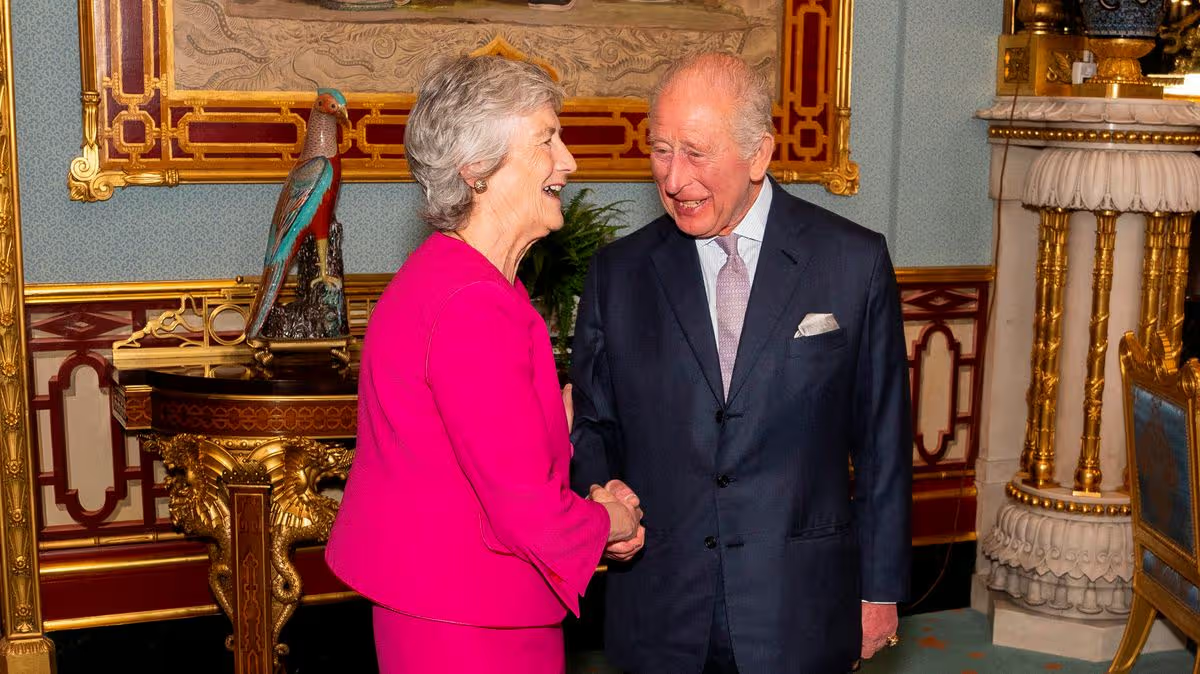



King Charles III has graciously accepted an historic invitation to undertake a state visit to Ireland, an event that would mark only the second such journey by a British monarch since the nation’s independence. The invitation was extended personally by Ireland’s President, Catherine Connolly, during a warm and substantive meeting at Buckingham Palace, which opened her own three-day official visit to Britain. This reciprocal gesture of diplomacy builds directly upon the monumental state visit of the late Queen Elizabeth II in 2011, a trip widely hailed as a transformative moment in healing the complex historical wounds between the two nations. For King Charles, whose deep personal interest in and affection for Ireland is well-documented, this prospective visit represents a profound opportunity to further a legacy of reconciliation and to reaffirm the unique bond between the two neighbouring countries, a relationship he has consistently championed as a positive voice for peace.
The significance of this invitation was warmly underscored by President Connolly following her “wonderful” audience with the King, which lasted just under an hour. She noted their discussion was mindful of the “unique relationship as close neighbours and our intertwined history,” consciously linking the future visit to the groundbreaking precedent set by Queen Elizabeth over a decade ago. The Queen’s 2011 visit, during which she wore symbolic green and delivered a deeply empathetic speech acknowledging painful history, masterfully recalibrated the emotional landscape of Anglo-Irish relations. By accepting this invitation, King Charles steps into a carefully nurtured diplomatic framework, one where the symbolism of the monarchy can be harnessed to project mutual respect, friendship, and a shared future. President Connolly expressed confidence that he would “receive the warmest of welcomes,” viewing the visit as a crucial next step in the “further deepening of our relationship as neighbours and as friends.”
President Connolly’s visit to Britain itself served as a powerful testament to the living, breathing connections that form the bedrock of this political relationship. Beginning her engagements at the Irish Cultural Centre in Hammersmith, London, she celebrated the immense and vibrant contribution of the Irish diaspora to British society. In her address, she poignantly observed, “there is hardly a sector of the economy or an area of life that has not been touched by the Irish here in Britain,” highlighting fields from healthcare and construction to the arts and sciences. Her presence acknowledged the generations of Irish immigrants who have shaped modern Britain, from the 19th century waves to contemporary citizens, some of whom, she noted with candour, still leave today due to challenges like housing shortages. This focus on the diaspora humanised the high-level diplomacy, grounding it in the experiences of communities and families.
The resonance of the President’s engagement with the diaspora was vividly apparent in the reactions of those she met. Individuals like Aengus Collins O’Malley, who teaches Irish history in London, appreciated her outreach and her staunch promotion of the Irish language, seeing it as a vital link to cultural identity. For young people like Oisin Moroney, a 21-year-old Irish dancer born in London to Irish parents, her visit was a proud affirmation of an identity nurtured abroad—”growing up as Irish as you could be without growing up in Ireland.” Meanwhile, community pillars like Larry O’Leary commended the President for fearlessly speaking her mind and for her dedicated advocacy for Irish culture. These interactions underscored that the relationship between the two nations is not merely a matter of statecraft, but a tapestry woven from millions of personal stories, traditions, and a enduring sense of shared heritage.
The President’s itinerary, which also included the Chelsea Flower Show, the London Irish Centre, and a journey to Leeds to visit university links and the renowned Irish Centre there, painted a comprehensive picture of modern Irish influence in Britain. In Leeds, her planned briefing at the Irish Health Centre would highlight the practical, community-based support networks that sustain the diaspora. This multifaceted tour, encompassing culture, academia, community welfare, and horticulture, reflected the depth and diversity of the bilateral relationship. It provided a fitting backdrop against which the invitation to the King was made—not in isolation, but as part of a continuous, broad-spectrum dialogue between two intricately linked nations.
Thus, the forthcoming state visit of King Charles III to Ireland emerges not as a standalone event, but as the next deliberate chapter in a patient and purposeful story of reconciliation. It follows a path illuminated by his mother’s courage and informed by the ongoing, grassroots connections celebrated during President Connolly’s visit. When the King walks on Irish soil as monarch, he will carry with him the weight of a complicated past, but also the promise of a present relationship characterised by immense people-to-people ties, economic partnership, and collaborative peace-building. His visit will be a powerful symbol, acknowledging history while firmly looking forward to a future defined not by division, but by the close, interdependent, and friendly neighbourhood that Ireland and Britain have worked so diligently to build.