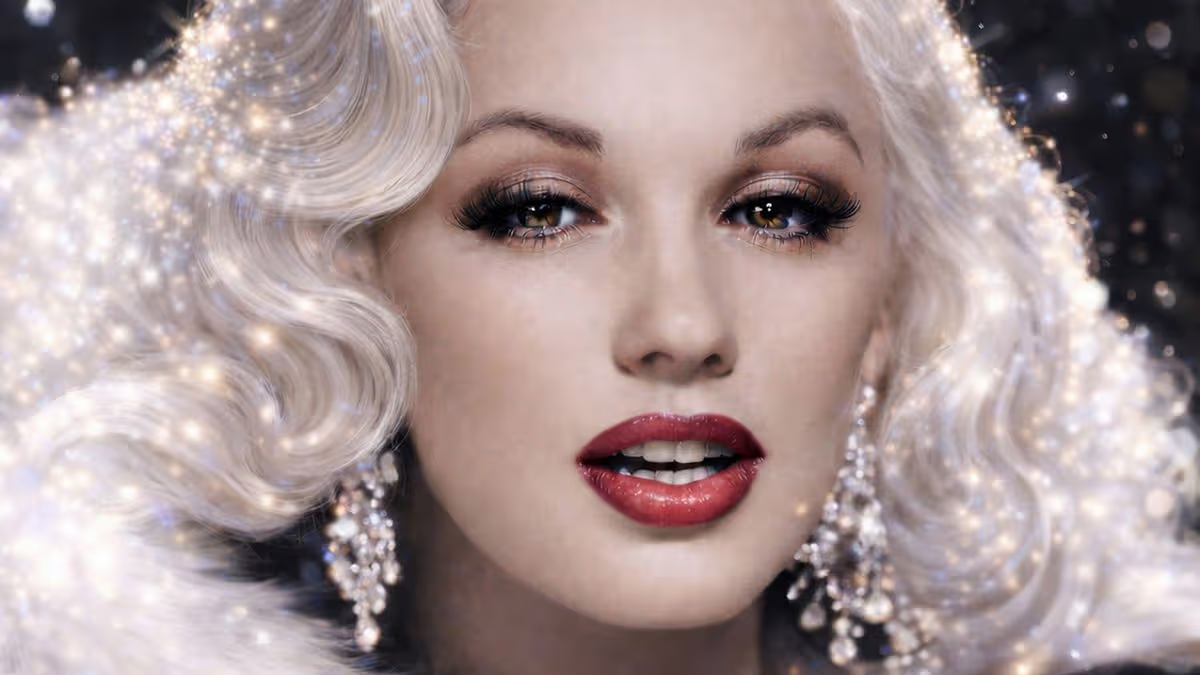


In the golden glow of Hollywood’s most glamorous era, among the constellation of starlets who defined an age of cinema, Mamie Van Doren stood as a luminous fixture. Now, at 95, she is the last living torchbearer of the legendary “blonde bombshell” archetype, famously grouped with Marilyn Monroe and Jayne Mansfield as one of the “Three M’s.” From her home in Newport Beach, California, Van Doren reflects not only on a career filled with glittering highlights and gritty realities but on the simple, profound fact of her longevity. “How many actresses live to be almost 100?” she muses. “We’re celebrating what would have been Marilyn’s birthday, but she’s been dead all these years, while I’ve been alive—and living a hell of a life.” Her new autobiography, You Thought I Was Dead: My Life of Celebrities, Sex and Champagne, serves as both a celebration and a candid correction, a memoir determined to shatter myths and share the unvarnished stories from the edges of stardom.
Van Doren’s journey began far from the palm-lined boulevards of Los Angeles. Born Joan Lucille Olander in South Dakota during the Depression, her childhood was marked by poverty, illness, and simplicity—years spent on a farm without electricity or running water. Yet, within that humble existence, a powerful dream took root. Seeing a newspaper photograph of Jean Harlow, with her striking white blonde hair, the young Joan found her aspiration. “That’s who I want to be like,” she decided. When her family moved to LA at age 11, the sight of the Hollywood sign cemented her destiny. “Jean Harlow saw that sign,” she thought. “It was where I was meant to be.” Working as an usherette, she absorbed every celluloid fairy tale, yearning for the happy endings she witnessed, a longing that would both propel and complicate her path.
Her entry into the film world was swift. After winning the title of Miss Palm Springs in 1949, she caught the eye of Howard Hughes, the formidable producer who also discovered Marilyn Monroe. He signed her to RKO, where she soon appeared alongside John Wayne. Her romantic life blossomed just as rapidly, with dates and engagements spanning figures like Hughes, Quincy Jones, and boxer Jack Dempsey. She recalls the challenges of that time, particularly her relationship with Quincy Jones: “It was difficult in those days going out with a Black guy; it was scary sometimes.” As her platinum hair and scarlet lips earned her the “blonde bombshell” label, comparisons to Marilyn Monroe arose. Van Doren, however, felt only flattery and camaraderie. “I adored Marilyn and knew her very well,” she says, noting a shared background of unhappy childhoods. “There was no jealousy between us… She had a problem with rejection; when she didn’t get something or had a personal problem she couldn’t seem to get over it. Me? If I didn’t get something I just moved on.”
Navigating the rigid studio system of the 1950s required resilience. Signed to Universal by 1952, Van Doren found herself in a conservative environment lacking the overtly sensual starlets of other studios. “It was hard for me in the beginning,” she admits, “because although women get jealous, so do men if they can’t get a piece of you.” Her professional challenges included the intense scrutiny surrounding her role in All American opposite Tony Curtis, who was married to Janet Leigh at the time. “The studio told me, ‘Stay away from Tony Curtis,’” she recalls. “How was I supposed to do that? I was doing love scenes with him… Janet hated me.” Yet among these trials came magical moments, such as working with her childhood idol, Clark Gable. Having first seen him at age five when her father took her to a crowded airport to glimpse the star, she found herself decades later filming a love scene with him. “I had to kiss him,” she laughs. “I was so nervous my lips were quivering and his moustache was in the way—I had to do the take about 10 times!”
Despite the whirlwind of fame, Van Doren’s life was not confined to the spotlight. She stepped back from Hollywood in the late 1950s to raise her son, though she continued to work in television, theatre, and modelling. Reflecting on Monroe’s enduring icon status, she offers a poignant perspective: “She is still remembered, I think, because she was beautiful, she sang Happy Birthday to the President and she died so young. Then, of course, there was mystery at the time around her death. When she died, she broke my heart.” Her own story, however, is one of survival and adaptation, of moving forward through personal and professional shifts, including five marriages she now views with a wry humor: “I’m sorry I married a couple of people… if I’d had a dog that might not have happened.”
Today, Mamie Van Doren carries within her both the glamorous persona of the bombshell and the essence of Joan Lucille Olander, the dreamy little girl from South Dakota. Her memoir is a testament to a life fully lived, a refusal to be erased by time or overshadowed by myth. “I’ve been around so long,” she states, “I wanted to make sure that people realised I was still here.” With a voice that is both celebratory and confessional, her stories promise to make readers “laugh and cry and might even embarrass you—but it’s all me.” In sharing these final, unfiltered recollections, she not only preserves a vibrant chapter of Hollywood history but affirms her own indelible place within it.