



Of course. Here is a humanized and expanded summary of the provided content, structured into six paragraphs and meeting the requested length.
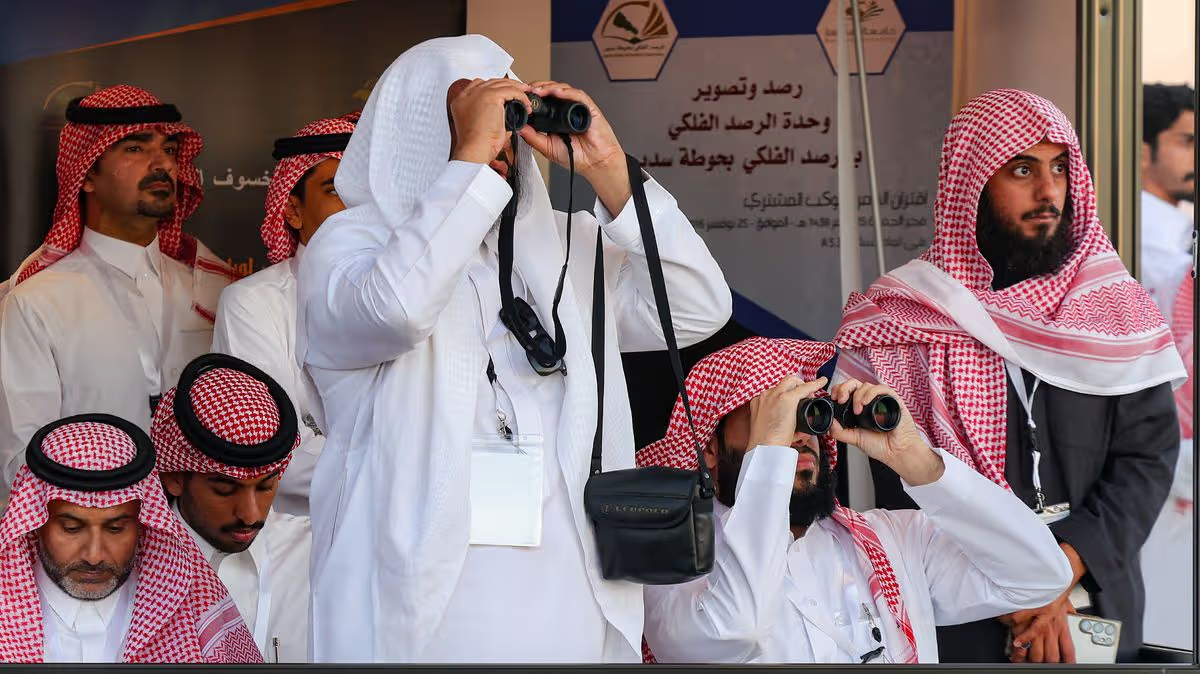
The rhythm of Islamic life in the United Kingdom is uniquely tied to the celestial dance of the moon, a connection that brings both profound unity and occasional, practical divergence. For Muslims, the beginning of sacred months—most notably Ramadan, Eid al-Fitr, and Eid al-Adha—is determined not by fixed calendar dates but by the physical sighting of the new crescent moon (hilal). This practice, rooted in Prophetic tradition, imbues the passage of time with a sense of reverence and observable wonder. However, in the modern, globalized context of Britain, this beautiful tradition encounters complex realities. The UK’s Muslim community, vibrant and diverse, approaches this lunar obligation through different methodologies, leading to a tapestry of practices where faith meets geography, technology, and cultural heritage.
A key point of divergence lies in the source of the moon sighting announcement. A significant portion of the British Muslim community follows the declarations made by Saudi Arabia, due to its role as the guardian of the two holy sites (Makkah and Madinah). This approach offers a clear, unified date for major events like Eid, simplifying logistics for families, national organizations, and the media. It fosters a sense of global Islamic unity, allowing Muslims in Britain to celebrate in sync with millions around the world. Conversely, many other communities and scholars emphasize the importance of local sighting, based on classical interpretations that each region should seek its own moon. This practice underscores a connection to the local environment and skies of Britain itself, asserting that the religious obligation is tied to one’s own horizon. This dual approach means that, not infrequently, different mosques or cities within the same country may commence a month on adjacent days, a situation that requires understanding and mutual respect within the broader community.
The variable and often challenging British climate plays a decisive role in this local sighting process. The ideal conditions for a naked-eye sighting require a clear, unobstructed western horizon shortly after sunset, with a thin crescent that is sufficiently separated from the sun’s glare. Britain’s notorious cloud cover, rain, and general atmospheric haze frequently obscure this delicate astronomical event. Therefore, even if the moon is technically above the horizon and “born,” it can be invisible to human observers on the ground. This meteorological gamble means that communities committed to local sighting must sometimes rely on calculation or await news from a clearer part of the country or world, adding an element of suspense and last-minute decision-making to the eve of major holy days.
Given these challenges, expertise and technology become invaluable. Astronomical scholars and organizations, such as the UK’s New Crescent Society, provide crucial guidance. They calculate the moon’s precise age, its angular distance from the sun (elongation), and its altitude at sunset—key factors determining visibility. As per the content regarding a specific date, experts might advise that on, for example, the evening of May 17th, the crescent will be very young and faint, likely below the ideal naked-eye visibility threshold in much of the UK. However, they will also note that the use of telescopes or specially designed camera systems can potentially detect the crescent under perfect clear-sky conditions. This scientific insight helps communities make informed decisions: whether to attempt a visual sighting, to accept a telescopic sighting as valid, or to defer to another criterion if local observation fails.
In anticipation of these pivotal nights, mosques, Islamic centers, and national bodies undertake a coordinated effort of communication. They monitor expert forecasts, establish local sighting committees, and liaise with international bodies. “Guidance closer to the expected sighting date” is not merely an announcement; it is a community-wide mobilization. Websites and social media channels are updated, text message alerts are prepared, and imams confer with one another. This process transforms an astronomical event into a social and spiritual one, building anticipation and ensuring that every member of the community, from the elderly to the children, knows when and how the sacred occasion will begin. It is a bridge between ancient tradition and modern communication networks.
Ultimately, this multifaceted approach to moon sighting in Britain reflects the dynamic and adaptable nature of the Muslim community there. The differences in start dates, while sometimes confusing to outsiders, are generally handled with a spirit of tolerance and brotherhood. Most understand that each method is rooted in sincere scholarly interpretation. The shared purpose—to worship God and commemorate sacred times—remains overwhelmingly unified. The journey of the British Muslim community through its lunar calendar is thus a metaphor for its broader experience: navigating tradition within a modern, diverse society, respecting differing viewpoints while maintaining collective faith, and always looking to the heavens for a sign, whether through the naked eye, a telescope, or the shared heart of the global Muslim family. It is a living tradition, shaped by clouds, calculations, and conviction.