



The recent arson attack in Hendon, North-West London, marks a deeply concerning escalation in a series of incidents that are instilling fear within the city’s Jewish community. According to police reports, on the evening of Friday, the 18th of April, a man was observed approaching a row of shops carrying a plastic bag. He allegedly placed this bag beside a building—a premises formerly used by the Jewish community—before setting its contents alight. The bag was later found to contain three bottles of fluid. Thankfully, the materials failed to fully ignite, causing only minor damage to the shopfront and, most importantly, resulting in no injuries. The suspect fled the scene, and despite a swift response from emergency services, no arrests have yet been made. This act has been formally declared an antisemitic hate crime by the Metropolitan Police, reflecting its targeted nature and the profound distress it has caused.
This event does not stand in isolation but is part of a troubling pattern of violence aimed at Jewish institutions in the capital. Just last month, four Jewish community ambulances were set alight in Golders Green. More recently, an attempted arson attack occurred at a Persian media organisation’s premises in Wembley. While police have stated that the Hendon incident is not currently being linked to these other attacks and is not being treated as an act of terrorism, the similarities in method and apparent motive have prompted Counter Terrorism Policing (CTP) London to lead the investigation. This decision is based on the “similar circumstances and online claims of responsibility” associated with these events. The cumulative effect is a community living under a shadow, with each new report amplifying anxieties.
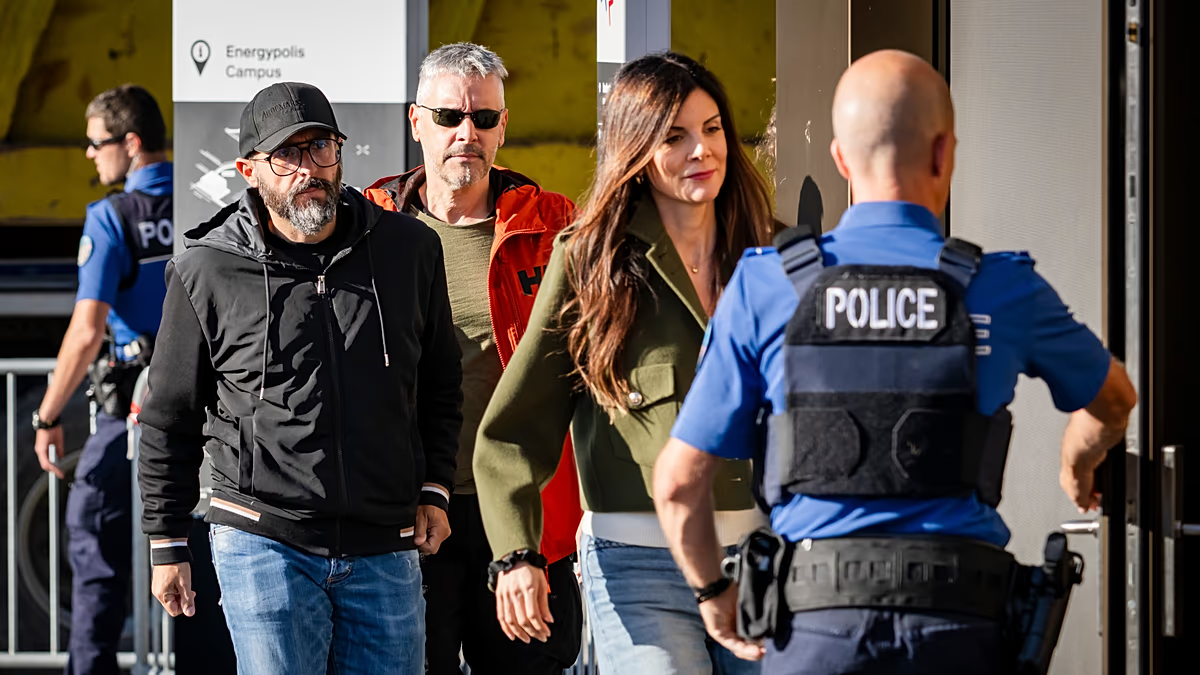
In direct response to this climate of fear, authorities have launched a significant security operation across the borough of Barnet. Residents can expect to see a “significantly increased” presence of both uniformed and plain-clothed police officers throughout the weekend. Furthermore, additional stop and search powers, under Section 60 of the Criminal Justice and Public Order Act, have been authorised for the area, granting officers greater discretion to deter and prevent further violence. The police cordon around the damaged building in Hendon, alongside the deployment of armed response vehicles and counter-terrorism resources, paints a stark picture of a neighbourhood on high alert. Commander Helen Flanagan of CTP London emphasised a “relentless” pursuit of those responsible, while local Detective Chief Superintendent Luke Williams acknowledged the profound impact on residents, stating the force does “not underestimate the concern among local people.”
The human cost of these attacks is measured in the eroded sense of safety and the quiet anxiety that now permeates daily life. A 26-year-old local resident, speaking to the Press Association, captured this sentiment perfectly: “It’s getting too close to home now. It’s worrying that this sort of thing is happening at the moment.” This simple statement reflects a universal fear—that the backdrop of abstract headlines has violently intruded upon one’s own street. In response, the Community Security Trust (CST), a charity dedicated to protecting British Jews, has urged people to “remain calm” but vigilant, advising them to report any suspicious activity immediately. The police are maintaining a direct dialogue with Jewish community leaders and are providing reassurance patrols to places of worship, schools, and businesses, striving to balance necessary vigilance with a sense of normalcy.
Broader community and political responses have underscored the gravity of the situation. The Campaign Against Antisemitism highlighted the alarming frequency, noting this was the “third in a month as we witness a worldwide pattern of attacks.” Their statement also connected these local acts of hate to wider geopolitical tensions, criticising the government’s stance on proscribing Iran’s Islamic Revolutionary Guard Corps. This linkage, whether direct or rhetorical, points to the complex and charged atmosphere in which these crimes are occurring. It reflects a perception among some that Jewish communities are facing threats that are both domestic in execution and potentially inspired by international conflicts, deepening the sense of vulnerability.
As investigations continue, the fundamental need is for community cohesion and robust, transparent policing. The Metropolitan Police and CTP are appealing to the public for any information or footage that could assist their inquiries. While the increased police presence is a necessary short-term measure, the long-term challenge is to address the roots of such hatred and prevent its violent expression. For now, the residents of Hendon, Golders Green, and beyond are left navigating a reality where a plastic bag left by a building is no longer just litter, but a potential object of terror—a symbol of a hostility that has arrived at their doorstep. The hope of the city rests on the effectiveness of the police response and the resilience of a community determined not to be intimidated by acts of hate.