


A rare and powerful celestial event is poised to deliver a stunning gift to skywatchers across the Northern Hemisphere. A so-called “cannibal” solar storm is barreling toward Earth, carrying with it the potential to paint the night sky with spectacular auroral displays far beyond their usual polar confines. For residents in places like the United Kingdom and the northern United States, typically denied such visions, this presents a remarkable opportunity to witness the ethereal dance of the Northern Lights. The phenomenon is a vivid reminder of our planet’s intimate and dynamic connection with our home star, transforming a torrent of solar particles into a breathtaking natural spectacle.
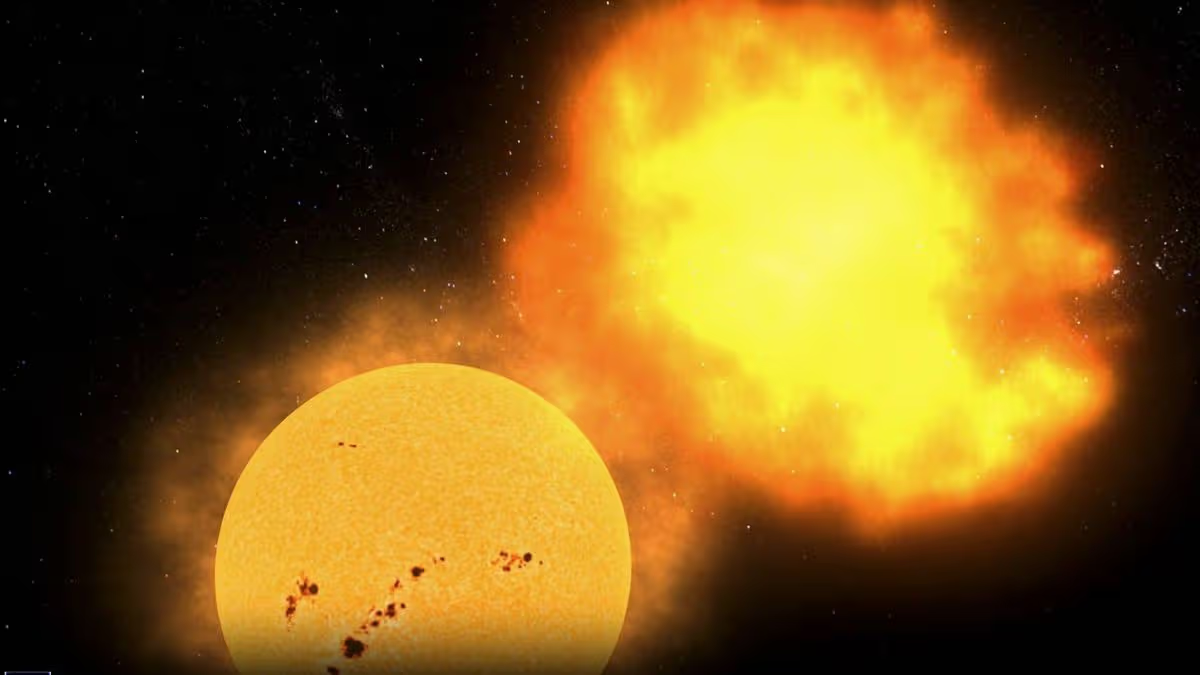
The drama began on June 2nd, originating from a tempestuous region on the Sun known as sunspot 4455. This wasn’t just any sunspot; scientists classify it as an “anti-Hale” sunspot, a relatively rare breed with a reversed magnetic polarity. This unusual configuration makes it inherently unstable and prone to violent outbursts. True to form, the sunspot erupted with a series of intense X-class solar flares—the most powerful category—while simultaneously hurling multiple coronal mass ejections (CMEs) into space. These CMEs are colossal clouds of magnetized solar plasma, each weighing billions of tonnes and racing away from the Sun at staggering speeds.
This is where the event earns its dramatic “cannibal” moniker. In the vast expanse between the Sun and Earth, a later, faster-moving CME caught up with an earlier, slower cloud. The two merged, with the faster one essentially consuming the first. This collision creates what NASA scientists call “complex ejecta”—a tangled, supercharged mass carrying significantly more energy than a typical solar storm. When this merged storm front, a true giant of magnetized plasma, slams into Earth’s protective magnetic field, it has the potential to trigger a profoundly intense and long-lasting geomagnetic disturbance.
Forecasters from the U.S. National Oceanic and Atmospheric Administration (NOAA) are predicting this impact to occur late on June 4th into the early hours of June 5th. They have issued warnings for a strong G3 geomagnetic storm, with conditions possibly escalating to a severe G4 level. The human consequence of this cosmic collision is the potential for a breathtaking auroral display. As the storm energizes Earth’s magnetosphere, it sends charged particles spiraling down magnetic field lines toward the poles, where they collide with gases in our upper atmosphere. These collisions excite oxygen and nitrogen molecules, causing them to release photons of light—the shimmering greens, pinks, purples, and reds of the aurora borealis.
Given the exceptional strength of the incoming “cannibal” storm, the auroral oval—the ring around the poles where the lights are typically visible—is expected to expand dramatically southward. This means that across Europe, sightings could stretch well beyond Scandinavia, potentially gracing the skies of Scotland, central England, Wales, and even parts of northern Europe where sightings are rare. In North America, viewers deep into the northern continental United States may be in for a treat. The key for hopeful observers is to find a dark location, as far from the light pollution of cities and towns as possible, and to monitor local aurora forecasts for precise timing, as increasing cloud cover could obscure the view in some areas.
While the primary focus is on the visual splendor, such powerful solar storms can have minor technological side effects. These may include brief disruptions to high-frequency radio communications, increased atmospheric drag on satellites, and possible faint fluctuations in power grids. However, scientists and agencies like NOAA emphasize that this event is not expected to pose any danger to people on the ground or to cause significant damage to critical infrastructure. Instead, it serves as a powerful reminder of the Sun’s influence and offers a chance for millions to look up in wonder, connecting with one of the universe’s most beautiful and fundamental forces playing out in our own night sky.